How to Tell Whether a Bag Is Made from Virgin Material or Recycled Material
A practical guide from a bag manufacturing factory
Problem – Agitate – Solution
In bag sourcing, material descriptions often look clear but become risky once production starts. Bags that seem acceptable at sampling may later show color instability, odor, or strength issues. When buyers cannot accurately identify virgin versus recycled material, disputes, returns, and lost trust follow. Correct material judgment reduces these risks at the source.
Direct Answer to the Title Question
Bags made from virgin material use newly produced polymers or fibers, while recycled-material bags are produced from reprocessed industrial or post-consumer waste.
In actual manufacturing, differences appear in color consistency, surface texture, odor level, mechanical strength, and printing performance. Virgin material usually offers higher stability and uniformity. Recycled material varies depending on sorting and processing quality. Recognizing these differences helps buyers select materials that match real business needs.
Why This Matters and What Comes Next (~30 words)
From a factory perspective, material choice affects quality control, complaint rates, and long-term cooperation. The sections below explain how buyers can evaluate materials accurately and realistically.
1. A Factory Perspective on Material Identification
As a bag manufacturing factory supplying traders and direct customers, one issue appears repeatedly:
material misunderstanding causes more problems than production errors.
Buyers often focus on price first.
Factories focus on feasibility and consistency.
When both sides align on material reality, orders move smoothly.
When they do not, even small differences become major conflicts.
This guide is written from the production side, based on what is physically observable and technically accurate.
2. What Virgin Material Means in Real Production
Virgin material refers to polymers or fibers that have not been previously used or recycled.
In bag production, this typically includes:
- New polypropylene (PP)
- New polyethylene (PE)
- New polyester fibers
From a factory standpoint, virgin material offers:
- Stable input quality
- Predictable melting and forming behavior
- Consistent output across batches
For buyers, this translates into lower variation and easier quality control.
3. What Recycled Material Means in Real Production
Recycled material is obtained by reprocessing waste materials.
Common sources include:
- Post-industrial scrap from factories
- Post-consumer plastics collected and sorted
Quality depends on:
- Source cleanliness
- Sorting accuracy
- Reprocessing technology
Recycled material is a legitimate choice, but its performance range is wider.
Understanding this range is essential for correct application.
4. Visual Inspection: Color Consistency as the First Indicator
Color is the most immediate difference observable during sampling.
Virgin-material bags usually show:
- Uniform color distribution
- Cleaner light tones
- Stable dark colors
Recycled-material bags may show:
- Slight tone variation
- Gray or yellow undertones in light colors
- Minor specks or uneven shading
This matters for traders serving multiple clients, where one batch may be acceptable for one buyer but rejected by another.
5. Surface Texture and Hand Feel
Touch provides information that documents cannot.
Virgin-material bags generally feel:
- Smooth
- Even across the surface
- Consistent in structure
Recycled-material bags may feel:
- Slightly rougher
- Less uniform
- Different in stiffness between areas
During factory visits, experienced buyers often identify material type through handling samples alone.
6. Odor Evaluation in Practical Use
Odor is not always visible during initial inspection.
Virgin material:
- Typically has minimal or no detectable odor
Recycled material:
- May retain light residual odors
- Odor can become noticeable after packaging or exposure to heat
For applications such as food delivery, apparel packaging, or indoor retail use, odor sensitivity must be considered carefully.
7. Strength and Load Performance Stability
Strength is influenced by material structure, not only thickness.
Virgin material offers:
- More consistent tensile strength
- Predictable performance at seams and handles
Recycled material:
- Can meet strength requirements
- May show wider variation between batches
For traders supplying chain customers, inconsistent performance can lead to complaints that affect future orders.
8. Printing Results as a Material Signal
Printing quality often reveals material differences clearly.
Virgin material supports:
- Sharper edges
- Better ink adhesion
- More stable color reproduction
Recycled material may show:
- Reduced contrast
- Slight ink absorption variation
- Less consistency between runs
For buyers prioritizing brand presentation, this factor should not be overlooked.
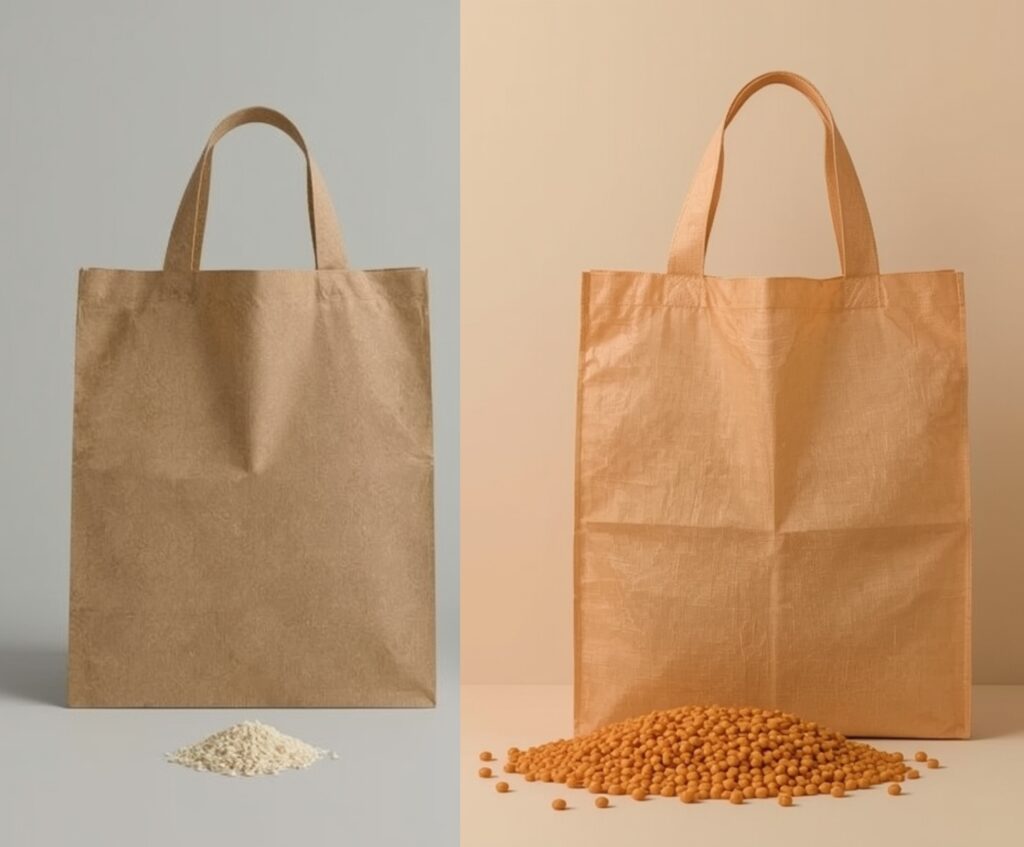
9. Material Surface Comparison
At this stage, visual comparison becomes helpful for buyers reviewing samples remotely.
Clear surface texture and color differences are often visible in close-up images, especially under consistent lighting.
10. Thickness, Density, and Structural Feel
At the same stated thickness, material behavior can differ.
Virgin material:
- Holds shape more consistently
- Shows better structural recovery
Recycled material:
- May feel softer or less resilient
- Often requires increased thickness to achieve similar strength
This affects storage efficiency, shipping volume, and shelf appearance.
11. Certification: Useful but Limited
Certifications such as ISO or recycled-content certifications support credibility.
However, from a factory perspective:
- Certifications describe systems
- They do not replace physical inspection
Buyers should combine documentation with sample evaluation for reliable decisions.
12. Image Reference: Production and Material Handling
Understanding production context also helps buyers assess material claims.
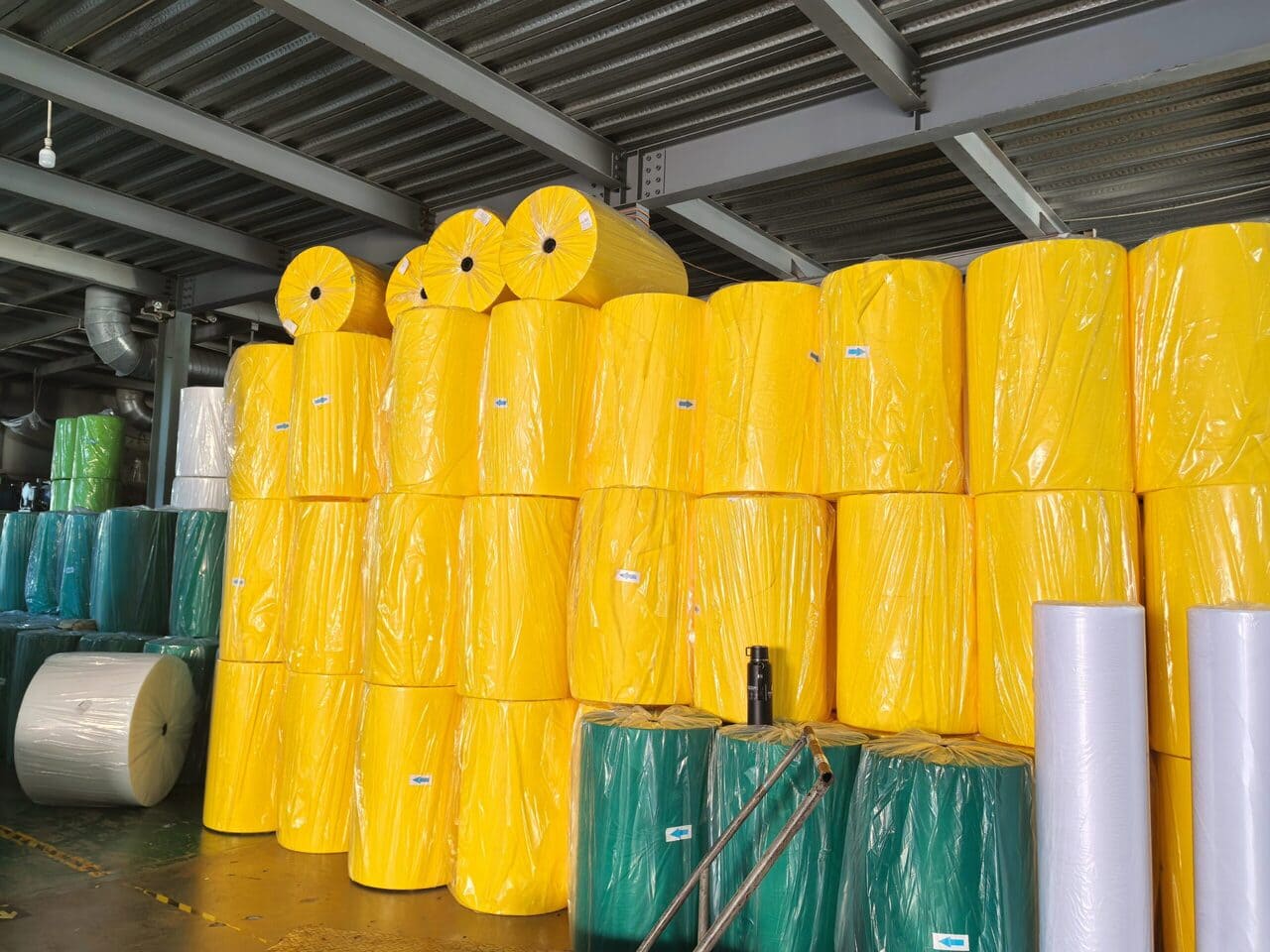
Seeing how raw materials are handled and processed provides insight into material consistency and quality control.
13. The Real Risk for Traders and Direct Buyers
The main risk is not choosing recycled material.
The real risk is:
- Expecting uniform appearance without allowing variation
- Assuming performance without defining limits
- Communicating unclear expectations to end customers
When expectations are not aligned, disputes often follow.
14. When Recycled Material Is a Practical Choice
Recycled material is suitable when:
- Sustainability messaging is transparent
- Slight variation is acceptable
- Cost efficiency is important
- Orders are stable and repeatable
In these cases, recycled material supports long-term cooperation.
15. When Virgin Material Is the Safer Choice
Virgin material is often preferred when:
- Visual consistency is critical
- Brand image must remain stable
- End-user tolerance for variation is low
- Complaint risk must be minimized
Many buyers select virgin material primarily to reduce uncertainty.
16. Questions Buyers Should Ask the Factory
Effective questions include:
- Is the material virgin or recycled?
- If recycled, what is the approximate percentage?
- How stable is color between batches?
- Can multiple samples be reviewed?
Clear questions lead to clear answers.
17. Long-Term Meaning for B2B Cooperation
From the factory side, stable partnerships are built on:
- Honest material discussion
- Realistic performance expectations
- Mutual understanding of trade-offs
Material clarity supports smoother production and fewer disputes.
18. Final Notes from the Manufacturing Side
Virgin material and recycled material both have valid roles.
Problems arise only when material reality is misunderstood or oversimplified.
Clear communication protects buyers, factories, and end customers alike.
Contact
For material consultation, sampling support, and factory-level guidance:
📧 Email: [email protected]
📱 WhatsApp: +86 138 6773 1930
Clear material understanding leads to stable orders.