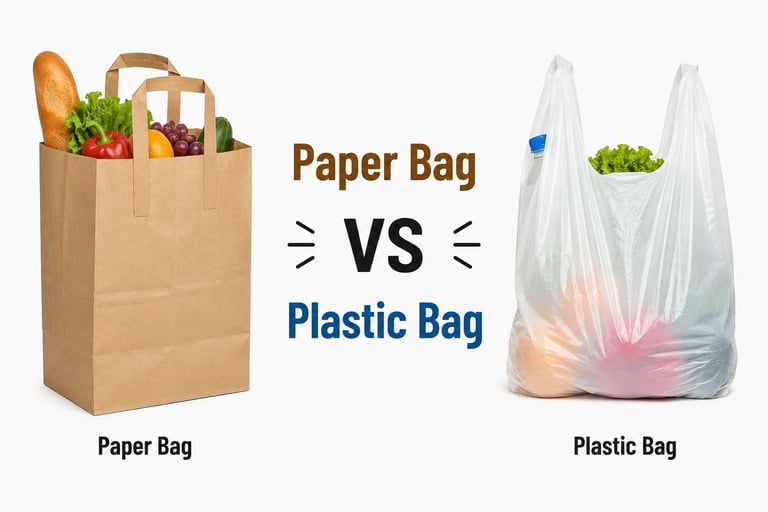
Many retailers, supermarkets, and packaging buyers face the same question when selecting grocery bags: should they choose paper or plastic?
At first glance, plastic appears stronger because it stretches without tearing. Paper, on the other hand, looks more rigid but can fail unexpectedly when overloaded or exposed to moisture. Choosing the wrong bag can lead to broken handles, damaged products, customer complaints, and unnecessary replacement costs.
In most cases, plastic grocery bags can support more weight than traditional paper grocery bags when comparing material strength alone. However, modern seamless paper bags have significantly improved load-bearing performance and can match or even exceed many standard plastic grocery bags under certain conditions. The best choice depends on the product weight, environment, and intended use.
The answer is more complex than simply asking whether paper or plastic is stronger. The real question is how the bag is constructed and where the load is applied.
Quick Summary
- Plastic bags generally have higher strength-to-weight ratios than paper bags1.
- Traditional paper bags often fail at the bottom2 rather than through the paper itself.
- Seamless paper bags solve many bottom-strength issues found in conventional paper bags.
- Structure often has a greater impact on carrying capacity than material alone.
- Laminated paper bags improve moisture resistance but are still affected by water.
- Plastic remains the strongest option in wet environments.
- Seamless paper bags offer a balance between sustainability and strength.
- Different bag types perform best in different applications.
Which Material Is Stronger: Paper or Plastic?
If the comparison is based solely on material properties, plastic is generally stronger3.
A thin plastic grocery bag made from HDPE or LDPE can often carry surprisingly heavy loads despite weighing only a few grams.
Typical carrying capacities include:4
| Bag Type | Typical Load Capacity |
|---|---|
| Standard HDPE Plastic Grocery Bag | 8–15 kg (18–33 lbs) |
| Heavy-Duty Plastic Bag | 15–25 kg (33–55 lbs) |
| Traditional Kraft Paper Bag | 5–12 kg (11–26 lbs) |
| Reinforced Paper Bag | 10–15 kg (22–33 lbs) |
| Seamless Paper Bag | 12–20 kg+ (26–44 lbs+) |
Based on these figures, plastic often wins when comparing material strength alone.
However, shoppers do not carry raw materials.
They carry finished bags.
This is where bag design becomes important.
Why Material Strength Does Not Tell the Whole Story
Imagine two bridges.
One bridge uses stronger steel but has a poor design.
The other uses slightly weaker materials but has superior engineering.
The better-designed bridge often supports more weight.
The same principle applies to grocery bags.
A bag's performance depends on:
- Material quality
- Bag construction
- Bottom design
- Handle attachment
- Load distribution
- Manufacturing precision
This explains why some paper bags outperform certain plastic bags in real-world use.
Why Traditional Paper Bags Usually Fail at the Bottom
Many people assume that paper bags tear because the paper is weak.
In reality, the weakest point is often the bottom structure.
Traditional paper grocery bags are produced by folding and gluing multiple sections of paper together.
This creates:
- Fold lines
- Bonded joints
- Stress concentration areas5
- Structural interruptions
When heavy groceries are placed inside the bag, most of the weight transfers directly to the bottom panel6.
Products such as:
- Milk cartons
- Bottled beverages
- Canned foods
- Glass jars
create significant pressure on the bottom corners.
Over time, the force concentrates around folded sections and glued joints.
As a result, many paper bags fail from the bottom before the paper itself reaches its maximum strength.
This is one of the biggest limitations of traditional paper bag construction.
The Hidden Problem: Bottom Gaps and Stress Concentration
The bottom of a conventional paper bag contains multiple folded layers.
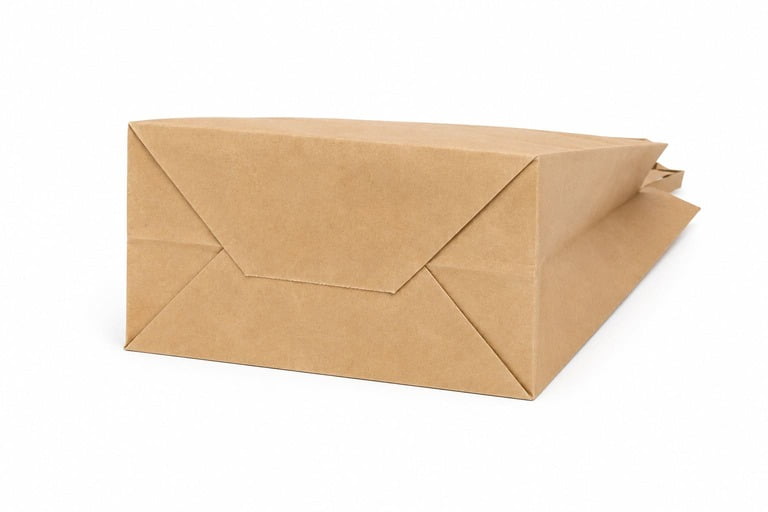
While these folds create the square-bottom shape consumers like, they also create interruption points in the structure.
Every fold changes how force travels through the bag.7
When a customer lifts a heavy load, stress accumulates around these areas.
Think about bending a piece of cardboard repeatedly along the same line.
Eventually, that fold becomes weaker than the surrounding material.
Traditional paper bag bottoms experience a similar effect under heavy loads.
The heavier the contents, the greater the stress concentration becomes.
How Seamless Paper Bags Solve This Problem
Modern seamless paper bags use a different manufacturing method.
Instead of relying on multiple folded sections to create the bag body, the bag is machine-formed into a more integrated structure.
The biggest improvement is found at the bottom.
Unlike traditional paper bags, seamless paper bags eliminate many of the structural gaps and weak points8 that exist in folded bottom designs.
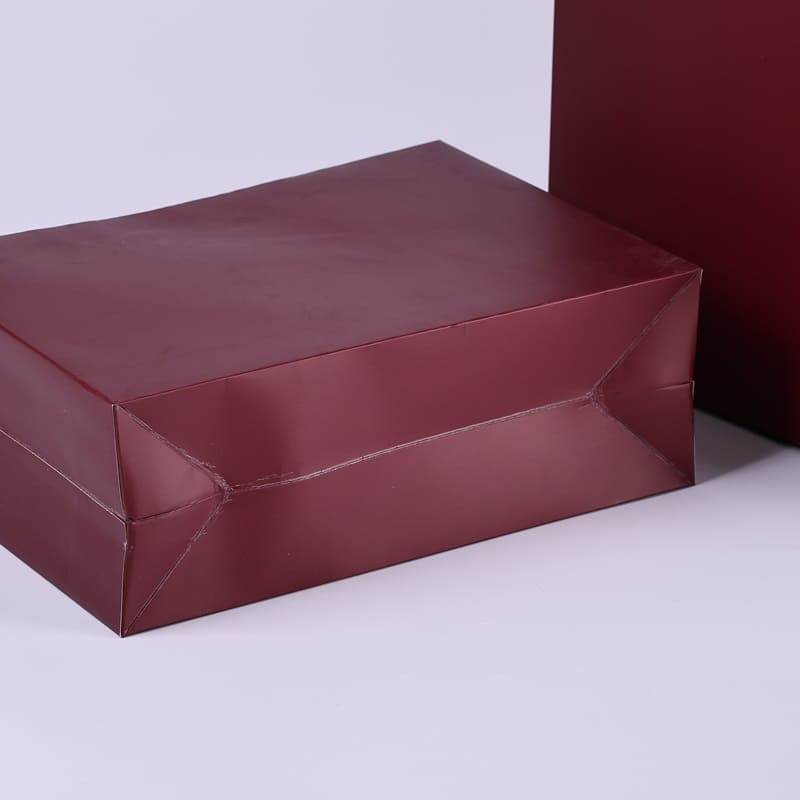
Bottom view of a machine-made seamless paper bag. The integrated bottom structure helps distribute weight more evenly and reduces stress concentration compared with traditional folded-bottom paper bags.
The load is distributed across a larger area rather than concentrating at specific folds.
This creates several advantages:
- More uniform force distribution
- Reduced stress concentration
- Stronger bottom performance
- Better resistance to sudden impacts
- Improved durability during transportation
Using the same paper grade, a seamless paper bag can often achieve noticeably higher carrying performance than a traditional paper bag.
In practical applications, improvements of 20% to 50% are commonly achievable9 depending on bag size, paper weight, and handle construction.
Why Some Seamless Paper Bags Can Rival Plastic Bags
Many people assume paper can never compete with plastic.
That is no longer always true.
While plastic remains stronger at the material level, seamless paper bag construction changes the equation.
A high-quality seamless paper bag made from heavy kraft paper can often carry loads that exceed those of many standard supermarket plastic bags10.
This happens because:
- The structure is stronger.
- The bottom is more stable.
- The bag retains its shape under load.
- Force is distributed more efficiently.
The result is a paper bag that performs much closer to plastic than traditional paper bags ever could.
What Happens When Water Is Added?
Water changes everything.
Plastic is naturally water resistant.11
Paper is not.
When paper fibers absorb moisture, they lose strength.
This is why a paper bag carrying groceries in heavy rain may fail even when it could safely support the same load in dry conditions.
To reduce this problem, manufacturers often add:
- PE coating
- Matte lamination
- Gloss lamination
- Water-resistant coatings
These treatments significantly improve moisture resistance.
A laminated paper bag can withstand:
- Light rain
- Condensation from cold drinks
- Brief exposure to moisture
much better than an uncoated paper bag.
However, it is important to understand that lamination does not completely eliminate water's effect.
The paper fibers still exist beneath the coating.
If water penetrates the surface or the bag remains wet for an extended period, strength will still decrease.
For this reason, plastic remains the preferred choice for:
- Seafood packaging
- Frozen food distribution
- Outdoor markets
- Wet environments
Comparing Performance in Real Grocery Shopping
Carrying Bottled Drinks
Winner: Seamless Paper Bag
Heavy bottles create concentrated loads.
The stronger bottom structure helps distribute force more effectively.
Carrying Frozen Foods
Winner: Plastic Bag
Condensation and moisture favor plastic.
Premium Retail Stores
Winner: Seamless Paper Bag
Provides both strength and premium appearance.
Budget Grocery Stores
Winner: Plastic Bag
Lower cost and high carrying capacity make plastic attractive for high-volume operations.
Eco-Friendly Retailers
Winner: Seamless Paper Bag
Offers sustainability benefits while maintaining strong carrying performance.
Which Bag Should Businesses Choose?
The answer depends on the application.
Choose Plastic Bags If:
- Moisture resistance is critical.
- Cost is the main priority.
- Products are frequently exposed to water.
- Maximum material strength is required.
Choose Traditional Paper Bags If:
- Loads are relatively light.
- Sustainability is important.
- Premium printing quality is desired.
- Cost must remain competitive.
Choose Seamless Paper Bags If:
- Heavy products are carried regularly.
- Sustainability matters.
- Premium brand image is important.
- Strong bottom support is required.
- Customers expect a high-quality shopping experience.
The Real Winner Depends on the Situation
Many articles try to declare a single winner in the paper-versus-plastic debate.
The reality is more nuanced.
Plastic is generally stronger when comparing materials alone.
Traditional paper bags are weaker than plastic in most load-bearing situations and are especially vulnerable at the bottom structure.
However, seamless paper bags have changed what paper packaging can achieve.
By eliminating many of the weak points found in traditional paper bag construction, they deliver significantly improved carrying performance while maintaining the environmental and branding advantages of paper.
The best bag is not necessarily the one with the strongest material.
It is the one designed for the specific products, environment, and customer experience a business wants to deliver.
For many modern retailers, that increasingly means choosing seamless paper bags as a practical middle ground between traditional paper and plastic grocery bags.
"An overview of paper and paper based food packaging materials", https://pmc.ncbi.nlm.nih.gov/articles/PMC6801293/. Published packaging-material data comparing polyethylene films and kraft papers can support the statement that plastic carrier-bag films often deliver greater tensile performance per unit mass. Evidence role: statistic; source type: paper. Supports: Plastic bags generally have higher strength-to-weight ratios than paper bags.. Scope note: Strength-to-weight ratios vary by film gauge, paper basis weight, fiber quality, and manufacturing process. ↩
"[PDF] Technologic Papers", https://nvlpubs.nist.gov/nistpubs/nbstechnologic/nbstechnologicpaperT187.pdf. Packaging-engineering sources describing paper sack and bag failure modes can support the observation that seams, folds, and bottom closures are common failure locations under load. Evidence role: mechanism; source type: paper. Supports: Traditional paper grocery bags often fail at the bottom rather than through the paper sheet itself.. Scope note: The exact failure point depends on bag geometry, adhesive quality, paper grade, moisture, and contents. ↩
"Tensile Behavior of High-Density Polyethylene Including the Effects ...", https://pmc.ncbi.nlm.nih.gov/articles/PMC7564066/. Materials-engineering references report that polyethylene films typically have high tensile elongation and useful tensile strength at low basis weight, supporting the general material-level comparison with paper. Evidence role: general_support; source type: education. Supports: Plastic is generally stronger than paper when comparing material properties alone.. Scope note: This supports material behavior, not the load capacity of every finished grocery bag design. ↩
"Bag Requirements at Grocery and Retail Stores - CalRecycle - CA.gov", https://calrecycle.ca.gov/plastics/bagrequirements/. Independent carrier-bag load-testing data or standardized packaging performance tests can substantiate typical load-capacity ranges for HDPE, heavy-duty plastic, kraft paper, reinforced paper, and seamless paper bags. Evidence role: statistic; source type: research. Supports: The table’s stated load-capacity ranges are representative of common grocery bag types.. Scope note: Load capacity is highly test-dependent and changes with bag dimensions, handle design, humidity, and loading rate. ↩
"Stress concentration-relocating interposer in electronic textile ... - PMC", https://pmc.ncbi.nlm.nih.gov/articles/PMC9166807/. Solid-mechanics references explain that folds, notches, joints, and abrupt geometry changes can concentrate stress, supporting the article’s explanation of why folded bag bottoms can become weak points. Evidence role: mechanism; source type: education. Supports: Fold lines and bonded joints in traditional paper bag bottoms can create stress concentration areas.. Scope note: The principle is general; applying it to a specific bag requires geometry-specific testing or finite-element analysis. ↩
"Inserting a false bottom into a bag | Easy sewing project for any size ...",
. Packaging-structure and mechanics sources describe how vertical loads in open-top bags are transmitted through the contents to the base and bottom seams, supporting the stated load path. Evidence role: mechanism; source type: education. Supports: When heavy groceries are placed inside a paper bag, much of the load is transferred to the bottom panel.. Scope note: Load transfer varies with product shape, packing arrangement, sidewall stiffness, and whether handles or sides carry part of the load. ↩"Evaluation of changes in fold cracking and mechanical properties of ...", https://bioresources.cnr.ncsu.edu/resources/evaluation-of-changes-in-fold-cracking-and-mechanical-properties-of-high-grammage-paper-based-on-pulp-fiber-modification/. Engineering mechanics literature on folded sheet materials shows that creases alter stiffness, local strain, and load paths, supporting the claim that folds affect force distribution in paper bags. Evidence role: mechanism; source type: paper. Supports: Folds in a conventional paper bag alter how force travels through the structure.. Scope note: This supports the underlying mechanics, not a measured strength reduction for the exact bag type discussed. ↩
"Paper bag - Wikipedia", https://en.wikipedia.org/wiki/Paper_bag. Documentation of seamless or tubular paper-bag manufacturing and comparative closure designs can support the claim that reducing folded seams and bottom interruptions reduces potential structural weak points. Evidence role: mechanism; source type: institution. Supports: Seamless paper bags reduce structural gaps and weak points found in folded-bottom designs.. Scope note: The source may support the design principle; measured superiority still requires controlled load testing. ↩
"Fully Automatic Paper Bag Making Machine With Twisted Handle", https://www.instagram.com/reel/DLr5lehM9tL/. Comparative load-testing data for conventional folded-bottom and seamless paper bags would substantiate the claimed 20–50% performance improvement under matched paper grade, size, and handle conditions. Evidence role: statistic; source type: research. Supports: Seamless paper bags can commonly improve carrying performance by 20% to 50% compared with traditional paper bags.. Scope note: The percentage improvement is conditional and may not generalize outside the tested bag specifications. ↩
"Plastic, Paper or Cotton: Which Shopping Bag is Best?", https://news.climate.columbia.edu/2020/04/30/plastic-paper-cotton-bags/. Controlled carrier-bag load tests comparing heavy kraft seamless paper bags with standard supermarket HDPE bags can support the claim that some paper designs exceed some standard plastic bags in carrying capacity. Evidence role: case_reference; source type: research. Supports: Some high-quality seamless paper bags can carry loads exceeding those of many standard supermarket plastic bags.. Scope note: This is a conditional comparison and does not imply that paper bags generally outperform plastic bags across all gauges, sizes, and wet conditions. ↩
"Effect of Water Absorption on Electric Properties of Temperature ...", https://pmc.ncbi.nlm.nih.gov/articles/PMC10892007/. Polymer property references report that polyethylene has very low water absorption and is commonly used as a moisture-barrier packaging material, supporting the claim that plastic grocery bags resist water. Evidence role: definition; source type: education. Supports: Plastic grocery bags made from polyethylene are naturally water resistant.. Scope note: Water resistance does not mean resistance to all solvents, puncture, heat, or environmental degradation. ↩