For importers, wholesalers, retailers, and brand owners, sourcing insulated shopping bags may look simple:
Find suppliers, compare quotations, check samples, and place orders.
However, experienced buyers know that insulated shopping bags are not ordinary reusable bags with an extra foil layer. They are functional products that need to balance insulation performance, material durability, manufacturing consistency, customization requirements, and cost efficiency.
The lowest quotation may look attractive, but professional buyers ask a more important question:
Why can this supplier offer a lower price?
A lower price can come from real manufacturing advantages, or it can come from hidden compromises in materials and quality control.
This guide explains the most common mistakes buyers make when selecting insulated bag suppliers and how to evaluate manufacturers more effectively.
Quick Overview
Price is only the final result. The real difference comes from factory capability, material choices, production management, and quality control.
Myth 1: The Cheapest Quotation Means the Lowest Manufacturing Cost
Price comparison is normal in bulk purchasing.
For example, a $0.10 difference in a 50,000-piece order creates a $5,000 cost difference. However, comparing only the final quotation can be misleading.
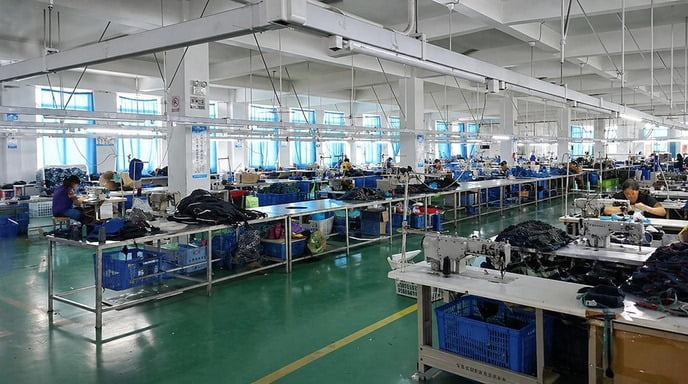
A direct manufacturer may offer a lower price because they control more parts of production:
- Raw material purchasing
- Cutting
- Printing
- Lamination
- Sewing
- Quality inspection
Producing in their own factory can reduce outsourcing costs and unnecessary transportation between different workshops.
For example, a supplier that purchases materials in larger quantities, uses efficient equipment, and has experienced workers may naturally achieve a lower manufacturing cost.
However, some suppliers reduce prices by reducing product standards:
- Using recycled materials instead of stable virgin materials
- Choosing lower GSM non-woven fabric
- Reducing insulation thickness
- Using cheaper accessories
- Removing reinforcement structures
- Reducing inspection procedures
These differences are often invisible in product photos but appear after customers start using the bags.
Common problems include:
- Weak handles
- Loose stitching
- Shorter insulation performance
- Poor appearance after repeated use
- Quality differences between samples and bulk production
Real Purchasing Example:
A European supermarket buyer once selected a supplier mainly because the quotation was $0.08 lower per bag.
During mass production, the insulation layer separated from the outer fabric because the lamination bonding was not strong enough. The order required rework, which delayed the product launch by three weeks.
The buyer later found that the small unit price saving created much higher costs through production delays, additional labor, and potential sales losses.
This example shows that a lower quotation is not always a better deal. The real value comes from balancing manufacturing efficiency, material control, and consistent quality.
Quick Overview
A low price is not always a problem. Buyers need to understand whether the saving comes from better manufacturing efficiency or lower product standards.
Myth 2: Any Bag Factory Can Produce High-Quality Insulated Bags
An insulated shopping bag is not simply a normal bag with insulation added.
The manufacturing process involves multiple technologies:
- Multi-layer material assembly
- Lamination control
- Insulation material management
- Reinforced sewing
- Structural design
- Final inspection
A factory experienced only in simple promotional bags may not understand the difficulties of insulated products.
For example, thicker insulation may improve thermal performance, but it also creates challenges during cutting and sewing.
Workers need experience because insulated bags often involve:
- Thick EPE pearl cotton layers
- Multiple fabric layers
- Heavy-load handle structures
- Special reinforcement areas
Small details determine final durability.
Even operations such as cutting, trimming, and removing loose threads test worker skills and factory management ability.
A factory with clear production standards can control:
- Stitching distance
- Thread trimming requirements
- Handle reinforcement methods
- Final appearance standards
These details separate professional manufacturers from ordinary bag suppliers.
Quick Overview
Insulated bags require experience beyond basic bag production. Manufacturing ability is reflected in small production details.
Myth 3: A Factory Is Reliable Because It Shows a Large Product Catalog
Many suppliers can show hundreds of bag designs online.
However, product pictures do not prove manufacturing capability.
Before selecting a supplier, buyers should verify:
- Whether they own production equipment
- Whether they control important processes
- Whether they have previous customization experience
- Whether they have supplied similar industries
Professional buyers usually request:
- Product catalogs
- Factory videos
- Production process information
- Previous cooperation examples
- Customer references when possible
Social media can also provide useful clues.
A real manufacturer usually has consistent production records, factory activities, employee content, and product development information.
The goal is not only finding a supplier who can make a sample.
The goal is finding a manufacturer who can repeatedly produce the same quality for thousands of pieces.
Quick Overview
A supplier’s real capability is proven by production experience, not only by online pictures.
Myth 4: Good Samples Guarantee Good Bulk Production
A common mistake is assuming:
“The sample looks perfect, so the mass production will be identical.”
However, sample production and bulk production are different.
During sample development:
- Quantity is limited
- Workers have more time to adjust details
- Problems can be corrected immediately
During bulk production:
- Thousands of pieces are produced
- Multiple workers participate
- Material batches become larger
- Production speed increases
Without proper management, differences can appear.
A reliable factory should control quality during the whole process:
Incoming Material Inspection
Checking:
- Fabric quality
- GSM consistency
- Insulation thickness
- Aluminum foil condition
- Accessories
Production Inspection
Checking:
- Printing accuracy
- Lamination bonding
- Cutting size
- Sewing quality
- Handle strength
Final Inspection
Checking:
- Appearance
- Dimensions
- Function
- Packaging
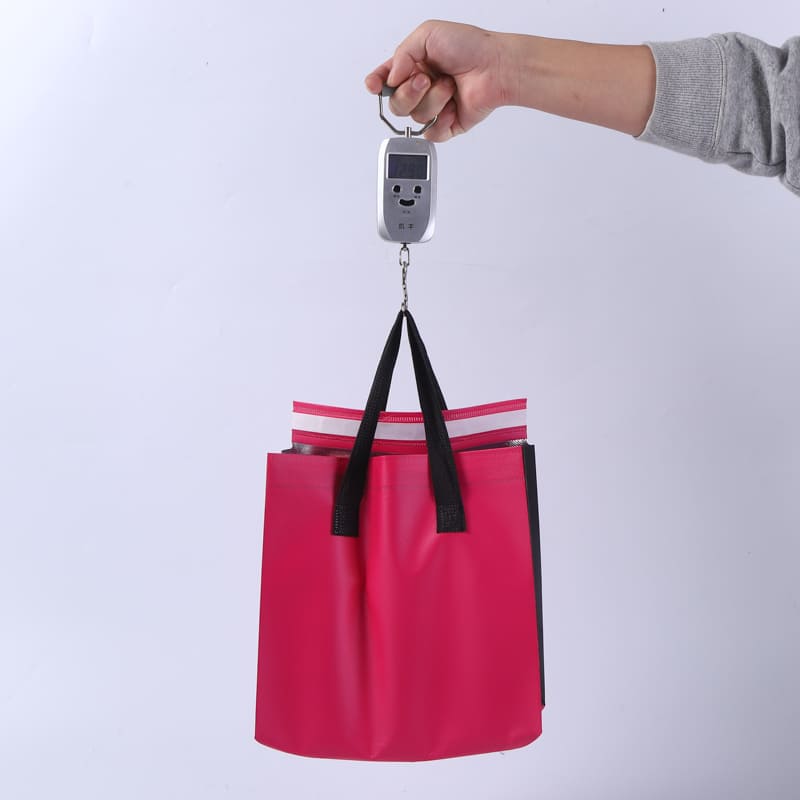
Quality control is not only about finding defective products. It is about preventing problems before thousands of bags are completed.
Quick Overview
A good sample is only the beginning. Stable bulk production requires a complete QC system.
Myth 5: The Most Expensive Material Creates the Best Product
Some buyers believe better insulated bags simply require thicker insulation or more expensive materials.
In reality, performance depends on the complete product structure:
- Outer fabric
- Aluminum foil layer
- Insulation material
- Inner lining
- Closure design
- Waterproof treatment
- Usage environment
Different applications require different solutions.
For example, not every insulated bag needs to be designed for long-term repeated use.
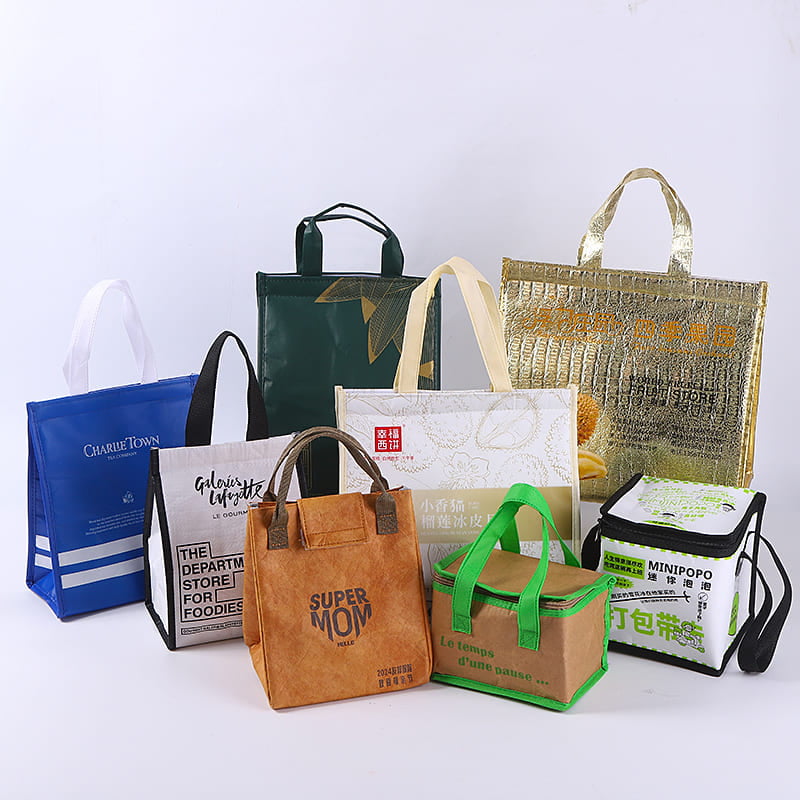
For one-time food delivery or promotional campaigns, many buyers choose aluminum foil insulated bags with adhesive self-sealing closures.
These bags are lightweight, cost-effective, and suitable for short-term use where controlling purchase cost is the priority.
For applications that require repeated opening and closing, manufacturers may recommend different closure solutions:
- Hook-and-loop (Velcro) closure for frequent reuse
- Snap button closure for simple and durable fastening
- Zipper structures for stronger protection and better user experience
The right closure design depends on how customers will actually use the bag.
Waterproof requirements also influence material selection.
An insulated bag without lamination can be more environmentally friendly because it uses fewer additional materials. However, durability, moisture resistance, and cleaning performance may be reduced.
A laminated insulated bag provides better protection against water, stains, and daily wear. Although the initial cost is higher, it can usually be reused more times. For repeated-use scenarios, this can help reduce the consumption of disposable bags and create better long-term value.
Different applications require different priorities.
A supermarket promotional bag may focus on:
- Cost efficiency
- Lightweight design
- Easy customization
A food delivery cooler bag may require:
- Stronger Oxford fabric
- Reinforced handles
- Better abrasion resistance
- More durable construction
The correct question is not:
“Which material is the most expensive?”
The better question is:
“Which structure fits the product’s real application?”
Quick Overview
The best insulated bag is not the thickest or most expensive one. It is the one that matches the usage scenario, including frequency of use, closure method, waterproof requirements, and durability expectations.
Myth 6: Choosing a Supplier Is Only About Comparing Prices
Many buyers believe the best supplier is either:
- The cheapest supplier
- The biggest factory
- The supplier with the largest product catalog
However, factory size alone does not determine whether a supplier is the right choice.
A large factory usually has advantages such as:
- Higher production capacity
- More production equipment
- More complete management systems
- Ability to handle large-volume orders
- Better stability for long-term supply
For example, a retailer planning hundreds of thousands of insulated shopping bags for a nationwide promotion may need a factory with enough production lines, workers, and supply chain capability to complete the order on schedule.
However, larger factories are not always the best option for every project.
Some smaller or medium-sized manufacturers may provide advantages such as:
- Faster communication
- More flexible customization
- More attention to product details
- Easier adjustment during product development
For customized insulated bags, especially when the order involves specific materials, structures, or design requirements, communication efficiency and manufacturing experience can be more important than factory size.
The key question is not:
“Is this the biggest factory?”
The better question is:
“Can this factory consistently produce the product according to my requirements?”
A suitable manufacturer should have the ability to control the processes required for your product, including:
- Material sourcing and inspection
- Printing and lamination
- Cutting accuracy
- Sewing and reinforcement
- Assembly
- Final quality inspection
Different projects require different factory capabilities.
For example:
A promotional insulated bag project may prioritize:
- Competitive pricing
- Large production capacity
- Fast delivery
- Simple customization
A premium reusable cooler bag project may prioritize:
- Material expertise
- Strong sewing capability
- Structural development experience
- Higher quality control standards
A factory that is excellent at producing millions of simple promotional bags may not be the best choice for a complex cooler bag requiring reinforced structures and frequent daily use.
On the other hand, a smaller factory with strong craftsmanship may not be suitable for extremely large orders requiring fast delivery and stable monthly capacity.
Before choosing a supplier, buyers should evaluate:
- Whether the factory has experience with similar products
- Whether they understand the required materials and structure
- Whether they can maintain consistent quality during bulk production
- Whether their production capacity matches the order quantity
- Whether their communication and management style fits the project
A professional supplier should ask questions before quoting:
- What products will be stored inside?
- How frequently will customers use the bag?
- Is it for promotion, retail sales, food delivery, or commercial transportation?
- What quality standard does the market require?
- What quantity and delivery schedule are expected?
These questions are not unnecessary.
They help determine the correct material structure, production method, quality standard, and realistic cost.
Quick Overview
The best supplier is not always the largest or cheapest factory. It is the manufacturer whose production capability, experience, and quality system match your specific product requirements.
Real Purchasing Example: Choosing Value Instead of the Lowest Price
A retail customer originally wanted the lowest-cost insulated shopping bag for a promotional campaign.
After discussing the application, the manufacturer learned that customers would continue using the bags after the promotion and that the bags needed to carry frozen food and beverages.
Instead of choosing the cheapest structure, the project used:
- Laminated non-woven outer material
- Aluminum foil insulation layer
- EPE pearl cotton
- Reinforced handles
The unit price was slightly higher, but the customer avoided problems such as broken handles, poor appearance, and short product lifespan.
The lesson was simple:
The lowest manufacturing price is not always the lowest total business cost.
Quick Overview
Better product decisions can reduce replacement costs and protect brand reputation.
How to Verify a Reliable Insulated Bag Manufacturer
Before placing a bulk order, buyers should check:
1. Production capability
Ask about:
- Equipment
- Production processes
- Factory management
- Quality inspection methods
2. Manufacturing experience
Check whether the supplier understands:
- Different insulation structures
- Material performance
- Sewing difficulties
- Reinforcement requirements
3. Quality consistency
Ask how they control:
- Incoming materials
- Production standards
- Finished products
4. Real market experience
Review:
- Product catalogs
- Previous projects
- Brand cooperation examples
- Factory social media presence
Quick Overview
Supplier verification reduces the risk of receiving products that look good in pictures but fail in real use.
Final Thoughts: Choose a Manufacturing Partner, Not Just a Supplier
Buying insulated shopping bags is not simply a price comparison.
The best supplier understands the relationship between:
- Material selection
- Manufacturing process
- Product application
- Quality control
- Customer expectations
A professional manufacturer does not only provide a quotation.
They help buyers choose the right structure, avoid unnecessary costs, and create products that perform well in the market.
At JiaRong Packaging, we support importers, wholesalers, retailers, and brands with customized insulated shopping bags, including laminated non-woven insulated bags, Oxford cooler bags, and other reusable insulated solutions.
From material selection and production planning to quality inspection and shipment, we help customers develop reliable products based on their market needs.
If you are sourcing customized insulated shopping bags, share:
- Product application
- Size requirements
- Quantity
- Target market
- Material preference
We can help recommend a suitable structure and provide a practical manufacturing solution.
The right supplier is not the one with the lowest price. It is the one that creates the best value throughout the product lifecycle.