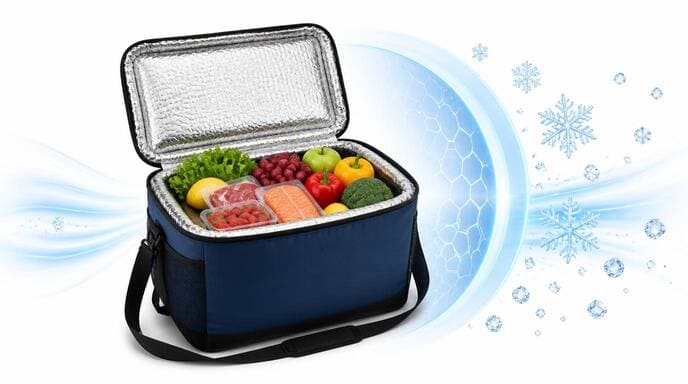
For anyone buying or using an insulated bag, the most important question is usually simple: how long can it keep food cold?
In general, most insulated bags can keep food cold for 2 to 12 hours1, depending on the bag type and usage conditions. Basic lunch bags are designed for short periods, while stronger cooler bags with thicker insulation and ice packs can maintain low temperatures for much longer.
A realistic cold retention range is:
- Basic insulated lunch bags: around 2–4 hours
- Standard insulated grocery bags: around 4–8 hours
- Insulated delivery bags with ice packs: around 6–12 hours
- Heavy-duty cooler bags: around 12–24+ hours under suitable conditions2
It is important to understand that insulated bags do not create cold3. They work by slowing down heat transfer, helping food maintain its existing temperature for a longer period.
Quick Overview
- Most insulated bags keep food cold for several hours, not indefinitely.
- Better insulation structures and cooling packs can extend cold retention.
- The right bag depends on how long temperature protection is needed.
Average Cold Holding Time of Different Types of Insulated Bags
The cold retention time of an insulated bag mainly depends on its intended application. A small lunch bag and a commercial cooler bag may look similar, but their insulation structures are designed for completely different purposes.
| Type of Insulated Bag | Cold Holding Time | Typical Uses |
|---|---|---|
| Lightweight lunch bag | 2–4 hours | Office meals, personal food storage |
| Reusable grocery insulated bag | 4–8 hours | Shopping, fresh food transportation |
| EPE insulated cooler bag with ice packs | 6–12 hours | Food delivery, frozen products |
| Heavy-duty insulated cooler bag | 12–24+ hours | Outdoor use, long-distance transportation |
Lightweight Insulated Lunch Bags (2–4 Hours)
Basic insulated lunch bags are designed for short daily use.
They are commonly used for:
- Bringing meals to work
- Carrying snacks
- Short-distance food transportation
These bags usually focus on portability and convenience rather than maximum cold retention.
Without ice packs, they typically provide several hours of temperature protection, especially when food is already chilled before packing.
Standard Insulated Grocery Bags (4–8 Hours)
Reusable insulated grocery bags are designed to protect refrigerated products during shopping and transportation.
Typical products include:
- Dairy products
- Fresh vegetables
- Chilled drinks
- Frozen groceries for short trips
They usually provide stronger insulation than lunch bags because they need to handle larger product volumes and longer transportation times.
Insulated Delivery Bags with Ice Packs (6–12 Hours)
Food delivery and commercial transportation require more reliable temperature control.
These bags commonly use:
- Thicker insulation layers
- EPE pearl cotton or foam insulation
- Reflective aluminum foil layers
- Stronger outer fabrics
When combined with suitable ice packs, they can maintain cold conditions for a full delivery cycle in many situations.
Heavy-Duty Cooler Bags (12–24+ Hours)
Heavy-duty insulated bags are designed for longer temperature protection.
They are commonly used for:
- Outdoor activities
- Long-distance food transportation
- Professional cold storage applications
With strong insulation, proper sealing, and enough cooling materials, these bags can maintain cold temperatures for much longer than standard insulated bags.
Quick Overview
- Short trips: 2–4 hour bags are usually enough.
- Daily grocery use: 4–8 hour insulation is common.
- Delivery and commercial use: 6–12 hours is a practical target.
- Long holding periods require heavy-duty designs and cooling support.
How Long Do Insulated Bags Keep Different Foods Cold?
Different food products have different temperature requirements. The same insulated bag may provide different results depending on what is inside.
Frozen Food
Frozen food requires the longest temperature protection because it needs to remain at very low temperatures.
Typical cold holding time:
- Basic insulated bags: several hours of slowing thawing
- Cooler bags with ice packs: 6–12+ hours
- Heavy-duty cooler bags: 12–24 hours or longer under suitable conditions
For frozen products, the amount of frozen material and cooling packs has a major impact. A full bag of frozen items usually stays cold longer than a partially filled bag4 because frozen products themselves help maintain lower temperatures.
Fresh Meat and Seafood
Fresh meat and seafood require more stable temperature protection.5
Typical applications include:
- Seafood delivery
- Meat transportation
- Restaurant supply
These products are usually transported with stronger insulated bags and sufficient cooling materials.
For commercial users, the goal is not only keeping products cold for a certain number of hours but maintaining stable temperatures throughout the entire delivery process.
Fruits, Vegetables, and Groceries
Fresh produce generally requires moderate cooling protection.
Insulated grocery bags commonly keep products protected for:
- Around 4–8 hours in normal shopping conditions
- Longer when combined with cooling packs
Their purpose is mainly to slow warming during transportation rather than provide long-term cold storage.
Drinks
Beverages often stay cold longer because liquids have higher thermal mass.6
Cold drinks in a properly packed insulated bag can remain chilled for several hours, especially when:
- The drinks are already refrigerated
- The bag is filled efficiently
- Ice packs are added
Quick Overview
- Frozen food requires the longest protection time.
- Fresh meat and seafood need more stable temperature control.
- Grocery products usually need short-term cooling protection.
- Drinks often maintain cold temperatures longer than smaller food items.
What Affects How Long an Insulated Bag Keeps Food Cold?
Although insulated bags have different performance levels, several practical factors determine the final cold holding time.
Insulation Material and Bag Structure
The insulation system is the foundation of cold retention.
Common materials include:
- EPE pearl cotton
- PE foam
- Polyester insulation
- Aluminum foil reflective layers
A multi-layer structure usually performs better7 because each layer has a different function:
The insulation layer slows heat transfer, while reflective materials help reduce heat from the surrounding environment8.
Ice Packs and Starting Temperature
An insulated bag maintains temperature; it does not cool warm products.9
For longer cold retention:
- Pack already chilled or frozen food.
- Use enough ice packs.
- Place cooling packs around products.
- Reduce empty space inside the bag.
Environment and Usage
External conditions also influence performance.
Cold retention time may be shorter when:10
- The bag is exposed to direct sunlight.
- The surrounding temperature is high.
- The bag is opened frequently.
- Products are packed at room temperature.
A bag used indoors at 20–25°C may perform differently from the same bag used outdoors in hot weather.
Quick Overview
Cold retention depends on three main elements: insulation design, cooling preparation, and real usage conditions.
How to Make Food Stay Cold Longer in an Insulated Bag
If longer cold retention is needed, proper usage can significantly improve performance.
Use Ice Packs
Ice packs provide additional cooling energy11 and are usually more practical than loose ice.
Benefits include:
- Reusable performance
- Cleaner packing
- Less water leakage
- More stable cooling
Pre-Cool Food Before Packing
Always place cold products into the insulated bag whenever possible.
An insulated bag helps maintain low temperatures, but it cannot replace a refrigerator or freezer.
Choose the Right Bag Size
A properly sized bag improves efficiency.
A bag that is too large may contain too much empty air, while a bag that is too small may prevent proper placement of products and cooling packs.
Reduce Opening Frequency
For delivery businesses, reducing unnecessary opening is especially important.
Organized packing helps:
- Shorten loading time
- Reduce cold air loss
- Improve delivery efficiency
Quick Overview
The easiest ways to extend cold retention are using ice packs, starting with cold products, choosing the right size, and reducing unnecessary openings.
Choosing the Right Insulated Bag Based on Required Holding Time
The best insulated bag is not always the one with the thickest insulation. It should match the required holding time and application.
For 1–4 Hours
Recommended for:
- Lunch transportation
- Short trips
- Personal use
Choose:
- Lightweight insulation
- Easy carrying design
- Simple structure
For 4–12 Hours
Recommended for:
- Grocery delivery
- Food delivery
- Commercial transportation
Choose:
- Multi-layer insulation
- Stronger outer fabric
- Ice pack compatibility
- Better sealing design
For 12+ Hours
Recommended for:
- Long-distance transportation
- Professional cooling applications
Choose:
- Heavy-duty insulation
- Strong closure systems
- Durable construction
- Tested performance
Quick Overview
Match the insulated bag to the required holding time. Choosing the right structure is more important than simply choosing the largest bag.
How Long Do Insulated Bags Keep Food Cold for Businesses?
For businesses, cold retention is only one part of choosing an insulated bag.
Commercial buyers usually need bags that can provide consistent performance during repeated daily use.
Important considerations include:
- Stable insulation performance
- Durable materials
- Easy cleaning
- Strong handles and stitching
- Custom sizes and branding options
A food delivery company may need a different insulated bag from a grocery retailer or frozen food supplier.
Professional manufacturers usually evaluate:
- Product type
- Transportation time
- Loading method
- Environmental conditions
- Required capacity
The best commercial insulated bag is not only one that keeps food cold longer, but one that works reliably every day.
Quick Overview
For businesses, the ideal insulated bag combines cold retention, durability, and suitability for real working conditions.
Conclusion: How Long Can an Insulated Bag Keep Food Cold?
So, how long do insulated bags keep food cold?
The practical answer is:
- 2–4 hours for basic lunch bags
- 4–8 hours for standard insulated grocery bags
- 6–12 hours for insulated bags with ice packs
- 12–24+ hours for heavy-duty cooler bags under suitable conditions
The actual result depends on the bag design, insulation materials, cooling method, food temperature, and environment.
For everyday users, selecting the correct bag size and using ice packs properly can greatly improve performance.
For businesses, choosing a reliable insulated bag manufacturer is important because cold retention, durability, and production consistency all affect long-term usage.
Frequently Asked Questions About How Long Insulated Bags Keep Food Cold
How long does an insulated bag keep food cold without ice packs?
Most insulated bags can only provide limited cold protection without ice packs.
A basic insulated lunch bag may keep chilled food cold for around 2–4 hours, while stronger insulated bags may last longer depending on the product and environment.
How long does an insulated bag keep food cold with ice packs?
With ice packs, many insulated bags can keep food cold for approximately 6–12 hours.
Heavy-duty cooler bags with stronger insulation structures may maintain cold temperatures for 12 hours or more.
Can an insulated bag keep food cold overnight?
Some heavy-duty cooler bags can maintain cold conditions overnight when combined with enough ice packs and suitable conditions.
However, standard lunch bags are generally not designed for overnight temperature protection.
Do insulated bags keep food frozen?
Insulated bags can slow the thawing process, but they do not freeze food.
To keep frozen products frozen longer, a strong insulation structure and sufficient cooling materials are required.
Are thicker insulated bags always better?
Not always.
Thickness can improve insulation, but overall performance also depends on material quality, sealing design, and bag construction.
What is the longest time an insulated bag can keep food cold?
High-performance cooler bags may maintain cold temperatures for 24 hours or longer under suitable conditions.
However, actual results depend on the complete system, including insulation, cooling sources, and usage environment.
"Bag Lunch Safety - [email protected]", https://hgic.clemson.edu/factsheet/bag-lunch-safety/. A university extension or government food-safety source can contextualize this range by explaining that insulated containers slow warming and that safe holding time depends on initial food temperature, ice packs, ambient temperature, and time outside refrigeration. Evidence role: general_support; source type: education. Supports: Most insulated bags can keep food cold for 2 to 12 hours depending on bag type and usage conditions.. Scope note: Such sources usually support the factors affecting cold holding rather than verifying this exact 2–12 hour range for all insulated bag types. ↩
"Cold chain time- and temperature-controlled transport of ...", https://pmc.ncbi.nlm.nih.gov/articles/PMC7024728/. Cold-chain and cooler-performance literature shows that insulated containers with adequate coolant can maintain low temperatures for extended periods, sometimes overnight or longer, depending on insulation, coolant load, fill level, and ambient conditions. Evidence role: general_support; source type: institution. Supports: Heavy-duty cooler bags can keep contents cold for about 12–24+ hours under suitable conditions.. Scope note: Evidence from cold boxes or passive insulated containers may be contextual and not a direct test of every heavy-duty soft cooler bag. ↩
"Thermal insulation", https://en.wikipedia.org/wiki/Thermal_insulation. Thermodynamics and heat-transfer references describe insulation as reducing heat flow between regions of different temperature rather than generating cooling, supporting the distinction between passive insulation and active refrigeration. Evidence role: mechanism; source type: encyclopedia. Supports: Insulated bags do not create cold; they slow heat transfer.. ↩
"How to Pack a Cooler to Prevent Food Poisoning", https://www.usda.gov/about-usda/news/blog/check-your-steps-chill-how-pack-cooler-prevent-food-poisoning. Food-safety and heat-transfer sources note that a full cooler retains cold better because frozen contents and ice packs add thermal mass and reduce warm air exchange, supporting the claim that fuller loads warm more slowly. Evidence role: mechanism; source type: government. Supports: A full bag of frozen items usually stays cold longer than a partially filled bag.. Scope note: The degree of improvement depends on fill composition, insulation, air gaps, and outside temperature. ↩
""Danger Zone" (40°F - 140°F) - Food Safety and Inspection Service - USDA", https://www.fsis.usda.gov/food-safety/safe-food-handling-and-preparation/food-safety-basics/danger-zone-40f-140f. FDA and USDA food-safety materials identify meat, poultry, fish, and seafood as perishable foods that should be kept at refrigerator temperatures, generally 40°F/4°C or below, to limit pathogen growth. Evidence role: expert_consensus; source type: government. Supports: Fresh meat and seafood require stable temperature protection during transport.. Scope note: The source supports the need for temperature control but may not discuss insulated bag selection specifically. ↩
"Specific Heat Capacity and Water | U.S. Geological Survey - USGS.gov", https://www.usgs.gov/water-science-school/science/specific-heat-capacity-and-water. Physics references identify water as having a high specific heat capacity, meaning it requires relatively large amounts of heat to raise its temperature; this supports the explanation that liquid beverages can warm more slowly than smaller low-mass items. Evidence role: mechanism; source type: education. Supports: Beverages often stay cold longer because liquids have higher thermal mass.. Scope note: Actual drink temperature retention also depends on container material, volume, packing density, and surrounding conditions. ↩
"MLI Blankets", https://hpf.psu.edu/2014/09/29/mli-blankets/. Heat-transfer references explain that composite insulation systems can reduce different modes of heat transfer, with low-conductivity layers limiting conduction and reflective surfaces reducing radiative heat gain. Evidence role: mechanism; source type: education. Supports: A multi-layer insulated bag structure usually performs better because different layers reduce different forms of heat transfer.. Scope note: The source would support the physical principle, not guarantee that every multi-layer bag outperforms every single-layer design. ↩
"Attic Radiant Barriers - Building America Solution Center", https://basc.pnnl.gov/resource-guides/attic-radiant-barriers. Sources on radiant barriers and reflective insulation state that low-emissivity reflective surfaces reduce radiant heat transfer, which supports the use of reflective layers as one component of thermal protection. Evidence role: mechanism; source type: government. Supports: Reflective materials help reduce heat gain from the surrounding environment.. Scope note: Reflective layers mainly reduce radiative heat transfer and do not by themselves address conductive or convective heat gain. ↩
"Keeping "Bag" Lunches Safe | Food Safety and Inspection ...", http://www.fsis.usda.gov/food-safety/safe-food-handling-and-preparation/food-safety-basics/keeping-bag-lunches-safe. Food-safety guidance on transporting perishables explains that foods should be cold before placement in an insulated container and kept with ice or gel packs, supporting the point that passive insulated bags maintain temperature rather than chill warm food. Evidence role: expert_consensus; source type: government. Supports: An insulated bag maintains temperature and does not cool warm products effectively.. Scope note: Food-safety guidance is practical rather than a controlled performance test of insulated bags. ↩
"Keep Food “Cool for the Summer” to Avoid Foodborne Illness", https://www.foodsafety.gov/blog/keep-food-cool-summer-avoid-foodborne-illness. Guidance on safe cooler use states that high ambient temperature, direct sun exposure, and frequent opening can reduce the ability of an insulated container to keep food cold, supporting the listed factors that shorten cold retention. Evidence role: general_support; source type: government. Supports: Cold retention time may be shorter when the bag is in sun or heat, opened frequently, or packed with room-temperature products.. Scope note: The source will generally support the direction of these effects rather than quantify the exact time reduction for a specific bag. ↩
"Phase Change and Latent Heat – ISP209", https://openbooks.lib.msu.edu/collegephysics/chapter/phase-change-and-latent-heat/. Thermal physics sources describe phase-change materials and ice packs as absorbing heat during melting, which explains how they add cooling capacity inside an insulated container. Evidence role: mechanism; source type: research. Supports: Ice packs provide additional cooling energy in an insulated bag.. Scope note: The exact cooling duration depends on ice-pack mass, phase-change temperature, bag insulation, and ambient heat load. ↩