
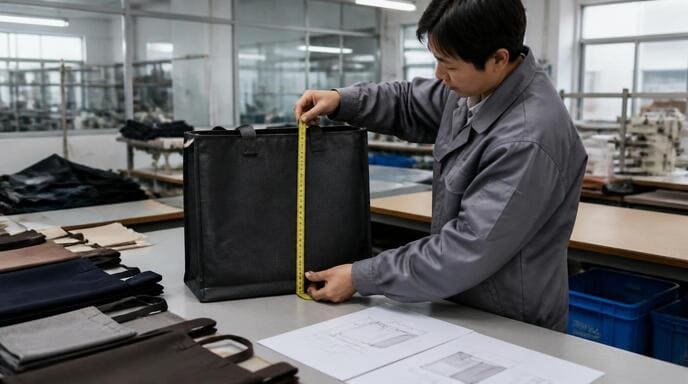
When ordering custom bags in bulk, accurate dimensions are one of the key factors affecting product quality, production efficiency, and overall cost. A size difference of only a few centimeters may seem minor for one sample, but the impact can become much larger when thousands of bags are manufactured.
For example, increasing a bag size by only 1–2 cm may require additional material during cutting, increase the printing area, and change carton dimensions. In large-volume production, these small adjustments can affect material usage, packing efficiency, and shipping costs.
The exact cost impact depends on the bag structure, material, and manufacturing process. However, providing accurate dimensions always helps manufacturers create more reliable quotations, recommend suitable materials, and avoid unnecessary production changes.
Before mass production begins, professional bag suppliers usually confirm dimensions through technical specifications, production drawings, and approved samples to ensure the final product matches the intended application.
Understanding Custom Bag Dimensions: Length, Width, Height and Gusset
Before ordering customized bags, buyers need to understand how bag dimensions are defined. Different bag structures may use different measurement methods, so clear communication is essential.
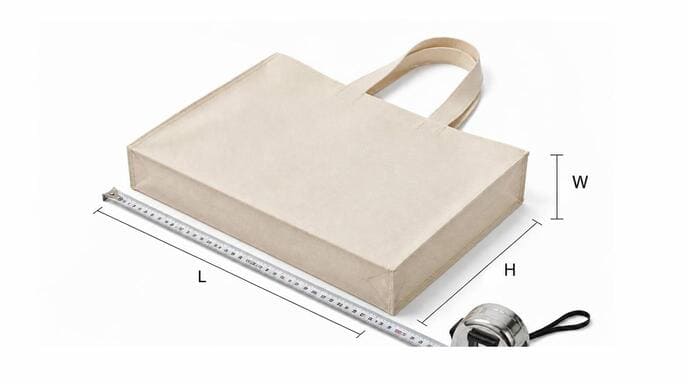
In bag manufacturing, the main measurements usually include:
| Measurement | Meaning | Common Measurement Method |
|---|---|---|
| Length (L) | Horizontal size of the bag | Measured across the front panel from left to right |
| Width (W) | Side depth or front-to-back distance | Related to gusset depth for expandable bags |
| Height (H) | Vertical size of the bag body | Measured from bottom to top opening |
| Gusset (G/D) | Expandable side or bottom section | Determines capacity and bag structure |
Length (L)
Length usually refers to the longest horizontal measurement of the bag body.
For many tote bags, shopping bags, and promotional bags, length is measured across the front panel from the left side to the right side.
Width (W)
Width can have different meanings depending on the bag design.
For flat bags, width often refers to the front panel measurement.
For gusset bags, width usually describes the depth between the front and back panels, which determines how much space the bag can hold.
Height (H)
Height is measured vertically from the bottom of the bag body to the top opening.
Handle length, handle drop, and straps are normally measured separately and should not be included in the bag body height.
Gusset (G)
A gusset is an additional folded section on the side or bottom of a bag that allows expansion.
It affects:
- Internal capacity
- Product loading space
- Bag standing ability
- Material consumption
For example, a shopping bag with a 10 cm gusset can hold significantly more products than a flat bag with the same front panel size.
Why Dimension Order Needs to Be Confirmed
One common mistake in custom bag orders is providing only a number format without explaining the measurement order.
For example:
40 × 15 × 35 cm
Different suppliers may interpret this size differently.
Common formats include:
Length × Width × Height (L × W × H)
or:
Width × Gusset × Height (W × G × H)
Paper shopping bags commonly use:
Width × Gusset × Height
because gusset depth is an important part of the bag structure.
A clearer specification should include:
- Length: 40 cm
- Width: 15 cm
- Height: 35 cm
- Gusset: 10 cm (if applicable)
This helps reduce risks such as:
- Incorrect quotation
- Wrong sample size
- Incorrect cutting pattern
- Production delays
Use Consistent Measurement Units
When communicating with international suppliers, always use one measurement unit.
Recommended:
- Length: 40 cm
- Width: 15 cm
- Height: 35 cm
Avoid:
- Length: 40 cm
- Width: 150 mm
- Height: 13.8 inches
Mixing different units increases the possibility of misunderstanding during design confirmation and production.
External Dimensions vs Internal Dimensions
Another important consideration is whether the measurement refers to the outside size or the usable internal space.
External Dimensions
External dimensions describe the finished outside size of the bag.
They are mainly used for:
- Production drawings
- Printing layout
- Packaging calculation
- Carton planning
Internal Dimensions
Internal dimensions describe the actual usable storage space.
They are important for:
- Product fitting
- Capacity evaluation
- Special applications
For example, an insulated food delivery bag may have an external size of 40 × 30 × 35 cm, but the internal space will be smaller because insulation materials, lining, and structural layers take up additional space.
For cooler bags, confirming both internal and external dimensions is especially important because insulation thickness directly affects usable capacity.
Key point:
A complete custom bag specification should clearly state whether dimensions refer to finished outer dimensions or usable inner dimensions.
How to Measure Different Types of Custom Bags
Different bag structures require different measurement methods. A flat tote bag, gusset shopping bag, and insulated delivery bag do not use exactly the same measurement points.
Measuring Flat Bags Without Gussets
Flat bags do not have expandable side or bottom sections.
Common examples include:
- Non-woven tote bags
- Canvas bags
- Cotton bags
- Promotional bags
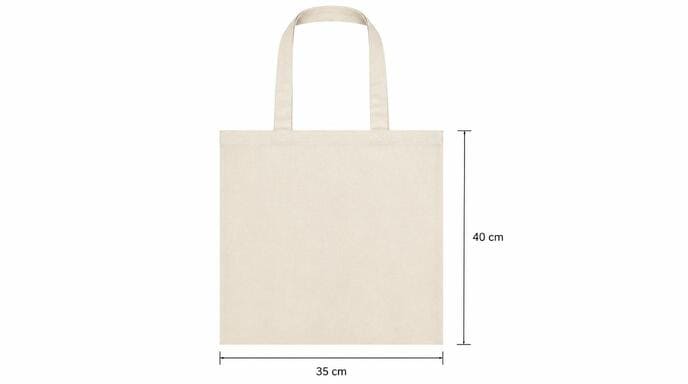
To measure a flat bag:
Measure the Width
Measure across the front panel from left to right.
Measure the Height
Measure from the bottom edge to the top opening.
Measure Handle Details
Also confirm:
- Handle length
- Handle drop
- Handle width
Handle measurements affect carrying comfort and production requirements.
A document bag and a promotional shopping tote may have similar appearances but require completely different dimensions depending on the intended use.
Measuring Gusset Bags
Gusset bags include expandable side or bottom sections.
Common examples include:
- Shopping bags
- Grocery bags
- Laminated non-woven bags
- Paper bags
Main measurements include:
- Front width
- Gusset depth
- Height
Measurement steps:
- Place the bag in its normal standing shape.
- Measure the front panel.
- Measure the side or bottom gusset.
- Measure the total height.
Do not flatten the gusset completely during measurement because this reduces the actual usable depth.
A larger gusset usually means:
- Higher material consumption
- Larger cutting patterns
- Increased production cost
However, a larger gusset is not always better. The correct size depends on the products the bag needs to carry.
For example:
A grocery bag may require deeper gussets for food packages, while a clothing shopping bag may focus more on appearance and vertical space.
Measuring Insulated Bags
Insulated bags require more detailed measurement because the outer dimensions and usable internal capacity are different.
Common insulated bag structures include:
- Aluminum foil insulated bags
- EPE insulated bags
- Oxford fabric cooler bags
- Food delivery thermal bags
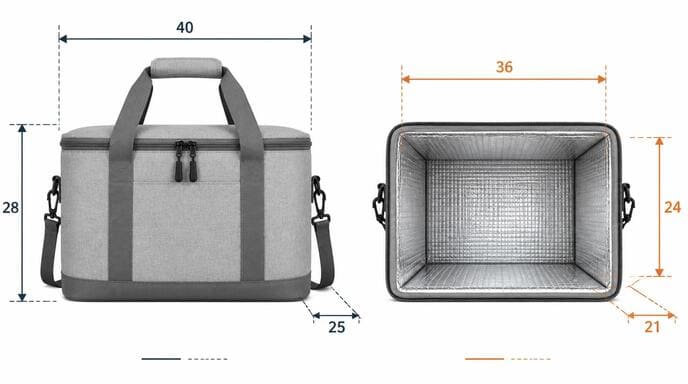
When measuring insulated bags, buyers should provide both outer dimensions and inner dimensions.
Outer Dimensions
Outer dimensions are mainly used for:
- Manufacturing specifications
- Printing layout
- Carton calculation
- Shipping planning
Inner Dimensions
Inner dimensions are used for:
- Food container fitting
- Bottle size confirmation
- Storage capacity evaluation
The difference between outer and inner dimensions depends on:
- Insulation thickness
- Foam layer structure
- Inner lining material
- Sewing allowance
For example, thicker insulation may improve cold retention performance but reduce available storage space.
For food delivery applications, internal dimensions are usually more important because the bag must fit specific food containers, trays, or delivery boxes.
Measuring Paper Bags
Paper bags usually follow the measurement format:
Width × Gusset × Height
Example:
30 × 10 × 40 cm
means:
- Width: 30 cm
- Gusset: 10 cm
- Height: 40 cm
When ordering custom paper bags, buyers should also confirm:
- Handle position
- Handle length
- Bottom structure
- Paper thickness
Paper thickness affects:
- Strength
- Appearance
- Folding performance
- Final cost
A thicker paper grade can support heavier products, but it may also increase material consumption and shipping weight.
Step-by-Step Guide to Measuring a Custom Bag
Accurate measurement requires more than recording three numbers. A complete specification should include the bag structure, additional components, and production requirements.
Prepare the Bag Before Measuring
Before measuring:
- Place the bag on a flat surface
- Remove wrinkles
- Keep the natural shape
- Do not stretch the material
Soft materials such as non-woven fabric and canvas can change shape when pulled, causing inaccurate measurements.
Record Main Dimensions
Always record:
- Length
- Width
- Height
- Gusset depth (if applicable)
Recommended format:
Bag Size: 40 × 15 × 35 cm
Details:
- Length: 40 cm
- Gusset: 15 cm
- Height: 35 cm
Clearly separating each dimension helps manufacturers understand the intended structure.
Measure Additional Components
A complete custom bag specification may also include:
- Handle length
- Handle drop
- Pocket size
- Zipper position
- Closure type
- Bottom panel size
These details affect both usability and production requirements.
For example, a longer handle may improve shoulder carrying comfort but may require different sewing positions and reinforcement.
Confirm Production Tolerance
Small dimensional differences can occur during manufacturing because materials and production processes naturally have variations.
Possible factors include:
- Sewing tension
- Fabric thickness
- Cutting accuracy
- Heat pressing process
- Material flexibility
Before mass production, buyers should confirm:
- Final dimensions
- Acceptable size tolerance
- Material thickness
- Approved sample
A confirmed sample helps avoid unexpected differences between the approved design and final production.
Common Mistakes When Measuring Custom Bags
Measuring From Photos
Photos cannot accurately show:
- Actual depth
- Internal capacity
- Material thickness
- Structural details
Always provide physical measurements or technical drawings instead of relying only on images.
Measuring a Folded Bag
A folded bag does not represent the final usable shape.
This is especially important for:
- Gusset bags
- Cooler bags
- Shopping bags
Measurements should be taken when the bag is opened and placed in its normal form.
Ignoring Material Thickness
Material selection affects the final dimensions.
Examples:
- Insulation layers reduce internal storage space.
- Thick fabrics require additional production allowance.
- Linings change usable capacity.
This is why insulated bags should always confirm both internal and external measurements.
Not Defining Dimensions Clearly
Writing:
“Need a 40 × 30 × 50 cm bag”
may create confusion.
A better specification is:
- Length: 40 cm
- Gusset: 30 cm
- Height: 50 cm
Clear dimension labeling prevents incorrect quotations and production mistakes.
How Bag Dimensions Affect Custom Manufacturing Costs
Bag size directly influences production cost through several factors.
Material Consumption
Larger bags require more:
- Fabric
- Handles
- Printing area
- Accessories
- Packaging materials
For example, increasing bag dimensions by 10% does not always mean the cost increases by exactly 10%. The actual impact depends on cutting layout, material waste, sewing requirements, and production efficiency.
When both width and height increase, material usage can rise significantly because the cutting area becomes larger.
Printing Cost
Bag dimensions also affect printing requirements.
A larger printing area may require:
- More ink usage
- Larger printing plates
- Additional production time
For custom printed bags, confirming the logo size and printing position together with bag dimensions helps avoid layout adjustments later.
Packaging and Shipping Costs
A larger bag may require:
- Larger cartons
- More warehouse space
- Higher shipping volume
For international shipments, carton volume is an important cost factor.
Even a small increase in finished bag size may reduce the number of bags packed per carton, increasing total shipping volume.
Production Efficiency
Incorrect dimensions may lead to:
- New samples
- Pattern adjustments
- Cutting changes
- Production delays
Confirming dimensions before production helps reduce unnecessary revisions and improves manufacturing efficiency.
The ideal bag size is not the largest possible size. It should balance:
- Product capacity
- Material cost
- Packaging efficiency
- Shipping requirements
- User experience
Information to Provide When Ordering Custom Bags
When requesting a quotation from a bag manufacturer, provide complete specifications including:
- Bag application
- Length, width, height
- Measurement unit
- Material type
- Fabric thickness or GSM
- Handle style and length
- Printing requirements
- Order quantity
- Special requirements
For specific applications, also include:
- Product size
- Weight requirement
- Waterproof requirements
- Insulation requirements
For example, a food delivery company should provide container dimensions and insulation requirements, while a retail brand should focus on product size, appearance, and printing details.
Complete specifications allow manufacturers to recommend suitable structures and provide more accurate quotations.
Conclusion: Accurate Measurement Creates Better Custom Bags
Accurate bag measurement is the foundation of successful customization.
Correct dimensions help businesses achieve:
- Better product fitting
- More accurate printing
- Controlled material usage
- Lower production risks
- Improved shipping efficiency
When working with a custom bag manufacturer, always provide clear Length, Width, Height, and Gusset information with consistent measurement units.
A correctly measured bag is easier to manufacture, more cost-effective, and more likely to meet the final application requirements.
Small measurement differences can create large impacts in bulk production. Clear communication before manufacturing helps ensure the final bags meet expectations in quality, function, and cost.
FAQ: Custom Bag Dimension Measurement
What are the standard dimensions used for custom bags?
Custom bags are usually measured using Length, Width, Height, and Gusset. The exact measurement order depends on the bag structure and supplier standard.
Why should I write Length, Width, and Height separately?
Different manufacturers may use different measurement methods. Clearly labeling each dimension reduces quotation errors, sample mistakes, and production misunderstandings.
What measurement unit should I use for bag dimensions?
Use one consistent unit, such as centimeters or millimeters. Avoid mixing different units because this increases the risk of incorrect interpretation.
Should I provide inside or outside bag dimensions?
Manufacturers usually need outside dimensions for production. For insulated bags and storage applications, inside dimensions are also important because they determine usable capacity.
Does increasing bag size increase the price?
Usually yes. Larger bags require more materials, larger packaging, and more shipping space. The exact increase depends on the bag structure, material, quantity, and production method.
How does gusset size affect a custom bag?
A larger gusset increases the bag’s storage capacity and standing ability but may also increase material usage and production cost.
What information should I provide when ordering custom bags?
Provide the bag usage, dimensions, material, handle details, printing requirements, quantity, and special requirements such as waterproofing or insulation.
Can manufacturers adjust bag dimensions after sampling?
Small adjustments may be possible, but major size changes after sample approval can affect production schedules, material planning, and final costs. Confirming dimensions before production is recommended.