
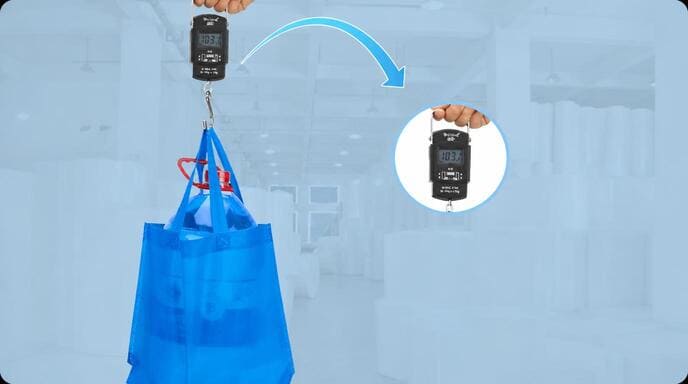
A grocery bag can typically carry 5–15 kg (11–33 lbs)1 in everyday use. Stronger reusable bags made from non-woven PP, PP woven fabric or canvas can be designed for 15–30 kg (33–66 lbs) or more when properly constructed and tested.
The actual load capacity depends on the bag material, structure, handle design and how the weight is distributed2 during use. Laboratory breaking strength is also different from the recommended daily carrying weight.3
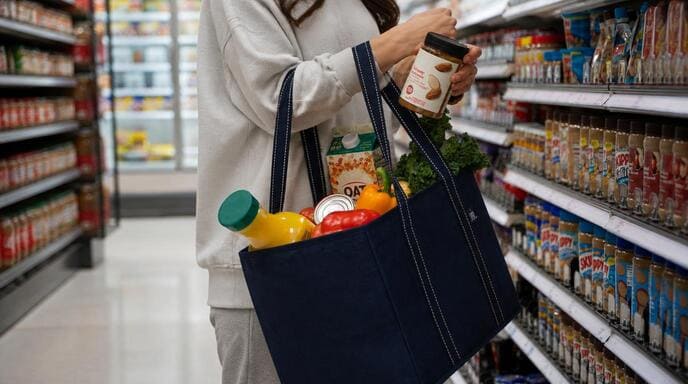
Typical Weight Capacity of Different Grocery Bags
Different grocery bag materials have different load capacities. The following ranges represent common practical applications rather than absolute limits.
| Bag Type | Typical Weight Capacity | Common Application |
|---|---|---|
| Thin plastic grocery bag | 3–7 kg (7–15 lbs) | Lightweight purchases |
| Paper grocery bag | 5–10 kg (11–22 lbs) | Supermarkets and takeaway packaging |
| Non-woven PP reusable bag | 8–20 kg (18–44 lbs) | Retail reusable shopping bags |
| PP woven shopping bag | 15–30 kg (33–66 lbs) | Heavy groceries and promotional bags |
| Cotton canvas tote | 15–35 kg (33–77 lbs) | Premium reusable bags |
For most retail applications, a regular shopping bag is usually designed for around 5–10 kg, while reusable bags commonly target 10–15 kg of daily carrying weight. Applications involving heavier products, such as bottled drinks or bulk food, usually require stronger materials and reinforced structures.
What Is the Maximum Weight a Grocery Bag Can Hold?
The maximum weight a grocery bag can hold depends on its material, construction and testing conditions.
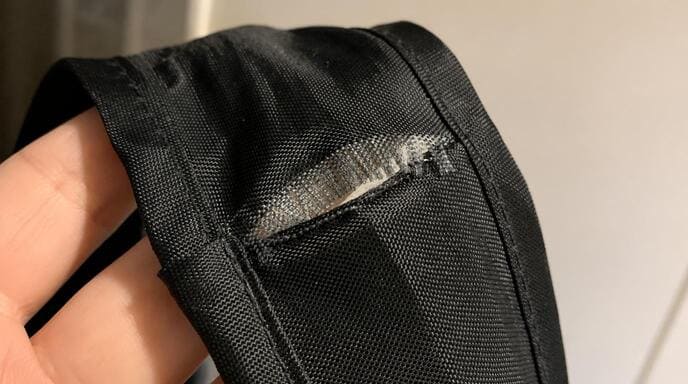
A bag may fail before reaching its theoretical material strength because the stress is concentrated in certain areas4. Common failure points include handle tearing, seam separation, bottom rupture and material stretching5.
For example, a standard non-woven PP reusable bag may be designed for a working load of around 10–15 kg, while a heavier version using higher GSM material and reinforced construction may support 20 kg or more.
The difference between breaking strength and recommended working load is important. A bag that breaks at 30 kg during a controlled test does not necessarily mean customers should carry 30 kg every day. Real usage includes uneven loading, sudden lifting forces, repeated reuse and transportation movement.
How Is Grocery Bag Weight Capacity Tested?
Professional manufacturers evaluate grocery bag strength through several types of load testing. These tests help determine not only how much weight a bag can carry, but also which part of the structure may fail under stress.
Static Load Test
Static load testing is one of the most common methods used to evaluate carrying capacity.6
During the test, the bag is placed on a support frame or test hook, and weights are gradually added until the required load level is reached or the bag fails. The bag is then observed for handle deformation, seam damage, bottom performance and material breakage.
This test helps determine the bag’s maximum load capacity under controlled conditions and identify the weakest part of the structure.
Handle Strength Test
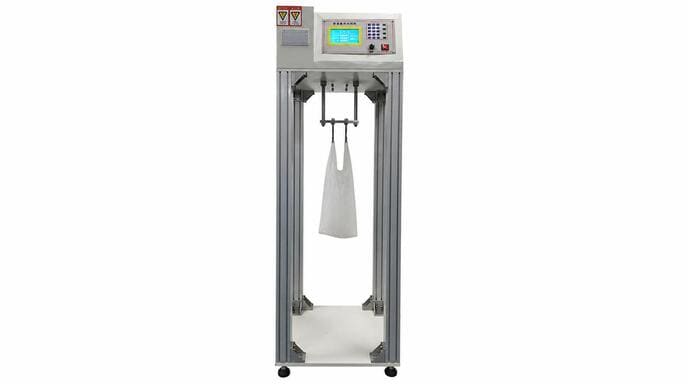
Handle strength testing focuses on the load-bearing performance of the handle and its attachment area.
During the test, force is applied directly to the handle while the bag body is secured. The testing process measures how much pulling force the handle can withstand before stretching, tearing or separating from the bag.
This test helps evaluate whether the handle design, bonding area and reinforcement method are suitable for the expected load.
Dynamic Load Test
Dynamic load testing evaluates how a bag performs during repeated movement and handling.7
During the test, a loaded bag is lifted, lowered or moved repeatedly to simulate real shopping conditions. Inspectors observe whether repeated stress causes handle loosening, seam failure, material fatigue or other damage.
This test helps assess whether a bag can maintain its strength during regular customer use rather than only carrying weight under static conditions.
Why Does a Grocery Bag Tear Before Reaching Its Weight Limit?
A grocery bag does not always fail because the total weight is too high. In many cases, failure occurs because force is concentrated in a small area.
Heavy products such as bottles or cans can create high pressure on the bottom corners. Sharp packaging edges may damage the material, while uneven loading can place excessive stress on one handle or seam.
Common failure areas include the handle attachment points, bottom corners, side seams and areas exposed to sharp product edges.
Does a Higher GSM Grocery Bag Hold More Weight?
For reusable bags, GSM is an important factor because it reflects the amount of material used in the fabric.
Generally, a higher GSM material provides greater thickness, stiffness and basic strength8. However, GSM alone does not determine the final carrying capacity of a finished bag.9
Typical non-woven PP bag applications include:
| Material GSM | Common Use |
|---|---|
| 40–60 GSM | Lightweight promotional bags |
| 75–90 GSM | Standard reusable shopping bags |
| 100–120 GSM | Heavy-duty reusable bags |
| 130+ GSM | Premium bags requiring higher durability |
A stronger grocery bag requires a balance between material strength, bag size, handle design, bottom structure and manufacturing quality.
A high GSM bag with weak construction may still fail, while a properly designed structure can help a suitable material perform more effectively.
How Much Weight Should Different Businesses Expect?
The right grocery bag capacity depends on the application and the type of products being carried.
| Application | Recommended Load Range |
|---|---|
| Clothing retail | 3–5 kg |
| General grocery shopping | 5–15 kg |
| Beverage and bulk products | 15 kg+ |
| Heavy-duty reusable bags | 20 kg+ |
A clothing retailer may prioritize appearance and lightweight handling, while supermarkets carrying beverages, canned products or bulk goods need bags with higher load capacity and stronger structures.
How Do Manufacturers Increase Grocery Bag Load Capacity?
When a bag needs to carry heavier loads, manufacturers usually improve both material selection and structural design.
The first step is choosing a material suitable for the expected weight. Lightweight non-woven bags are commonly used for promotional purposes, while medium GSM reusable bags are suitable for regular shopping. Heavier applications may require higher GSM materials, PP woven fabric or reinforced construction.
Handle performance can be improved through wider handles, larger bonding areas, additional reinforcement patches or stronger stitching. The bottom structure can also be strengthened through gussets, reinforced bases and suitable bag dimensions that help distribute pressure more evenly.
The best load performance comes from matching the material and structure to the actual application rather than simply making the bag thicker.
What Load Capacity Should Buyers Specify When Ordering Custom Bags?
When ordering custom grocery bags, buyers should define the required load capacity based on the products, usage conditions and expected bag lifespan.
Instead of only requesting a “strong bag,” buyers should provide clear requirements such as:
- Expected carrying weight (for example, 5 kg, 10 kg or 20 kg)
- Product type being packed
- Frequency of reuse
- Handle style and carrying method
- Required material and GSM range
For example, a promotional event bag may only need to carry lightweight items, while a supermarket reusable bag for beverages or household goods requires stronger material and reinforced handles.
A clear load requirement helps manufacturers select the right combination of material, structure and production process before quotation and sampling.
FAQ
How many kg can a reusable grocery bag hold?
Most reusable grocery bags can carry around 8–20 kg, depending on the material, GSM, size and construction. Heavy-duty reusable bags can support higher loads when properly designed.
Can a non-woven bag hold 10 kg?
Yes. A properly manufactured non-woven PP bag can commonly carry around 10 kg or more. The final capacity depends on material weight, handle design and production quality.
What is the strongest grocery bag material?
PP woven bags and heavy-duty canvas bags generally provide higher load capacity because of their stronger material structures. However, overall performance also depends on bag design and manufacturing quality.
Does a thicker grocery bag always hold more weight?
Not always. Higher GSM usually improves material strength, but handle construction, seams, bottom structure and production methods also affect the final carrying capacity.
How do manufacturers test grocery bag strength?
Manufacturers typically use static load tests, handle strength tests and dynamic tests to evaluate carrying capacity and identify potential failure points.
Conclusion
A grocery bag can typically hold around 5–15 kg for everyday shopping, while stronger reusable bags can be designed for 15–30 kg or more depending on material and structure.
The real carrying capacity is determined by the combination of material strength, GSM, handle design, bottom structure and manufacturing quality.
For custom bag projects, defining the expected load requirement early helps ensure the final design matches the actual application.
If you need reusable shopping bags with specific load requirements, our team can help recommend suitable materials, structures and production options based on your application.
Contact us for custom bag specifications and factory quotation.
"SIST EN 13590:2003 - Flexible Carrier Bags Volume and ...", https://standards.iteh.ai/catalog/standards/sist/0927b01e-2cac-430a-bd48-5a93a7e10ada/sist-en-13590-2003?srsltid=AU7gw4Vp7E1_9MUSOVlvriPHgduhMiA8lLcTDi5UF8MhcByS8jhhExoW. Carrier-bag test standards and public reusable-bag specifications commonly use load tests in the approximate 10 kg range, providing contextual support for the stated everyday grocery-bag carrying range. Evidence role: general_support; source type: institution. Supports: A grocery bag can typically carry 5–15 kg in everyday use.. Scope note: This would support the range contextually; it would not prove that every grocery bag in the market is rated for 5–15 kg. ↩
"The Effect of Selected Factors on the Strength of Stitches of ...", https://pmc.ncbi.nlm.nih.gov/articles/PMC9572404/. Packaging and textile-testing references identify material properties, seam and handle construction, and load distribution as determinants of bag strength, supporting the claim that carrying capacity is not set by material alone. Evidence role: mechanism; source type: research. Supports: A grocery bag’s load capacity depends on material, structure, handle design, and weight distribution.. Scope note: Such sources explain the engineering factors generally; they may not quantify their relative contribution for a specific bag design. ↩
"Working Load vs Breaking Strength: What You Need to Know?", https://qdpowerful.com/working-load-vs-breaking-strength/. Engineering references distinguish ultimate or breaking strength from allowable working load, supporting the distinction between a laboratory failure load and a recommended everyday carrying load. Evidence role: definition; source type: education. Supports: Laboratory breaking strength differs from recommended daily carrying weight.. Scope note: The concept is general engineering practice; a bag-specific source would still be needed to set a particular safety factor. ↩
"Stress Concentration Factor: Kt Values", https://www.neuralconcept.com/post/stress-concentration-mitigating-risk-factors-in-design-engineering. Materials-engineering sources describe stress concentration as the local amplification of stress around discontinuities, corners, holes, and attachments, supporting the explanation that bags may fail at localized points before the bulk material reaches its theoretical strength. Evidence role: mechanism; source type: education. Supports: A bag may fail before reaching theoretical material strength because stress is concentrated in certain areas.. Scope note: The source would explain the mechanism generally rather than test the specific grocery bags discussed in the article. ↩
"Laboratory and service tests of hand luggage", https://nvlpubs.nist.gov/nistpubs/Legacy/MP/nbsmiscellaneouspub193.pdf. Carrier-bag and flexible-packaging test methods evaluate failure at handles, seams, bottoms, and the bag body, supporting these listed locations as recognized failure modes in bag strength testing. Evidence role: case_reference; source type: institution. Supports: Common grocery-bag failure points include handle tearing, seam separation, bottom rupture, and material stretching.. Scope note: A standards source may identify failure modes and test observations but may not rank which failure mode is most common in consumer use. ↩
"SIST EN 13590:2003 - Flexible Carrier Bags Volume and ...", https://standards.iteh.ai/catalog/standards/sist/0927b01e-2cac-430a-bd48-5a93a7e10ada/sist-en-13590-2003?srsltid=AU7gw4XRHAikIFWiKZyHCQlzNc-PQoip5FHsqNx93AIR4lht9GCYnt_3. Flexible carrier-bag testing standards include static or suspended-load procedures for assessing whether a bag withstands a specified load, supporting static loading as an established method for evaluating carrying capacity. Evidence role: historical_context; source type: institution. Supports: Static load testing is a common method for evaluating grocery-bag carrying capacity.. Scope note: The source would show that static load testing is standardized; it may not prove it is the most common method across all manufacturers. ↩
"Bag Compliance Testing | Assured Testing Services", https://www.assuredtesting.com/bag-compliance-ccd-100. Carrier-bag performance standards and reusable-bag specifications include repeated lifting, carrying, or dynamic-load procedures to simulate use, supporting the role of dynamic testing in assessing durability under handling conditions. Evidence role: mechanism; source type: institution. Supports: Dynamic load testing assesses bag performance during repeated movement and handling.. Scope note: The exact dynamic procedure varies by standard and may not match every manufacturer’s internal test method. ↩
"Methods for characterisation of nonwoven structure, property ...", https://www.sciencedirect.com/science/chapter/edited-volume/pii/B9780081005750000061. Textile and nonwoven-material studies report that increasing fabric mass per unit area is often associated with greater thickness and changes in mechanical properties such as stiffness and tensile strength, supporting the general relationship described. Evidence role: mechanism; source type: paper. Supports: Higher GSM material generally provides greater thickness, stiffness, and basic strength.. Scope note: The relationship is material- and manufacturing-dependent; higher GSM does not guarantee higher finished-bag load capacity. ↩
"How Paper Bag Material Specifications Affect Load ...", https://www.paperindex.com/academy/how-paper-bag-material-specifications-affect-load-capacity-shelf-handling-and-retail-use/. Packaging and textile-testing sources show that finished-bag performance depends on material properties together with seams, handles, attachments, and construction geometry, supporting the claim that GSM alone is insufficient to determine load capacity. Evidence role: expert_consensus; source type: research. Supports: GSM alone does not determine the final carrying capacity of a finished bag.. Scope note: The source would support the principle; the relative importance of each factor must be measured for a particular bag design. ↩