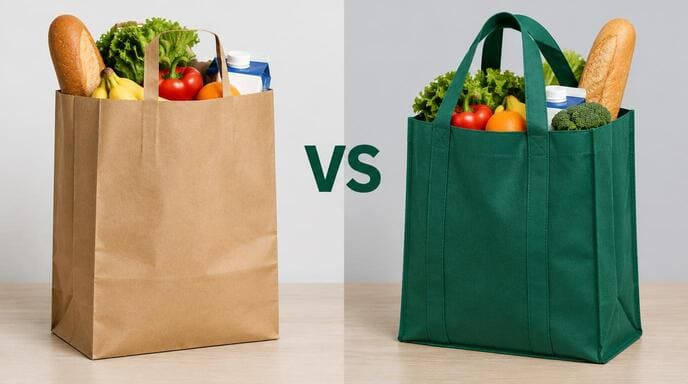
If you are choosing grocery bags for a supermarket, retailer, or reusable shopping program, the main question is not simply which material is stronger. The more important question is:
Which bag construction can safely carry the required grocery load during actual use?
A typical grocery bag may carry 3–5 kg for small purchases, 5–10 kg for regular grocery shopping, and 10 kg or more for heavier loads. Material type matters, but the final carrying capacity also depends on GSM, bag size, handle attachment, bottom construction, and production quality.
In general, PP non-woven grocery bags usually provide a higher practical load range than standard paper grocery bags, especially for reusable applications. However, heavy-duty paper bags and reinforced structures such as seamless M-bottom bags can also handle higher loads.
The correct comparison should therefore be based on the finished bag, not the material name alone.
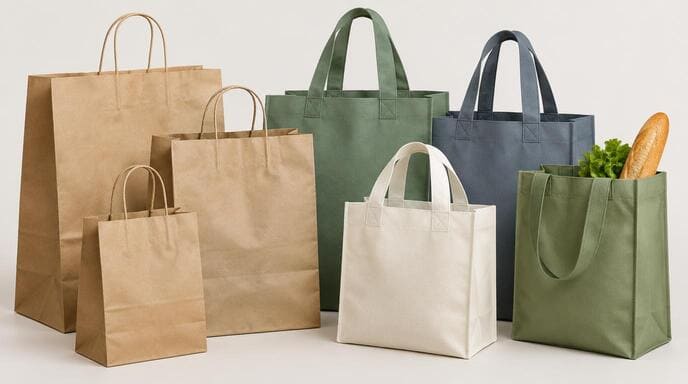
Paper vs Non-Woven Grocery Bags: Weight Capacity Comparison
The table below shows typical practical load ranges for commonly used grocery bags.
| Bag Type | Typical Load Capacity | Common Applications |
|---|---|---|
| Standard paper grocery bag | 3–5 kg | Light grocery shopping, retail packaging |
| Heavy-duty paper grocery bag | 5–10 kg | Larger grocery loads, reinforced retail use |
| Seamless M-bottom paper bag | 5–10 kg+ | Grocery and supermarket applications requiring improved bottom strength |
| PP non-woven bag (60–80 GSM) | 3–8 kg | Lightweight reusable shopping bags |
| PP non-woven bag (80–120 GSM) | 8–15 kg | Supermarket shopping, reusable grocery programs |
| Reinforced PP non-woven bag | 15 kg+ | Heavy-duty reusable applications |
*These are practical reference ranges, not guaranteed load ratings. Actual capacity depends on bag dimensions, handle design, seams, bottom structure, material quality, and load testing.
What does this comparison show?
For 3–5 kg loads, both paper and non-woven bags can usually meet the requirement.
For 5–10 kg loads, PP non-woven generally provides more flexibility because the material and bag structure are easier to adapt for repeated carrying.
For 10–15 kg loads, non-woven bags are commonly selected because they can be produced with heavier fabric, reinforced handles, and stronger structures. Paper can also reach this range, but it usually requires more specialized construction.
The material itself is only one factor. A poorly designed non-woven bag can fail at the handle or seam, while a well-designed paper bag can carry more than a basic construction.
Why Do Non-Woven Bags Usually Hold More Weight?
PP non-woven bags often achieve higher load capacity because they combine durable polypropylene material with flexible bag construction.
Unlike traditional paper bags, non-woven bags are made from a continuous fabric structure that can be customized with different GSM levels, reinforcement methods, and handle designs.
However, increasing GSM does not mean the load capacity increases at the same percentage. A 100 GSM bag is not automatically 25% stronger than an 80 GSM bag because strength depends on more than material weight.
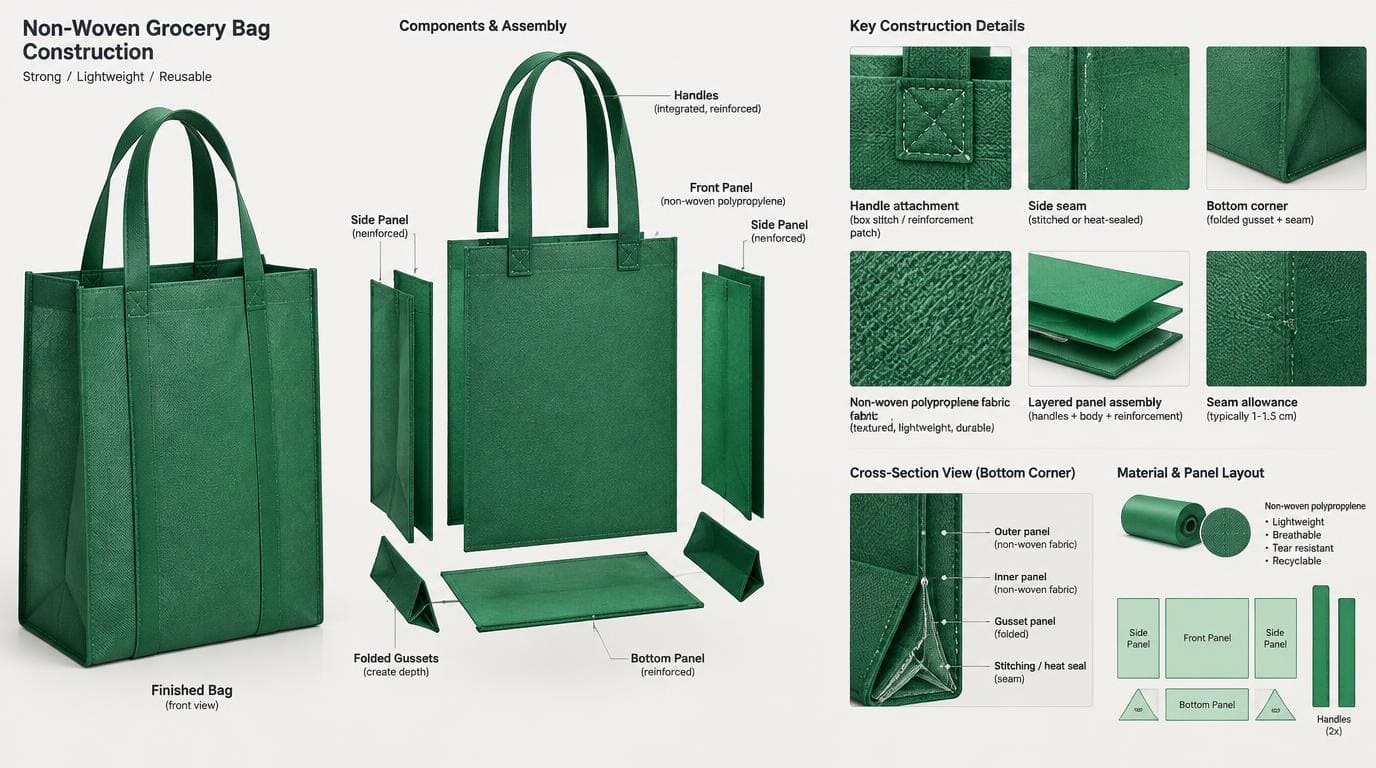
The actual performance depends on factors such as:
- Material quality: fiber strength and fabric production process
- GSM: higher GSM generally provides more material thickness and durability
- Handle reinforcement: handles must transfer the load safely to the bag body
- Bottom construction: the base must distribute the weight without tearing
- Bag size: larger bags experience different stress distribution under the same load
This is why buyers should treat GSM as a specification reference rather than a direct weight rating.
Can Paper Grocery Bags Handle Heavy Loads?
Paper bags are not limited to light shopping applications.
A standard paper grocery bag is commonly suitable for around 3–5 kg, while heavier paper grades and reinforced structures can extend the capacity toward 5–10 kg or more.
One important factor is the bottom structure.
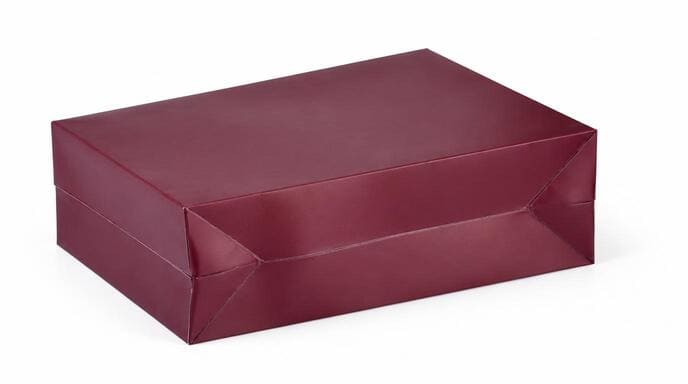
Traditional paper bags often rely on folded sections and glued joints at the bottom, which can become potential stress points under heavier loads. Seamless M-bottom paper bags improve the bottom structure by reducing dependence on conventional bottom seams and improving load distribution.
However, paper performance still depends on:
- Paper GSM and quality
- Handle attachment method
- Bag dimensions
- Bottom construction
- Manufacturing consistency
A heavy-duty paper bag can compete with a non-woven bag in certain applications, but it usually requires more careful structural design.
Does Moisture Affect Load Capacity?
Moisture is another important difference between paper and PP non-woven bags.
Paper can lose strength when exposed to water or prolonged humidity. This can become a problem when carrying:
- Frozen products
- Wet vegetables
- Chilled food
- Leaking containers
Lamination can improve paper's splash resistance, but it only slightly improves water resistance. Paper bags are still vulnerable to moisture and should be protected from direct or prolonged exposure to water.
PP non-woven does not absorb water like paper, although standard non-woven fabric itself is not fully waterproof because it has a porous structure. Lamination can be added when additional moisture resistance is required.
Therefore, for an 8 kg dry grocery load, both materials may work. For repeated exposure to moisture, PP-based bags are usually easier to configure for the application.
How Should Buyers Choose Between Paper and Non-Woven?
The best starting point is not GSM or material type. It is the actual usage requirement.
| Required Load | Recommended Options |
|---|---|
| 3–5 kg | Standard paper or lightweight PP non-woven |
| 5–10 kg | Heavy-duty paper, seamless paper, or medium/heavy PP non-woven |
| 10–15 kg | Higher GSM PP non-woven or reinforced paper construction |
| 15 kg+ | Reinforced PP non-woven, PP woven, or specialized structures |
Before selecting a bag, buyers should define:
Target load + bag size + material GSM + handle structure + bottom design + moisture exposure
The final specification should then be verified through appropriate load testing.
Final Answer: Paper or Non-Woven Grocery Bags?
For most reusable grocery applications, PP non-woven bags generally provide a wider practical load range than standard paper bags.
Paper bags can still perform well when heavier paper grades, reinforced handles, or seamless M-bottom structures are used.
For everyday grocery loads around 3–5 kg, both materials are suitable. For higher loads around 8–15 kg, PP non-woven usually offers more flexibility in design and reuse performance.
The most reliable approach is to select the bag based on the required load and usage conditions, then determine the appropriate material, GSM, handles, and structure.
FAQ
Which is stronger, paper or non-woven grocery bags?
PP non-woven bags generally provide a higher practical load range for reusable grocery applications. However, heavy-duty paper bags can also carry substantial loads when properly designed.
Can a paper grocery bag hold 10 kg?
Yes, but it usually requires heavier paper, reinforced construction, suitable handles, and a strong bottom design.
Can an 80 GSM non-woven bag hold 10 kg?
Some 80 GSM bags may handle this load depending on their construction, but GSM alone does not determine capacity. Handle design, bag size, and bottom structure are also critical.
Does higher GSM always mean a stronger grocery bag?
No. Higher GSM usually means more material per square meter, but actual strength depends on the complete bag structure and manufacturing process.
Are non-woven bags better for reusable grocery programs?
PP non-woven bags are commonly used for reusable programs because they combine durability, flexibility, and resistance to repeated handling.