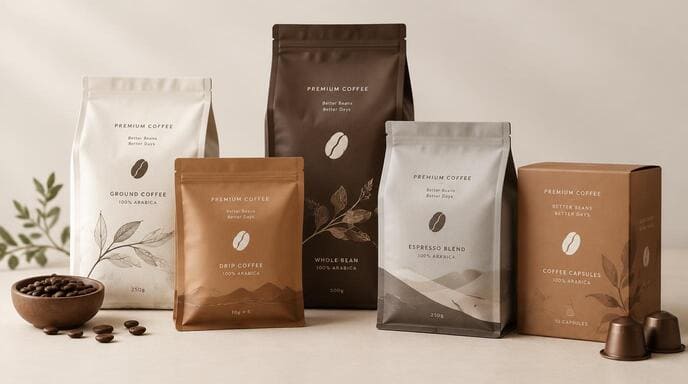
Choosing coffee packaging is not simply about finding a bag that can hold 250 g, 500 g, or 1 kg of coffee. The packaging format also affects shelf presentation, brand positioning, freshness protection, consumer convenience, and packaging cost. For coffee roasters, brands, importers, retailers, and packaging buyers, the practical questions are straightforward: What types of coffee packaging are available? Which bag format fits my product? What material should I choose? Do I need a valve or zipper? And how should the package look to support my brand? The right choice depends mainly on coffee format, filling weight, target shelf life, sales channel, distribution conditions, and brand positioning.
What Are the Main Types of Coffee Packaging?
For commercial coffee, packaging can be divided into several practical formats rather than simply “paper bags” or “plastic bags.” The most commonly used formats include flat-bottom bags, stand-up pouches, side-gusset bags, quad-seal bags, and flat sachets or drip coffee packaging.

Flat-Bottom Coffee Bags
Flat-bottom bags have a box-like base that allows them to stand firmly on shelves and provides several relatively large printable panels. They are commonly used for specialty coffee, premium retail coffee, and brands that want a structured shelf appearance. A 250 g or 500 g specialty coffee, for example, can use a flat-bottom bag with a high-barrier laminate, one-way valve, and zipper. This format is particularly useful when the package itself is an important part of the product presentation.
Stand-Up Pouches
Stand-up pouches use a bottom gusset to stand upright and can be used for both whole beans and ground coffee. They can incorporate zippers, valves, different barrier structures, and custom printing, making them suitable for brands that need a flexible retail format across several SKUs and filling sizes. For smaller coffee brands, a stand-up pouch can also be a practical starting point because the basic construction can be adapted to different weights and designs.
Side-Gusset Coffee Bags
Side-gusset bags are one of the traditional coffee-bag formats. Their folded side panels expand when filled, creating additional capacity without making the package excessively wide. They are commonly used for whole-bean coffee, larger retail packs, foodservice, and wholesale coffee. Depending on the application, they can be fitted with a one-way valve, heat seal, zipper, or tin tie.
Quad-Seal Coffee Bags
Quad-seal bags use additional vertical seals to create a more defined rectangular structure. Compared with a simple side-gusset bag, they can provide a more structured appearance and clearly defined front, back, and side panels. They are suitable for larger retail packs and brands that want stronger shelf presence, particularly when the package needs to maintain its shape after filling.
Flat Pouches, Sachets, and Drip Coffee Packaging
Flat pouches are more common for single portions, samples, small ground-coffee packs, and drip coffee than for conventional retail whole-bean coffee. Drip coffee products may use an individual filter bag inside an outer high-barrier package, while single-serve sachets prioritize portion control, compact shipping, and individual product protection. These formats are therefore a different packaging category from larger retail coffee bags.
Which Coffee Packaging Format Should You Choose?
The easiest way to choose the format is to start with the sales application. For premium retail coffee, a flat-bottom bag is a strong option when shelf appearance and brand presentation are important. For flexible retail packaging, a stand-up pouch works well when different filling sizes, zippers, and product variations are required. For traditional whole-bean coffee and larger packs, side-gusset or quad-seal bags are practical choices. For single-serve and drip coffee, flat sachets or dedicated drip-coffee packaging are more appropriate.
The bag shape itself does not determine freshness protection. A flat-bottom bag is not automatically better than a stand-up pouch. Material structure, barrier performance, sealing quality, valve design, and storage conditions are more important for product protection.
A useful rule: choose the bag shape for capacity, handling, shelf presentation, and brand positioning; choose the material structure for product protection.
How Does Coffee Packaging Affect Brand Image?
Once the basic format is suitable, the next question is what the coffee bag should communicate about the brand. The same 250 g of coffee can create very different impressions depending on the package structure, printing, surface finish, color, and information layout. A structured flat-bottom bag can support a premium or specialty-coffee positioning, while a matte stand-up pouch may create a more modern and minimalist appearance. A kraft-paper outer layer can communicate a natural, craft, or traditional visual direction, while high-coverage printing can provide stronger color impact and shelf visibility.

However, visual appearance should not be confused with technical performance. A coffee bag that looks like kraft paper does not necessarily have low barrier performance. In many commercial coffee bags, the paper is primarily the outer printable layer, while the inner laminated layers provide much of the oxygen and moisture protection.
This means coffee packaging should be designed around two questions: How should the package perform, and how should the package look? The strongest packaging solution addresses both without adding features that the product does not actually need.
How Should You Choose the Coffee Packaging Material?
Common coffee packaging structures include paper laminates, metallized films, aluminum foil laminates, and high-barrier polymer structures. The choice should start with the required shelf life. If coffee is roasted locally and expected to sell within several weeks, a standard laminated structure may be sufficient. If the product is expected to remain in distribution for 6–12 months, stronger oxygen and moisture protection becomes more important, especially for long-distance transportation and uncontrolled warehouse conditions.
Aluminum foil provides a very high barrier against oxygen, moisture, and light. Metallized films and high-barrier polymer structures can also provide substantial protection and may be considered when material reduction or recyclability is an important requirement. Research comparing coffee packaging systems has also evaluated packaging under accelerated conditions such as 40°C, 50°C, and 60°C, demonstrating why packaging performance should be evaluated against the intended storage conditions rather than assumed from the material name alone.

For buyers, a more useful request to a manufacturer is therefore: “Please provide the complete material structure and barrier specifications.” This is more informative than simply asking for a “kraft coffee bag,” because the visible outer material does not describe the complete packaging structure.
Do Coffee Bags Need a Valve and Zipper?
For freshly roasted coffee, a one-way degassing valve is commonly used because coffee continues to release CO₂ after roasting. The early post-roast period is particularly important, with substantial degassing occurring during approximately the first 20 days after roasting. The valve allows gas to escape while helping limit outside air from entering the package.
A zipper has a different purpose: consumer resealing. A retail coffee bag may therefore combine a high-barrier laminate + one-way valve + heat seal + zipper, with each component performing a different function: the laminate provides oxygen, moisture, and light protection; the valve manages CO₂; the heat seal provides package integrity; and the zipper allows consumer reclosure.
A valve does not replace a high-barrier film, and a zipper does not replace the primary heat seal.
How Does Coffee Type Affect the Packaging Choice?
The packaging requirement also changes according to the coffee format. Whole-bean coffee commonly uses a high-barrier bag with a one-way valve, particularly when packed soon after roasting. Ground coffee generally requires careful control of oxygen exposure because grinding increases the surface area exposed to the environment and accelerates the loss of volatile compounds. Drip coffee and single-serve coffee require a different package design because the product is portioned individually and may need separate protection for each serving.
For this reason, a manufacturer should know whether the product is whole bean, ground, drip, or instant coffee before recommending the final bag structure.
How Should You Choose Coffee Packaging for Different Shelf Lives?
Shelf life is one of the most useful decision points when selecting coffee packaging. For coffee with a short local turnover period, a standard laminated structure may provide enough protection. For coffee with a target shelf life of 6–12 months, a higher-barrier structure, reliable sealing, and appropriate light and moisture protection become more important. Export products also need to account for the time spent in transportation, warehouses, and retail distribution.
One published study has discussed residual oxygen levels around 1–2% in relation to approximately 6–8 months of shelf life under specific conditions. This should not be treated as a universal shelf-life formula because coffee type, packaging structure, temperature, roast level, and testing conditions can all affect the result.
The practical conclusion is simple: the longer the required shelf life, the more important it becomes to specify and validate the complete packaging system rather than choosing the bag by appearance alone.
How Do You Choose the Right Coffee Bag?
A practical selection process can be reduced to five questions.
1. What coffee are you packaging?
Whole beans, ground coffee, drip coffee, and instant coffee have different packaging requirements. Identify the product format before deciding on the bag structure.
2. What is the filling weight?
Common commercial sizes include 250 g, 340 g, 500 g, and 1 kg, but the correct bag dimensions depend on coffee density and the specific bag construction. A 1 kg foodservice package, for example, has different mechanical and handling requirements from a 250 g retail bag.
3. How long must the coffee remain in good condition?
Define the target shelf life before selecting the barrier structure. A product intended for rapid local turnover does not necessarily need the same packaging structure as coffee that will remain in export distribution for 6–12 months.
4. Where will the coffee be sold?
Supermarkets, specialty coffee shops, e-commerce, subscriptions, wholesale, and foodservice can require different combinations of shelf presentation, resealing, strength, and logistics efficiency.
5. What should the package communicate?
The final design should balance product protection, brand image, consumer convenience, and target cost. This is more useful than starting with a material name such as “kraft,” “foil,” or “plastic.”
Bag Expert Analysis: How Would a Packaging Manufacturer Select the Right Coffee Bag?
From a coffee-bag manufacturer's perspective, there is no universal “best coffee bag.” The appropriate configuration depends on the actual product and distribution requirements.
For a 250–500 g freshly roasted specialty coffee, a flat-bottom or stand-up bag with a high-barrier structure, one-way valve, heat seal, and optional zipper is a practical starting point. For 1 kg whole-bean coffee sold to foodservice customers, a side-gusset or quad-seal bag may be more appropriate because capacity, handling, and structural strength become more important. For drip coffee or single-serve products, flat sachets or dedicated drip-coffee packaging are more appropriate than conventional retail bags.
Material selection follows the same principle. A manufacturer should first understand the coffee type, filling weight, target shelf life, distribution conditions, and brand positioning, then recommend the structure.
For a custom coffee bag quotation, the most useful information to provide is:
Coffee type + filling weight + target shelf life + preferred bag format + quantity + destination market.
This allows the manufacturer to recommend a structure based on the actual application instead of simply offering a standard bag.
FAQ
What is the best packaging for coffee?
There is no single best format. Flat-bottom bags are suitable for premium retail coffee, stand-up pouches offer flexibility, and side-gusset or quad-seal bags are practical for traditional and larger coffee packs.
What type of bag is best for whole-bean coffee?
Flat-bottom, stand-up, side-gusset, and quad-seal bags can all be used. For freshly roasted whole beans, a high-barrier structure with a one-way valve is a common configuration.
What packaging is best for ground coffee?
Ground coffee is commonly packed in high-barrier stand-up pouches, flat-bottom bags, side-gusset bags, vacuum packs, or smaller sachets depending on the product and sales format.
Do coffee bags need a one-way valve?
Freshly roasted coffee commonly uses a one-way valve because it continues to release CO₂ after roasting. Coffee that has already been appropriately degassed may have different requirements.
Is kraft paper good for coffee packaging?
Kraft paper is useful for creating a natural or premium appearance, but kraft paper alone does not determine barrier performance. The complete multilayer structure should be evaluated.
Should coffee bags have a zipper?
A zipper is useful for retail coffee that consumers will open and reseal. It is less important for single-use or small-portion packaging.
What size coffee bag is most common?
250 g, 340 g, 500 g, and 1 kg are common commercial sizes, although the appropriate size depends on the market, coffee density, sales channel, and intended consumer usage.
How do I choose between a flat-bottom and stand-up coffee bag?
Choose a flat-bottom bag when shelf stability, premium presentation, and multiple printable panels are priorities. Choose a stand-up pouch when flexibility and a broader range of retail applications are more important.
Conclusion
Choosing coffee packaging is ultimately a balance between product protection, packaging format, brand image, consumer convenience, and cost. Start with three questions: What type of coffee am I selling? How long does it need to remain in good condition? What do I want the package to communicate about my brand?
Then choose the appropriate format—flat-bottom, stand-up, side-gusset, quad-seal, or sachet—and determine the material structure, valve, zipper, printing, and finish. For a typical freshly roasted retail coffee, a high-barrier laminated bag with a one-way valve is a practical starting point. For premium products, the bag structure and finish can then be developed around the brand's positioning. For longer shelf-life or export products, barrier performance and package testing become increasingly important.
JiaRong Packaging can support custom coffee bag development, including bag structure, material selection, valve, zipper, printing, dimensions, sampling, and mass production.
Send your coffee type, filling weight, target shelf life, preferred bag style, quantity, and destination market to JiaRong Packaging to discuss the suitable packaging structure and request a quotation.