
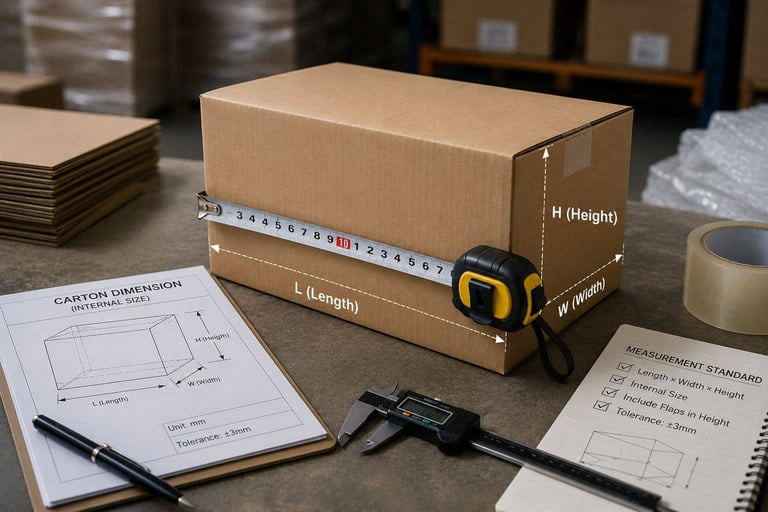
Worried about shipping damage and surprise costs? The problem might start with your supplier's ruler. A supplier's measurement method reveals their professionalism and protects your bottom line.1
A professional supplier’s carton measurement process reveals their commitment to quality. They define clear rules, account for variables beyond product size, conduct real packing trials, and manage tolerances. This prevents costly shipping damage and repacking issues that hurt your brand and budget.2

I've been in the packaging business for over a decade. In my experience, the discussion about carton sizes is one of the most revealing conversations you can have with a potential partner. It quickly separates the amateurs from the professionals. It shows you who just wants to sell you a product and who wants to be a true partner in protecting it. Let’s dive into what you should be looking for, because these details can save you thousands of dollars and a lot of headaches down the road.
Does Your Supplier Define Measurement Rules Before Giving You Dimensions?
You received carton dimensions, but they seem random. Inconsistencies can lead to packing errors and shipment failures. A professional supplier standardizes measurements first to ensure everyone is on the same page.
Yes, they absolutely should. A reliable supplier defines the measurement methodology before providing dimensions. This includes specifying orientation (L×W×H), internal vs. external measurements, and what is included in the height3. This prevents costly misunderstandings between departments and during QC inspections.
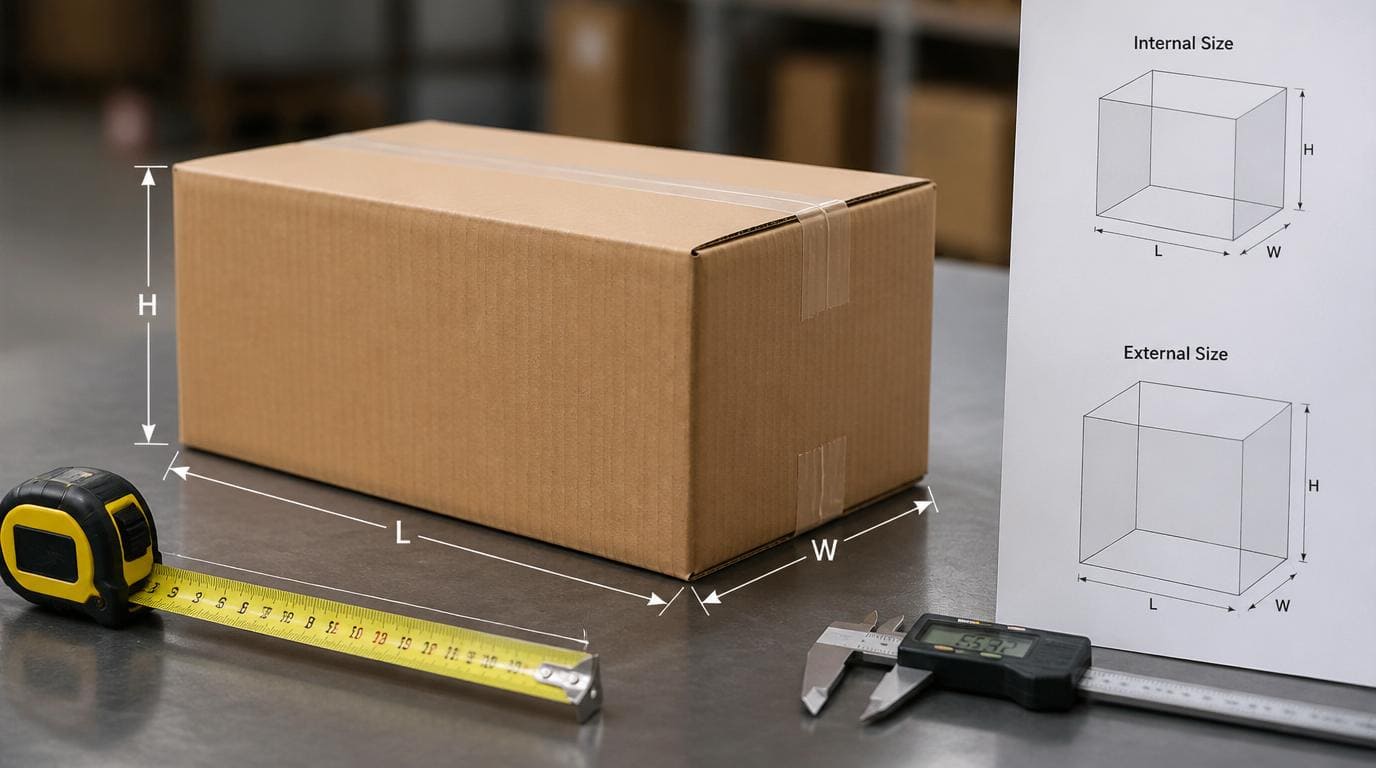
The first sign of a professional supplier isn't the carton size they recommend; it's how they talk about measuring it. Many suppliers can give you a set of numbers. Far fewer can clearly explain how they arrived at those numbers. Before we even discuss a specific carton size at JiaRong Packaging, we make sure the rules of measurement are clear. If your supplier’s sampling department measures the external length but the QC team measures the internal length, you have a built-in problem.4 This tiny difference can lead to massive issues later when your products don't fit or the cartons bulge. A good supplier’s process should be clear and consistent for everyone involved. The right question to ask is not "What carton size do you recommend?" Instead, you should ask, "How do you define and measure that carton size?"
| Topic | Unprofessional Approach | Professional Approach |
| :--- | :--- | :--- |
| Orientation | Assumes everyone knows L×W×H. | Explicitly defines Length × Width × Height. |
| Dimensions | Doesn't specify internal or external. | Clearly states if dimensions are internal or external. |
| Height | Vaguely measures "the top." | Defines if flaps are included in height measurement. |
| QC Process | Measures inconsistently. | Records dimensions using the pre-defined method. |
Why Do Great Suppliers Consider More Than Just Product Dimensions?
A supplier calculated carton size based only on your bag's dimensions. This is a major red flag. Real-world packing is complex, and this oversight often leads to damaged, bulging cartons.
They know that product dimensions are only the starting point. Material thickness, trapped air, folding methods, and stacking pressure all affect the final packed volume.5 Ignoring these factors can result in cartons that are either too small or too large. While undersized cartons may compress the products, oversized cartons often leave too much unused space inside6. A partially filled carton has lower stacking strength and is more likely to collapse or become deformed when heavy cartons are stacked on top during transportation. This can increase the risk of product damage and create additional repacking costs for traders upon arrival.
A common warning sign I see is when a supplier simply takes the dimensions of a bag and uses a calculator to find a carton size. This almost always fails.Experienced suppliers understand that how a product behaves during packing and shipping is critical. For example, a bag fresh off the production line is often puffy with trapped air. It needs time to rest and "condition" before you can get an accurate measurement for packing. We’ve learned that two bags with the exact same dimensions might need completely different carton sizes. One might be made of a stiffer material that doesn't compress, while another is soft and can be folded tightly. A professional supplier thinks about all these factors:
Material Thickness: Thicker materials add up over hundreds of units.
Bag Structure: Gussets and handles change how a bag sits.
Trapped Air: Bags need to settle or be compressed before measuring.
Folding Method: A standardized fold is key to consistent packing.
Carton Board Thickness: The carton walls themselves take up space.
Stack Pressure: How bags will compress under weight in a container.
Suppliers who understand these details are much better prepared to prevent shipping damage.
How Do Top Suppliers Validate and Finalize Carton Sizes?
You are relying on estimated carton sizes. This is a gamble. Without real-world tests, you might only discover a major packing problem when thousands of units are ready to ship.
Top suppliers don't just estimate; they validate. They conduct real packing trials to check product fit, layer arrangement, and carton stability.7 They also manage acceptable tolerances for dimensions, because they understand that perfect uniformity is impossible in manufacturing8.
Here lies the biggest difference between an average supplier and a truly professional one: validation. An average supplier estimates. A professional supplier tests. Before we approve a carton for mass production, we conduct a pilot packing trial. We take a batch of conditioned products and physically pack them into the proposed carton. This test reveals issues that no calculation can predict. We check for carton fullness, ensure there's no wasted space, and see how the box holds up to compression. Asking your supplier for photos or a short video of this packing trial is far more valuable than just looking at a carton drawing.
Furthermore, a reliable supplier is honest about manufacturing realities. They know no process creates perfectly identical cartons every time. Instead of promising perfection, they discuss acceptable tolerances, like +/- 3mm. This shows they understand their own production process and are setting realistic, controllable quality standards. This honesty prevents a scenario I’ve seen happen too often: a customer receives a shipment where the cartons have failed. Now they have to pay for labor in their own country—where it can be very expensive—to repack thousands of units before sending them to their own clients. A simple packing trial prevents this entire nightmare.
Why Are Carton Specifications a Critical Risk-Control System?
You see carton dimensions as just a few numbers on a spec sheet. This narrow view ignores their role in preventing transit disasters. A weak spec sheet invites inconsistency and risk.
Strong suppliers treat carton specifications as a complete system, not just a set of dimensions. The document includes measurement methods, packing layouts, void-fill requirements, and QC checkpoints.9 This comprehensive approach minimizes misunderstandings and ensures consistency from the first sample to the final shipment.
The most capable suppliers view carton specifications as a complete risk-control system. The numbers are just one part of it. A strong specification document is a rulebook that ensures everyone, from the sample maker to the final packer, is working toward the same goal: getting your product to its destination safely. It’s a living document that improves over time. In fact, one of the best signs of an experienced supplier is their willingness to discuss past failures. If a supplier tells me they've never had a shipping problem, I'm skeptical. If they can tell me about a time a carton failed and then explain the corrective actions they took—like upgrading the board material or adding edge protectors and updating their spec sheet—it shows they have a robust quality system. They learn and they improve. This documented experience is a powerful indicator of their real-world capability.
A strong carton specification should include:
Dimensions & Tolerances: The exact numbers and acceptable variance.
Measurement Method: A clear guide on how to measure.
Packing Layout: A diagram showing how products are arranged.
Layer & Unit Counts: The exact number of items per layer and box.
Void-Fill Rules: Instructions on using dunnage if needed.
QC Checkpoints: Key points for inspection during production.
This system turns packaging from a guess into a science.
Conclusion
A supplier's approach to carton measurement reflects their overall quality. Paying attention to these details helps you choose a reliable partner and protects your products and your budget.
"55.020 - Packaging and distribution of goods in general - ISO", https://www.iso.org/ics/55.020.html. Packaging standards and quality-control guidance treat defined measurement methods and specifications as part of process control, supporting the view that measurement discipline affects packaging performance and commercial risk. Evidence role: general_support; source type: institution. Supports: A supplier's measurement method can indicate process quality and help reduce commercial risk.. Scope note: This supports the general relationship between documented measurement practice and quality control, not a direct measure of supplier professionalism. ↩
"Getting Started with Design & Testing", https://www.ista.org/getting_started_with_design.php. Transport-packaging guidance from testing and standards organizations links packaging design, handling conditions, and validation procedures to reduced distribution damage; it provides contextual support for the claim that poor carton control can lead to damage and corrective costs. Evidence role: general_support; source type: institution. Supports: Clear carton measurement and packing controls help prevent shipping damage and repacking issues.. Scope note: The source may not quantify brand impact or repacking costs for this specific product category. ↩
"How To Measure A Shipping Box Or Carton - YouTube",
. Dimensional-weight and freight-measurement rules commonly require length, width, and height to be measured consistently, showing why orientation and the definition of measured dimensions are necessary for shipping calculations. Evidence role: definition; source type: government. Supports: Reliable carton dimensions require clear definitions of length, width, height, and measurement basis.. Scope note: Freight rules establish measurement convention for shipping charges and handling, but may not address every internal manufacturing specification detail. ↩"Corrugated fiberboard - Wikipedia", https://en.wikipedia.org/wiki/Corrugated_fiberboard. Corrugated packaging specifications distinguish inside and outside dimensions because board thickness changes usable volume, supporting the claim that mixing internal and external measurements can create fit and quality-control errors. Evidence role: mechanism; source type: institution. Supports: Using internal and external carton dimensions interchangeably can cause packing and inspection problems.. Scope note: The source would support the dimensional distinction generally, not document this exact supplier workflow problem. ↩
"Estimation of the Compressive Strength of Corrugated Board Boxes ...", https://pmc.ncbi.nlm.nih.gov/articles/PMC8467740/. Packaging-engineering literature describes package volume and load performance as functions of product geometry, material behavior, packing arrangement, and compression conditions, supporting the claim that carton sizing depends on more than nominal product dimensions. Evidence role: mechanism; source type: education. Supports: Final packed volume is affected by material thickness, air, folding, and stacking pressure, not just product length and width.. Scope note: A general packaging-engineering source may not address non-woven bags specifically. ↩
"A Guide About Everything Regarding Void Fill", https://www.thepackagingcompany.us/knowledge-sharing/a-guide-about-everything-regarding-void-fill/?srsltid=AfmBOopZu13y8euPzkoO-CxLQUbwzKhSxO3uaqhbKmWkzCTuZYsalggv. Carrier and packaging guidance commonly warns that excessive empty space permits movement inside the package and should be controlled with appropriate sizing or cushioning, supporting the claim that oversized cartons create packaging risk. Evidence role: general_support; source type: institution. Supports: Oversized cartons can leave unused space that increases shipping risk.. Scope note: This supports the risk of excess void space generally and may not prove that every oversized carton fails or deforms. ↩
"Investigation of the Effect of Pallet Top-Deck Stiffness on Corrugated ...", https://pmc.ncbi.nlm.nih.gov/articles/PMC8585293/. Distribution-packaging test methods evaluate compression and stacking loads because cartons can deform or fail under superimposed weight during transport and storage, supporting the stated failure mechanism. Evidence role: mechanism; source type: institution. Supports: Cartons may collapse or deform under stacking loads during transportation.. Scope note: The source establishes the general compression hazard; actual collapse probability depends on board grade, humidity, stacking pattern, and load duration. ↩
"Packaging Design - Fashion Institute of Technology", https://www.fitnyc.edu/academics/academic-divisions/art-and-design/packaging-design/index.php. Packaging-design references emphasize fit testing, cushioning, product orientation, and distribution hazards in addition to product dimensions, providing contextual support for the statement that dimensional calculation alone is insufficient. Evidence role: expert_consensus; source type: education. Supports: Carton sizing based only on product dimensions is an insufficient packaging-design method.. Scope note: The source is unlikely to verify the phrase “almost always fails,” which is experiential and should be softened or treated as anecdotal. ↩
"Recognized Consensus Standards: Medical Devices - FDA", https://www.accessdata.fda.gov/scripts/cdrh/cfdocs/cfstandards/detail.cfm?standard__identification_no=43297. Transport-packaging standards and pre-shipment testing protocols use physical trials or laboratory simulations to verify package fit and performance, supporting the role of packing trials in validating carton specifications. Evidence role: expert_consensus; source type: institution. Supports: Physical packing trials help validate product fit, layer arrangement, and carton stability.. Scope note: Formal laboratory tests may not be identical to the factory packing trial described in the article, but they support the broader principle of physical validation. ↩