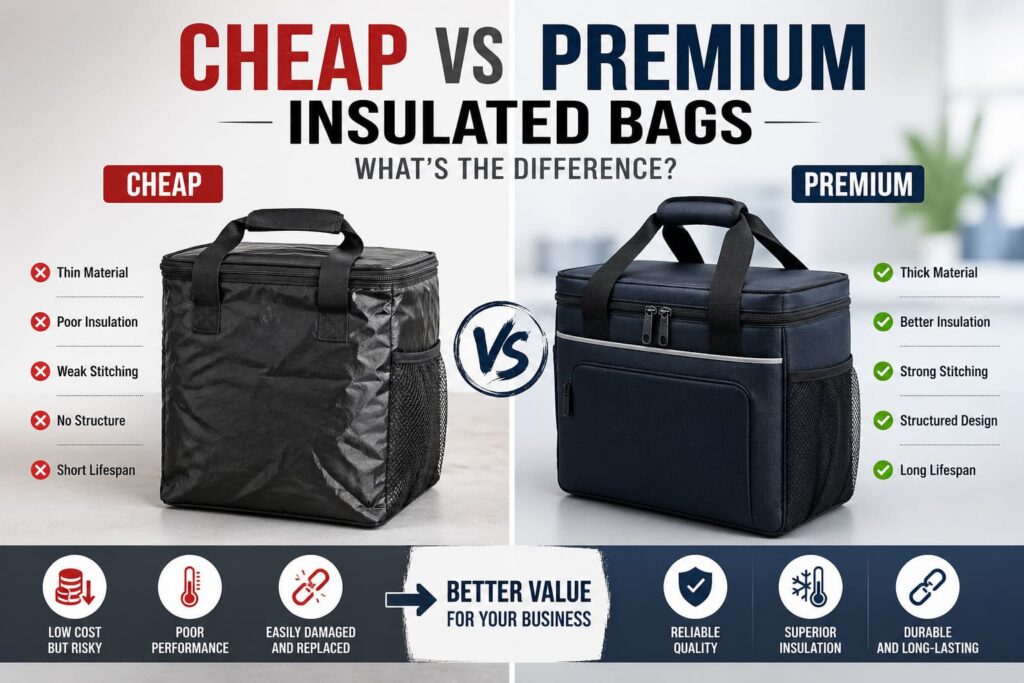
As an insulated bag manufacturer, I often see customers get confused by the wide price range of my products. "Why is this bag three times the price of that one?" they ask. Choosing the wrong one can lead to spoiled food or a broken bag, so I want to pull back the curtain and show you what really separates a budget-friendly bag from a premium one. It's the key to making the right choice.
Premium insulated bags offer superior insulation, durable materials, and robust construction for better performance and long-term use. The more common, cheaper bags are designed for basic, short-term needs—and they are perfectly fine for that—but they often lack the durability and leak resistance needed for heavy loads or repeated use.
The price tag only tells you part of the story. To really know which bag is right for you, we need to look closer at what goes into making them in my factory. Let's break down the details so you can see exactly where your money goes and make a choice that truly fits your needs, preventing any future disasters.
Are the materials in insulated bags really that different?
I get this question a lot: "Don't all insulated bags use the same stuff inside?" The simple answer is no. The wrong material can lead to leaks, tears, and food that doesn't stay at the right temperature for long. Let's look at the specific materials that separate a budget bag from a premium one.
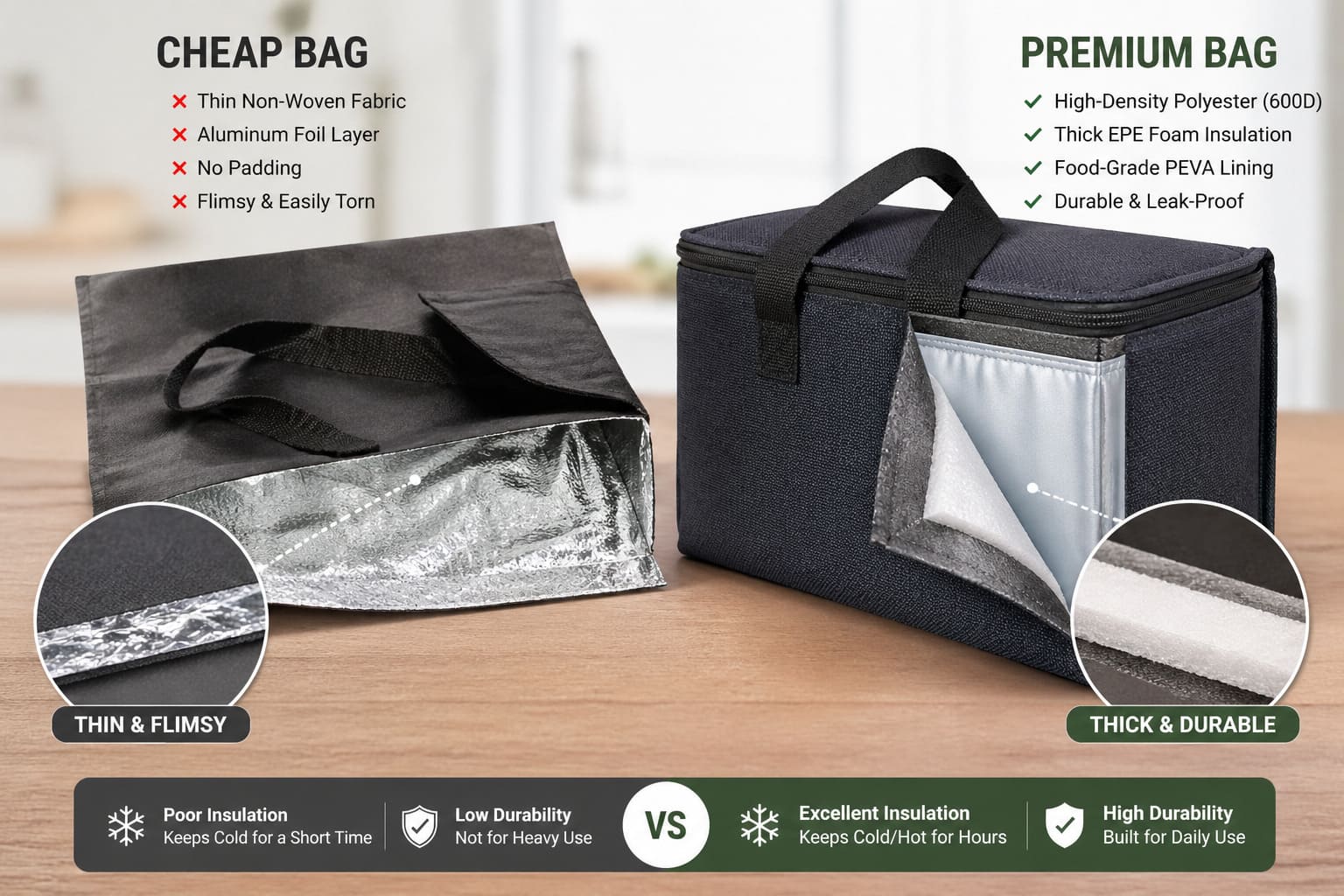
Yes, the materials we use vary significantly. For our premium bags, we use durable outer fabrics like high-density polyester, thick EPE foam for insulation, and food-grade, waterproof liners1. For our more common, budget-friendly bags, we typically use thinner non-woven fabric, a layer of aluminum foil, and less robust linings that are prone to tearing with heavy use.
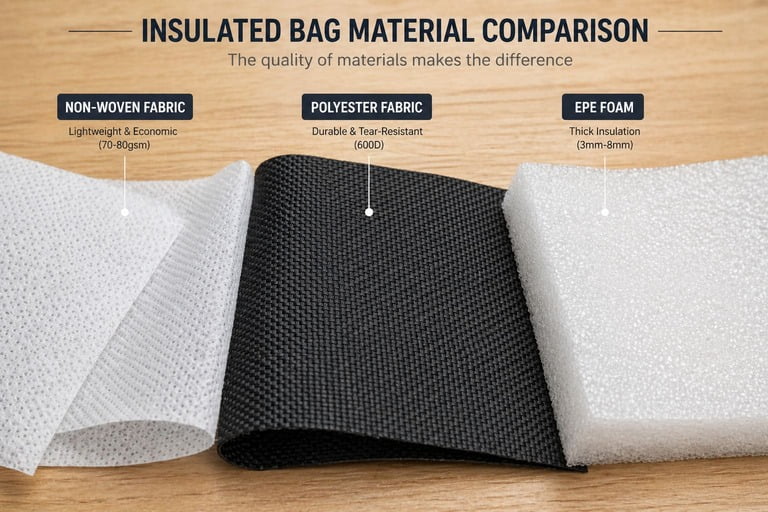
When we build an insulated bag, we're working with three key layers: the outer shell, the insulation core, and the inner lining. Each layer plays a critical role, and the quality of the materials we select for each is the biggest factor separating a cheap bag from a premium one.
Outer Shell Showdown
The outer fabric is the bag's first line of defense. In most budget-friendly bags, we use a thin, non-woven polypropylene fabric2, usually around 70-80 grams per square meter (gsm)3. It’s cost-effective for promotions but not very durable and can tear easily under stress. For our premium bags, we use much tougher materials like 600D polyester, nylon, or canvas4. These fabrics are woven for strength, resist tearing and abrasion, and often have a water-resistant coating5 to protect the contents.
The Insulation Core
This is the heart of the bag. A cheap bag might just have a thin layer of aluminum foil laminated onto the non-woven fabric6. It provides a reflective barrier but offers very little true insulation. A premium bag will have a dedicated insulation layer, typically made from 3mm to 8mm thick EPE (Expanded Polyethylene) foam7, which we sometimes call pearl cotton. This dense foam traps air, creating a powerful thermal barrier8 that can keep food hot or cold for hours, not just minutes.
The Inner Lining
The lining needs to be durable, safe, and easy to clean. In many cheap bags, the exposed aluminum foil acts as the lining, which can easily get punctured. Our premium bags feature a dedicated, seamless inner lining made from food-grade materials like PEVA9 or a reinforced, laminated foil. This makes them 100% leak-proof and easy to wipe clean, ensuring the bag stays hygienic.
| Feature | Cheap Insulated Bag | Premium Insulated Bag |
|---|---|---|
| Outer Fabric | Thin Non-Woven (70-80gsm) | High-Density Polyester (600D), Nylon, Canvas |
| Insulation | Thin Aluminum Foil Layer | Thick EPE Foam / Pearl Cotton (3-8mm) |
| Inner Lining | Exposed Foil or Thin Plastic | Leak-proof, Food-Grade PEVA or Reinforced Foil |
| Durability | Low; for temporary or light use | High; withstands regular, heavy use |
Does construction quality actually affect performance?
You might think a bag is just a bag, right? But I’ve seen firsthand what happens when construction fails. Imagine the handle snapping off a bag full of groceries in the middle of a busy street. Construction quality is the critical, unseen factor that defines a bag's reliability.
Absolutely. For our premium bags, we use reinforced stitching, like cross-stitching on handles, sturdy zippers, and strong, comfortable straps. Cheaper bags often use simple heat-sealing or single stitching that can fail under stress, with flimsy zippers and handles that can easily break.
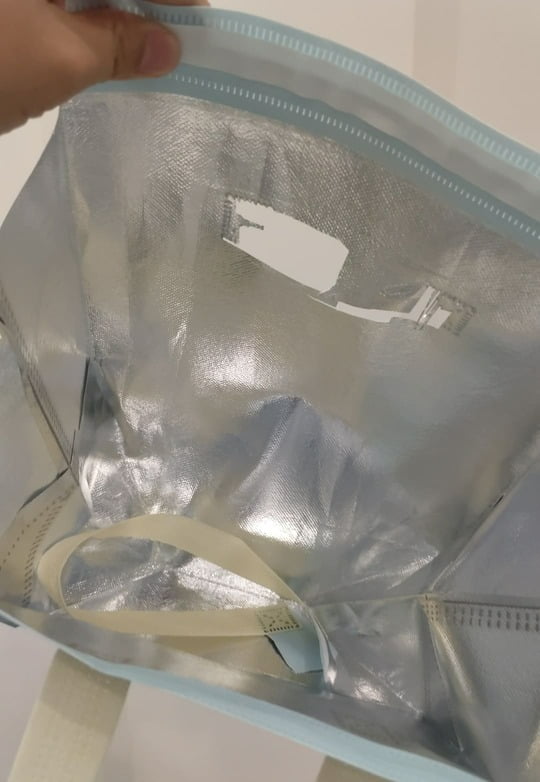
A bag is only as strong as its weakest point. Even if a bag uses decent materials, poor construction can make it useless. This is where we see a huge difference between a bag made for a single-use promotion and one designed to be a reliable daily carrier.
The Handle Test
Look at how the handles are attached. On many inexpensive bags, the handles are simply an extension of the bag's body, held together by ultrasonic heat-welding10. This is fast and cheap to produce, but it creates a weak point. For our premium bags, we use separate webbing straps that are sewn onto the bag's body with reinforced stitching, often in an "X" pattern11, to distribute the load and prevent tearing.
Zippers and Seams
A cheap, flimsy zipper is a common point of failure. The seams on budget bags are often heat-pressed instead of sewn. While this is a quick manufacturing method, these seams can split open. Our premium bags use higher-quality, smooth-gliding zippers and properly stitched seams, sometimes reinforced with piping, which helps the bag hold its shape and adds durability.
A Lesson from a Customer
Hot-press bags are great for most promotional uses—they're affordable and get the job done. The problem arises when clients try to cut costs on an already budget-friendly product. I once had a customer order a large batch of hot-press bags made from 105gsm material, which is a composite of 55gsm non-woven fabric laminated with a 50gsm aluminum foil. To save a few cents, they asked, "Can we make it without the aluminum foil?"
I explained that the cost difference was tiny, but that 50gsm foil layer does more than insulate—it provides crucial structural strength and rigidity to the thin fabric. They insisted. Later, I got an angry call. The bags, now made of only flimsy 55gsm fabric, were tearing, food was spilling, and their promotional event was a mess. That tiny saving cost them far more in the long run. It's a powerful reminder that while a simple bag is often sufficient, stripping it of its essential components is a recipe for disaster.
Why do some bags cost so much more to make and ship?
Have you ever seen two similar-looking bags with vastly different prices? From my factory's perspective, the answer lies in hidden costs that consumers never see—specifically, manufacturing and logistics.
The price reflects complexity and logistics. Our premium, sewn bags with thick pearl cotton insulation require manual labor, which is expensive. They are also bulky, meaning fewer units fit into a shipping carton, increasing freight costs per bag12. In contrast, our cheaper, machine-made bags are produced quickly and pack flat, keeping these costs low.
The journey from raw material to the bag in your hand involves several steps, and each adds to the cost. The two biggest hidden factors are the manufacturing method and the logistics of getting the bags from my factory to you.
Machine-Made vs. Hand-Sewn
Most of the simple, flat non-woven insulated bags you see are made entirely by machine. In my factory, ultrasonic welding machines can produce thousands of these bags an hour. This process is incredibly efficient and keeps labor costs down. However, our premium bags with thick pearl cotton insulation, multiple compartments, or complex shapes cannot be made this way. They require skilled workers to manually sew each piece together. This process is much slower and labor-intensive, which directly translates to a higher cost per bag.
The Logistics Puzzle
Here's something most people don't think about: shipping. A flat, machine-made bag is easy to pack. We can press them together and fit hundreds into a single carton. But a premium bag with thick EPE foam is bulky. It can't be compressed without damaging the foam's insulating properties. This means we can only fit a fraction of these bags into the same size carton, driving up both packaging and shipping costs for each individual bag. This "hidden" logistical cost is a major reason for the price difference.
| Factor | Cheap (Machine-Made) Bag | Premium (Sewn) Bag |
|---|---|---|
| Labor Cost | Low (Automated) | High (Manual Sewing) |
| Production Speed | Very High | Slower |
| Packaging Density | High (Packs Flat) | Low (Bulky) |
| Shipping Cost/Unit | Low | High |
Conclusion
Ultimately, choosing between a cheap and premium insulated bag isn't just about price—it's about purpose. A simple, machine-made bag is perfectly fine for a one-off event or a quick trip to the store. But for reliability, better performance, and long-term use, investing in a quality, well-constructed bag always pays off. My goal is to help you find the right tool for the job.
A neutral materials source can substantiate the relevant properties of polyester, EPE foam, and PEVA/food-contact liners. ↩
A materials or academic source can confirm the composition, common applications, and typical use of non-woven polypropylene in bags. ↩
A textile or packaging reference can support how GSM is used to describe non-woven fabric weight and whether 70–80 gsm is considered lightweight for bags. ↩
A textile engineering or educational source can explain denier and compare durability-related properties of woven polyester, nylon, and canvas. ↩
A neutral textile source can verify that coatings or finishes are used to improve water resistance in fabrics. ↩
A heat-transfer or building-insulation source can support that aluminum foil primarily reduces radiant heat transfer when used as a reflective barrier. ↩
A materials datasheet or academic source can verify that EPE foam is used for insulation and has low thermal conductivity due to its cellular structure. ↩
A physics, engineering, or materials source can explain how air-filled foam cells reduce conductive and convective heat transfer. ↩
A government or regulatory source can show whether EVA/PEVA-type polymers are permitted or commonly assessed for food-contact applications. ↩
A technical or university source can confirm that ultrasonic welding is used to bond thermoplastic non-woven fabrics such as polypropylene. ↩
A textile engineering or sewing-strength reference can support that reinforced box/X stitching is used to strengthen strap attachments. ↩
A postal, carrier, or logistics authority source can explain dimensional or volumetric weight and why bulky goods can cost more per unit to ship. ↩