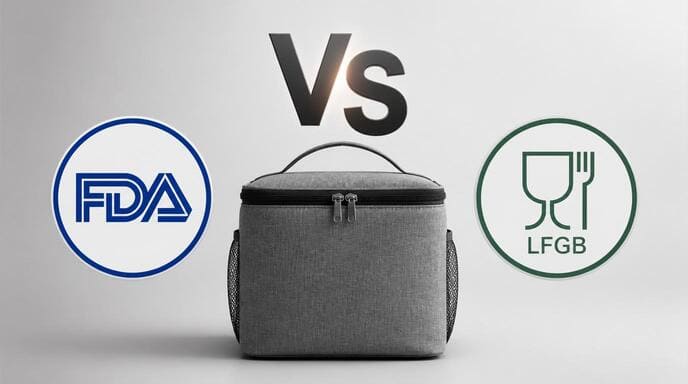
Choosing the wrong food-contact standard can lead to shipment delays, repeated laboratory testing, or rejected products. Many buyers assume FDA and LFGB evaluate how well a cooler bag keeps food cold. In reality, both standards focus on food-contact safety, not insulation performance1. Understanding the difference before production helps reduce compliance risks and simplifies supplier approval.
FDA and LFGB are two of the most widely recognized food-contact regulations for cooler bags. FDA compliance is commonly required for products sold in the U.S.2, while LFGB is frequently requested by European retailers because it generally applies broader food-contact testing. Neither standard measures insulation, cooling duration, or durability. Instead, they assess whether food-contact materials are safe for consumers.
Whether sourcing insulated lunch bags, grocery cooler bags, meal delivery bags, or promotional cooler bags, understanding these regulations helps buyers avoid unnecessary testing, communicate more effectively with suppliers, and ensure products meet destination-market requirements.
What Do FDA and LFGB Actually Mean for Cooler Bags?
Many suppliers advertise products as "FDA compliant" or "LFGB approved." These claims are common, but they are also one of the biggest sources of confusion during sourcing.
Neither FDA nor LFGB evaluates cooling performance, zipper durability, stitching quality, or insulation efficiency. Their purpose is to ensure that materials which contact food do not release harmful substances during normal use.
A cooler bag can provide excellent thermal performance yet fail food-contact testing if unsuitable materials are used. Likewise, a fully compliant lining does not guarantee better insulation or durability.
For buyers, separating food-contact compliance from product performance is essential. Performance should be verified through product specifications, thermal testing, and factory quality control, while FDA and LFGB verify material safety.
What Does FDA Compliance Mean for Cooler Bags?
When discussing cooler bags for the U.S. market, FDA compliance usually refers to the food-contact materials, not the finished bag itself.
The U.S. Food and Drug Administration regulates food-contact substances used in materials such as plastic films, coatings, adhesives, and other components that may contact food.
Common food-contact materials used in insulated cooler bags include:
- PE film
- PP film
- CPP film
- Food-grade EVA
- Laminated food-contact films
- Food-grade adhesive systems
These materials may directly or indirectly contact unpackaged food, making their safety an important part of regulatory compliance.
FDA Regulations Focus on Food-Contact Materials
FDA food-contact requirements are primarily established under Title 21 of the Code of Federal Regulations (21 CFR)3.
Rather than certifying an entire cooler bag, FDA regulations require each food-contact material to be suitable for its intended use. Manufacturers are responsible for selecting compliant materials before products enter the market4.
As a result, suppliers usually provide third-party laboratory reports instead of an official FDA certificate.
How FDA Migration Testing Works
One of the key concepts in FDA regulations is chemical migration.
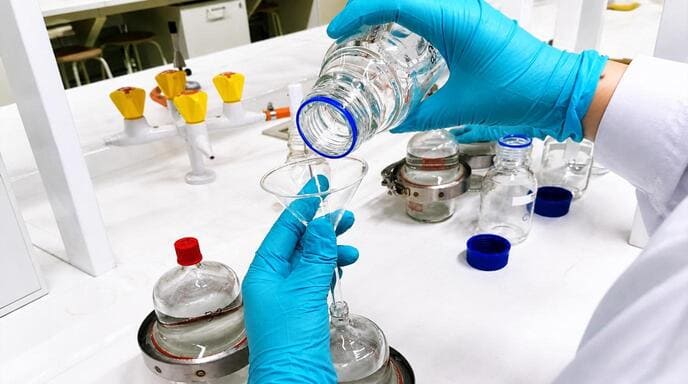
Migration refers to chemicals transferring from packaging materials into food5. Laboratory testing evaluates whether migration remains within acceptable safety limits under expected conditions of use.
Testing conditions vary according to actual applications. Different food simulants, temperatures, and contact times are selected to represent refrigerated foods, frozen foods, room-temperature storage, fatty foods, acidic foods, or dry foods6. This provides a practical evaluation of how materials behave during normal use.
Why Material Formulation Matters
FDA compliance depends on the entire material formulation, not simply the base plastic7.
Besides the polymer itself, laboratories may evaluate additives, color masterbatch, stabilizers, coatings, printing inks located near food-contact surfaces, and adhesive systems used in laminated structures.
Even a small formulation change may alter migration performance. Therefore, buyers should confirm that laboratory reports match the materials currently used in production rather than relying on outdated reports.
What Does LFGB Require for Cooler Bags?
Many European retailers request LFGB reports even when FDA reports are already available because LFGB generally applies more comprehensive food-contact testing.
LFGB stands for Lebensmittel-, Bedarfsgegenstände- und Futtermittelgesetzbuch, Germany's Food and Feed Code8. Although it is German legislation, it is widely recognized throughout Europe for evaluating food-contact materials.
Like FDA, LFGB focuses on preventing harmful chemical migration from packaging materials into food. However, it often includes additional assessments beyond standard FDA testing.
Overall Migration and Specific Migration
LFGB commonly evaluates both:
- Overall migration, which measures the total amount of substances transferred into food simulants.
- Specific migration, which measures individual regulated chemicals to ensure they remain below legal limits.
Testing conditions are selected according to the intended use of the material, providing a realistic assessment of food-contact safety.
Because migration depends on the complete laminate, laboratories generally evaluate the finished food-contact structure instead of testing each raw material separately9.
Broader Assessment of Chemical Safety
Depending on the material, LFGB testing may also assess:
- Heavy metals
- Primary aromatic amines (PAAs)
- Residual monomers
- Plasticizers
- Other restricted substances
This broader assessment is one reason many European retailers regard LFGB as an important supplier qualification requirement.
Sensory Testing Is a Major Difference
One of LFGB's most distinctive features is sensory testing.
Besides verifying chemical safety, laboratories assess whether food-contact materials affect the odor or taste of food10.
A material may pass migration testing but still fail LFGB if it leaves an unpleasant smell or changes food flavor after contact. This additional evaluation reflects Europe's strong focus on both food safety and consumer experience.
Why Do Many European Retailers Prefer LFGB?
Many suppliers can provide FDA food-contact reports, yet European retailers frequently request LFGB documentation because it generally applies a broader testing approach.
LFGB commonly combines migration testing with sensory evaluation, helping verify not only chemical safety but also whether materials affect the odor or taste of food.
LFGB reports are also widely recognized by European importers, retailers, and testing laboratories, making supplier qualification more efficient.
Although many food-contact materials can be designed to satisfy both FDA and LFGB requirements, compliance with one standard does not automatically demonstrate compliance with the other11. Products intended for both the U.S. and European markets are normally evaluated separately.
FDA vs. LFGB Comparison
| Item | FDA | LFGB |
|---|---|---|
| Primary market | United States | Germany and widely accepted across Europe |
| Main purpose | Food-contact safety | Food-contact safety |
| Legal basis | Title 21 CFR | German Food and Feed Code (LFGB) |
| Migration testing | Required where applicable | Generally more comprehensive |
| Overall migration | Depends on material | Commonly evaluated |
| Specific migration | Depends on material | Frequently evaluated |
| Odor and taste testing | Generally not required | Commonly required |
| Finished product certification | No | No |
| Typical supplier document | FDA food-contact test report | LFGB laboratory report / Declaration of Compliance (DoC) |
Which Parts of a Cooler Bag Require FDA or LFGB Testing?
Food-contact regulations do not apply equally to every component of a cooler bag. The primary focus is on materials that directly contact food or could transfer substances to food during normal use.
Inner Lining
The inner lining is usually the most important food-contact layer because it is closest to unpackaged food.
Common lining materials include:
- PE film
- CPP film
- Food-grade EVA
- Laminated food-contact films
These materials are commonly evaluated under FDA or LFGB requirements.
Laminated Structures
Most insulated cooler bags use a multilayer laminated structure instead of a single material.
A typical construction may include:
- Food-contact plastic film
- Aluminum foil
- Food-grade adhesive
- EPE foam insulation
Although the plastic film is usually the direct food-contact surface, migration performance depends on the entire laminate. For this reason, laboratories often test the complete laminated structure rather than each individual layer.
Adhesive Systems
Adhesives are hidden inside the laminate but still play an important role in food-contact safety.
Unsuitable adhesive formulations may affect migration performance, so food-grade adhesive systems are often included in compliance evaluations.
Insulation Foam
Insulation materials such as EPE foam, XPE foam, or PE foam primarily provide thermal insulation rather than direct food contact.
These layers are generally not evaluated under FDA or LFGB unless they are intended to contact unpackaged food directly.
Outer Fabric
Outer materials—including RPET, non-woven polypropylene, polyester, Oxford fabric, or canvas—normally do not contact food and therefore are usually outside the scope of FDA and LFGB food-contact regulations.
However, depending on the destination market, these materials may still need to comply with environmental or chemical regulations such as REACH.
What Compliance Testing Is Commonly Required for Exporting Cooler Bags?
Required documentation varies by destination market. Confirming customer requirements before production helps avoid repeated testing and shipment delays.
| Market | Common Compliance Requirements |
|---|---|
| United States | FDA food-contact laboratory reports for applicable materials |
| European Union | LFGB reports (when requested), REACH compliance, Declaration of Compliance (DoC) where applicable |
| Germany | LFGB laboratory reports are frequently requested by retailers and food brands |
| United Kingdom | UK food-contact regulations plus customer-specific compliance requirements |
| Large retailers & global brands | Food-contact reports, factory audits, material specifications, quality management certifications, and traceability documentation |
Food-contact compliance is only one part of supplier qualification. Many international retailers also evaluate manufacturing capability, quality management systems, production consistency, and traceability before approving a supplier.
What Documents Should You Request From a Cooler Bag Supplier?
Compliance claims alone are not enough. Buyers should review supporting documents to confirm that laboratory testing matches the actual production materials.
A reliable supplier should normally provide recent laboratory reports that clearly identify:
- Tested materials
- Applicable regulations
- Testing laboratory
- Product description
- Testing date
The reports should correspond to the materials currently used in mass production rather than older formulations.
For European projects, buyers often request a Declaration of Compliance (DoC). This manufacturer-issued document states that the supplied materials comply with the applicable food-contact legislation based on supporting technical documentation.
Although REACH is not a food-contact regulation, it is frequently requested for products sold in Europe because it helps verify that restricted chemicals, including Substances of Very High Concern (SVHCs), remain within regulatory limits.
Many buyers also request factory certifications such as:
- ISO 9001
- ISO 14001
- BSCI
- GRS (for recycled materials)
These certifications do not replace FDA or LFGB testing, but they demonstrate that the manufacturer operates under recognized quality, environmental, or social responsibility management systems.
Finally, buyers should confirm that laboratory reports remain valid whenever there is a change in raw material suppliers, adhesive systems, coatings, or production formulations. Even small material changes may require new testing.
Conclusion
FDA and LFGB are among the most important food-contact regulations for cooler bags, but they serve a different purpose from product performance testing. Neither standard measures insulation efficiency, cooling duration, waterproof performance, or overall product quality.
FDA compliance is commonly expected for products entering the U.S. market, while LFGB is frequently preferred by European retailers because it generally includes broader migration assessment and sensory evaluation.
Before mass production, buyers should verify that laboratory reports, material specifications, and supporting compliance documents accurately match the materials used in manufacturing. Reviewing these documents early helps reduce compliance risks, avoid costly shipment delays, and streamline customer approval.
Frequently Asked Questions
Does the FDA certify finished cooler bags?
No. The FDA does not certify finished cooler bags. Compliance is demonstrated by using food-contact materials that satisfy the applicable FDA regulations. Suppliers normally provide accredited third-party laboratory reports rather than an official FDA certificate.
Is LFGB stricter than FDA?
In many situations, yes. LFGB generally includes broader migration assessments and sensory testing for odor and taste, making it one of the preferred food-contact standards for many European retailers.
If a cooler bag passes LFGB, will it automatically comply with FDA?
No. FDA and LFGB are based on different legal frameworks and testing methods. Although many materials can meet both standards, compliance with one does not automatically guarantee compliance with the other.
Does the aluminum foil layer require separate testing?
Usually not. Laboratories commonly evaluate the complete laminated food-contact structure because migration performance depends on the interaction between the plastic films, adhesive systems, coatings, and aluminum foil layer.
Do FDA or LFGB measure insulation performance?
No. Neither regulation evaluates cooling duration, thermal insulation efficiency, foam density, waterproof performance, or product durability. These characteristics should be verified through separate performance testing and quality control.
When should food-contact materials be tested again?
Retesting is generally recommended whenever there are significant changes to raw material suppliers, material formulations, adhesive systems, coatings, manufacturing processes, or laminated structures, as these changes may affect migration performance.
Can one cooler bag comply with both FDA and LFGB?
Yes. Many manufacturers develop food-contact materials that satisfy both FDA and LFGB requirements. However, each regulation follows its own legal framework and testing methodology, so compliance normally needs to be verified separately.
"How FDA Regulates Substances that Come into Contact with Food", https://www.fda.gov/food/food-packaging-other-substances-come-contact-food-information-consumers/understanding-how-fda-regulates-substances-come-contact-food. FDA and German/EU food-contact rules address the safety of substances and materials intended to contact food, including limits on transfer to food, rather than measuring thermal insulation or product durability. Evidence role: definition; source type: government. Supports: FDA and LFGB concern food-contact safety rather than insulation performance.. Scope note: The sources define the regulatory scope; they do not specifically discuss cooler bags as a product category. ↩
"Food Packaging & Other Substances that Come in Contact with Food", https://www.fda.gov/food/food-ingredients-packaging/food-packaging-other-substances-come-contact-food-information-consumers. U.S. FDA materials explain that food-contact substances used in articles for the U.S. food supply must be authorized or otherwise compliant with applicable FDA requirements. Evidence role: general_support; source type: government. Supports: FDA compliance is commonly required for food-contact cooler bag materials sold in the U.S.. Scope note: This supports the regulatory expectation for food-contact materials in the U.S.; it does not prove that every buyer contract requires FDA reports. ↩
"21 CFR Part 174 -- Indirect Food Additives: General - eCFR", https://www.ecfr.gov/current/title-21/chapter-I/subchapter-B/part-174. FDA guidance and the Electronic Code of Federal Regulations place many U.S. food-contact material requirements in Title 21 CFR, including provisions for indirect food additives and food-contact substances. Evidence role: historical_context; source type: government. Supports: FDA food-contact requirements are primarily established under Title 21 CFR.. Scope note: Title 21 CFR is central but not the only legal authority; the FD&C Act and FDA notifications also form part of the compliance framework. ↩
"Regulatory Status of Components of a Food Contact Material - FDA", https://www.fda.gov/food/packaging-food-contact-substances-fcs/determining-regulatory-status-components-food-contact-material. FDA materials on food-contact substances describe compliance as a responsibility of manufacturers and suppliers, who must ensure that substances are authorized for their intended conditions of use before marketing. Evidence role: general_support; source type: government. Supports: Manufacturers are responsible for ensuring food-contact materials are suitable and compliant before products enter the market.. Scope note: FDA sources usually address food-contact substances and articles broadly, not cooler bags specifically. ↩
"Risk assessment of food contact materials - PMC - NIH", https://pmc.ncbi.nlm.nih.gov/articles/PMC9749432/. Food-contact material guidance from regulatory and scientific institutions defines migration as the transfer of chemical constituents from packaging or contact materials into food or food simulants. Evidence role: definition; source type: institution. Supports: Migration is the transfer of chemicals from packaging materials into food.. Scope note: Definitions may vary in wording across jurisdictions, but the transfer concept is consistent. ↩
"Chemistry Recommendations for Submissions of Food Contact ...", https://www.fda.gov/regulatory-information/search-fda-guidance-documents/guidance-industry-preparation-premarket-submissions-food-contact-substances-chemistry. EU and FDA food-contact testing frameworks use food simulants and prescribed time-temperature conditions to model intended uses such as aqueous, acidic, alcoholic, fatty, dry, refrigerated, or heated contact. Evidence role: mechanism; source type: government. Supports: Migration testing uses food simulants, temperatures, and contact times selected according to intended food-contact conditions.. Scope note: Exact simulants and conditions differ by material, jurisdiction, and intended use. ↩
"Regulatory Status of Components of a Food Contact Material - FDA", https://www.fda.gov/food/packaging-food-contact-substances-fcs/determining-regulatory-status-components-food-contact-material. FDA food-contact regulations and guidance evaluate food-contact substances according to their identity, composition, additives, and intended conditions of use, indicating that compliance depends on the full formulation rather than the base polymer alone. Evidence role: mechanism; source type: government. Supports: FDA compliance depends on the full material formulation, not only the base plastic.. Scope note: The source supports the formulation principle generally; specific testing requirements depend on the material and use scenario. ↩
"Lebensmittel- und Futtermittelgesetzbuch - Wikipedia", https://de.wikipedia.org/wiki/Lebensmittel-_und_Futtermittelgesetzbuch. German federal legal sources identify the LFGB as the Lebensmittel-, Bedarfsgegenstände- und Futtermittelgesetzbuch, the national Food and Feed Code governing food, feed, and consumer goods including food-contact articles. Evidence role: definition; source type: government. Supports: LFGB is Germany’s Food and Feed Code and its full German name is Lebensmittel-, Bedarfsgegenstände- und Futtermittelgesetzbuch.. ↩
"Chemistry Recommendations for Submissions of Food Contact ...", https://www.fda.gov/regulatory-information/search-fda-guidance-documents/guidance-industry-preparation-premarket-submissions-food-contact-substances-chemistry. Food-contact testing guidance recognizes that migration from multilayer materials depends on the final article structure, including layers and barriers, so compliance assessment may require testing or modeling of the finished multilayer material. Evidence role: mechanism; source type: government. Supports: Migration performance of multilayer laminates depends on the complete food-contact structure.. Scope note: The need to test the finished structure varies with material design, available declarations, functional barriers, and applicable regulation. ↩
"Risk Assessment of Food Contact Materials - PubMed", https://pubmed.ncbi.nlm.nih.gov/33294048/. German food-contact requirements and BfR-related testing practice include sensory assessment of whether consumer goods transfer odor or taste to food, reflecting LFGB provisions against unacceptable sensory impairment. Evidence role: mechanism; source type: government. Supports: LFGB testing may include sensory assessment of odor or taste transfer from food-contact materials.. Scope note: The precise sensory test method may depend on the material and laboratory standard applied. ↩
"Food Packaging & Other Substances that Come in Contact with Food", https://www.fda.gov/food/food-ingredients-packaging/food-packaging-other-substances-come-contact-food-information-consumers. FDA and German/EU food-contact systems use different legal bases, authorization mechanisms, test conditions, and limits, so evidence of compliance under one framework is not automatically evidence of compliance under the other. Evidence role: expert_consensus; source type: institution. Supports: FDA and LFGB compliance are not automatically interchangeable.. Scope note: This is a comparative regulatory inference; an individual material may meet both regimes if tested and documented for both. ↩