Are you throwing aluminum foil into the recycling bin but wondering whether it actually gets recycled? It is a common question for households, restaurants, and food packaging businesses that want to reduce waste.
Yes, pure aluminum foil can be recycled indefinitely without losing its quality1. However, because household foil is extremely thin and is often contaminated with food, much of it never enters the recycling stream2. In addition, many products that appear to contain aluminum foil—including some insulated bags—actually use composite materials that are much harder to recycle3.
Although aluminum foil looks simple, it is actually a highly engineered material with excellent barrier properties, corrosion resistance, and thermal reflectivity. Understanding these characteristics helps explain both why aluminum foil is so widely used and why recycling it can sometimes be more difficult than expected.
Why Is Aluminum Foil So Recyclable?
Aluminum is one of the few packaging materials that can be recycled repeatedly without a significant loss of quality. Unlike many plastics that gradually degrade during recycling, aluminum maintains its original chemical structure after melting.
Pure aluminum foil is highly recyclable because it can be melted, refined, and manufactured into new aluminum products almost indefinitely.
Most household aluminum foil is manufactured from aluminum with a purity of approximately 99% or higher4. Since aluminum is an elemental metal rather than a polymer, melting changes only its physical form—not its chemical composition. Once contaminants are removed during recycling, the recovered aluminum performs almost the same as newly produced aluminum.
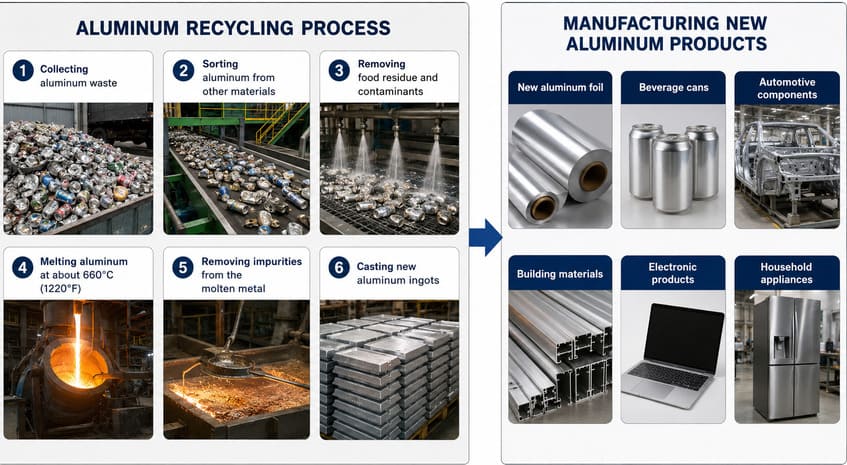
The recycling process generally includes:
- Collecting aluminum waste
- Sorting aluminum from other materials
- Removing food residue and contaminants
- Melting aluminum at approximately 660°C (1220°F)5
- Removing impurities from the molten metal
- Casting new aluminum ingots
- Manufacturing new aluminum products
The recycled aluminum can become:
- New aluminum foil
- Beverage cans
- Automotive components
- Building materials
- Electronic products
- Household appliances
Material Properties That Make Aluminum Foil Valuable
The popularity of aluminum foil is not only due to its recyclability. Its physical properties make it one of the most versatile packaging materials available.
Excellent Barrier Performance
One of aluminum foil's biggest advantages is that it forms an almost complete barrier against:
- Oxygen
- Moisture
- Water vapor
- Light
- Dust
- Bacteria
- Odors
Unlike many plastic films, pure aluminum foil has an extremely low oxygen transmission rate (OTR) and water vapor transmission rate (WVTR)6. This helps extend the shelf life of food, pharmaceuticals, and temperature-sensitive products.
Outstanding Thermal Reflectivity
Aluminum foil reflects most radiant heat because of its naturally low emissivity7.
Rather than absorbing heat radiation, the shiny surface reflects a large percentage of it. This is why aluminum foil is commonly used inside thermal packaging, building insulation, and Aluminum Foil Cooler Bag products to help reduce heat transfer.
It is important to note that aluminum foil primarily reflects radiant heat. By itself, it is not a thick insulating material. In insulated bags, the actual insulation usually comes from foam materials such as EPE, XPE, or PE foam, while the aluminum foil layer reflects thermal radiation and improves overall thermal performance.
Excellent Ductility
Aluminum is an extremely ductile metal.
Large aluminum sheets can be rolled into foil only 6–20 microns8 thick while still maintaining excellent barrier properties. Even at such a small thickness, the foil remains flexible enough to fold, wrap, and laminate with other materials.
Corrosion Resistance
When exposed to air, aluminum naturally forms a thin aluminum oxide layer on its surface9.
This invisible oxide film protects the metal from further corrosion, allowing aluminum foil to remain stable during normal food contact and long-term storage.
Environmental Benefits
Recycling aluminum provides enormous environmental benefits.
Compared with producing aluminum from bauxite ore, recycling requires approximately:
- 95% less energy10
- Significantly lower greenhouse gas emissions
- Less mining
- Less industrial waste
This is why aluminum is widely considered one of the most sustainable packaging materials available.
What Makes Aluminum Foil Difficult to Recycle in Practice?
Although aluminum itself is highly recyclable, recovering thin aluminum foil is much more challenging than recycling products like aluminum cans.
The biggest obstacles are the foil's thickness, contamination, and material structure.
Extremely Thin Material
Household aluminum foil is usually only 10–20 microns thick.
At this thickness, even a large sheet weighs very little.
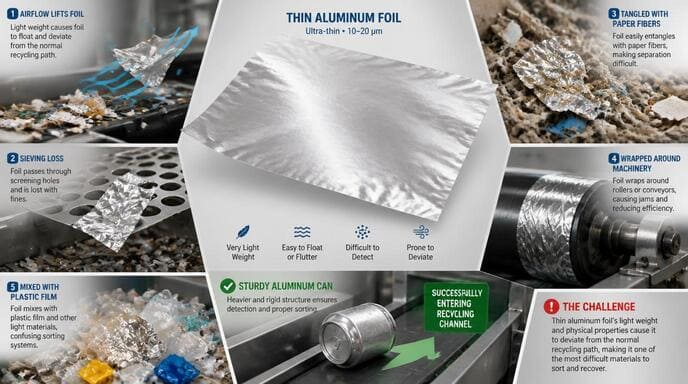
During mechanical sorting, lightweight foil can:
- Blow away under airflow
- Pass through screening equipment
- Become trapped in paper fibers
- Wrap around machinery
- Mix with plastic films
Unlike rigid aluminum cans, thin foil is much harder for sorting equipment to recover efficiently.
Food Contamination
Food contamination is another major problem.
Grease, cheese, sauces, cooking oils, and burnt food often remain attached to used foil.
Although aluminum itself does not absorb food, these residues contaminate the recycling stream and increase cleaning costs. Many recycling facilities reject heavily contaminated foil because processing it is not economically practical.
Composite Structures
Many products that appear to contain aluminum foil are not made entirely from aluminum.
Common examples include:
- Aluminum laminated with plastic
- Aluminum bonded to paper
- Multi-layer food packaging
- Metallized plastic films
Because these materials are permanently bonded together, separating each layer requires specialized equipment that many recycling facilities do not have.
Which Types of Aluminum Foil Are Easiest to Recycle?
Not every aluminum product has the same recycling rate.
Generally, thicker and cleaner aluminum products are much easier to recycle.
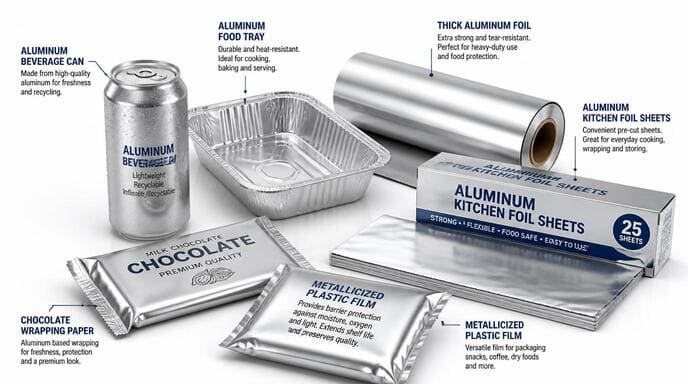
| Product | Typical Structure | Recycling Difficulty |
|---|---|---|
| Aluminum beverage cans | Pure aluminum | Easy |
| Aluminum food trays | Pure aluminum | Easy |
| Heavy-duty aluminum foil | Pure aluminum | Moderate to Easy |
| Household kitchen foil | Pure aluminum but very thin | Moderate |
| Chocolate wrappers | Often composite | Difficult |
| Metallized plastic film | Plastic with aluminum coating | Not recyclable as aluminum |
Rigid products such as aluminum trays and beverage cans contain significantly more aluminum by weight, making them much easier for eddy current separators11 and optical sorting systems to identify.
Kitchen foil, however, is often too thin to be efficiently recovered unless it is collected in larger pieces.
Products made from metallized films contain only an extremely thin aluminum coating measured in nanometers. Although they have a metallic appearance, the amount of aluminum is far too small to justify aluminum recycling.
Can the Aluminum Foil Inside Insulated Bags Be Recycled?
Many people assume the shiny silver lining inside an insulated bag is simply aluminum foil.
In reality, several different materials may be used, and they do not all have the same recycling characteristics.
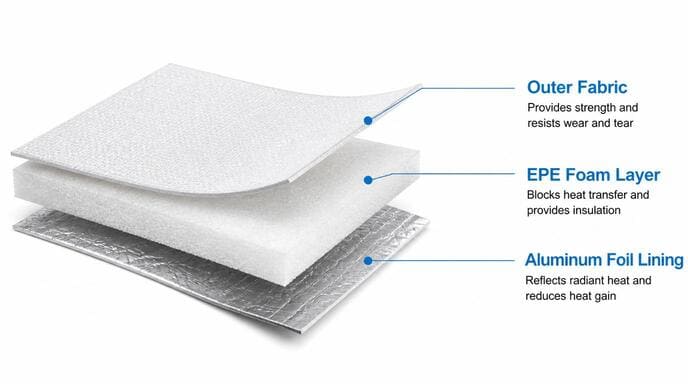
The reflective layer inside an Aluminum Foil Cooler Bag performs several important functions beyond simply giving the interior a metallic appearance.
Reflects Radiant Heat
The aluminum layer reflects a large portion of radiant heat, helping reduce heat exchange between the inside and outside of the bag.
This improves the overall thermal efficiency of the cooler bag.
Moisture Barrier
Aluminum foil has an extremely low water vapor transmission rate.
It helps prevent outside moisture from entering the insulation layer while reducing moisture loss from chilled or frozen foods.
Oxygen Barrier
Pure aluminum foil is almost completely impermeable to oxygen.
Reducing oxygen exposure helps slow oxidation, preserve food quality, and extend shelf life for many packaged products.
Hygienic Surface
The smooth aluminum surface is resistant to oil penetration and is easy to wipe clean after use.
This makes it suitable for food-contact applications when combined with appropriate food-safe materials.
Why Most Aluminum Foil Cooler Bags Cannot Be Recycled as Aluminum
Although the aluminum layer itself may be recyclable, the complete bag usually is not.
Most insulated bags are manufactured using multiple laminated materials, including:
- Aluminum foil
- EPE foam
- XPE foam
- PE foam
- PET film
- Non-woven fabric
- Oxford fabric
- Woven fabric
- Adhesives
These layers are permanently bonded together during manufacturing.
Separating them would require specialized industrial processes that are rarely available in municipal recycling systems.
Metallized Film Is Even More Common
Many economical insulated bags do not actually use pure aluminum foil.
Instead, manufacturers use metallized PET or OPP film.
During production, an extremely thin aluminum layer—only a few nanometers thick12—is vacuum deposited onto the plastic surface.
Although it looks almost identical to aluminum foil, it behaves like plastic during recycling because there is virtually no recoverable aluminum.
How Can Aluminum Foil Recycling Rates Be Improved?
Improving recycling rates requires efforts from manufacturers, recycling facilities, and consumers.
Manufacturers Can Improve Packaging Design
Packaging manufacturers can improve recyclability by:
- Reducing unnecessary multi-material laminates
- Using mono-material structures where practical
- Clearly identifying packaging materials
- Designing products that are easier to separate after use
As recycling technology continues to improve, design-for-recycling principles are becoming increasingly important.
Consumers Can Help
Consumers can also improve recycling success through simple habits.
Remove Excess Food
Scrape away food residue before disposal.
Lightly rinsing foil may improve recyclability if permitted by local recycling guidelines.
Crumple Small Pieces Together
Small sheets often fall through sorting equipment.
Compressing several clean pieces into one larger aluminum ball makes recovery much easier.
Separate Aluminum from Other Waste
Avoid wrapping aluminum tightly around paper, plastic, or food waste before disposal.
Keeping aluminum separate improves sorting efficiency.
Follow Local Recycling Rules
Recycling requirements vary significantly between municipalities.
Some recycling programs accept clean household foil.
Others only recycle aluminum cans and rigid aluminum packaging.
Checking local recycling guidelines is always the best approach.
FAQ
Can aluminum foil be recycled after cooking?
Yes, if it is relatively clean. Foil with small amounts of food residue can often be recycled after excess grease or food has been removed. Heavily contaminated foil may not be accepted.
Is aluminum foil infinitely recyclable?
Yes. Pure aluminum can be recycled repeatedly without losing its mechanical properties or quality.
Why is aluminum foil used inside cooler bags?
Aluminum foil provides excellent heat reflectivity, moisture resistance, oxygen barrier performance, light blocking, and corrosion resistance. These properties help an Aluminum Foil Cooler Bag improve temperature retention and food preservation.
Is the silver lining inside every Aluminum Foil Cooler Bag real aluminum?
No. Many cooler bags use metallized PET or OPP film instead of pure aluminum foil. Although the appearance is similar, these materials have different recycling characteristics.
Is metallized film the same as aluminum foil?
No. Metallized film is plastic coated with an extremely thin aluminum layer. It provides a reflective appearance but contains very little aluminum and is generally recycled as plastic rather than aluminum.
Why can't most insulated bags be recycled as aluminum?
Because the aluminum layer is permanently laminated with foam, fabric, plastic films, and adhesives. These materials cannot be economically separated in most recycling facilities.
Is aluminum foil biodegradable?
No. Aluminum is a metal and does not biodegrade. However, it can be recycled repeatedly, making recycling a much more sustainable disposal option.
Does thicker aluminum foil recycle more easily?
Generally, yes. Thicker aluminum products are easier for sorting equipment to detect and recover, while very thin household foil is more likely to be lost during the recycling process.
Conclusion
Pure aluminum foil is one of the most recyclable packaging materials available because it can be melted and reused indefinitely without losing quality. However, its extremely thin structure, food contamination, and widespread use in composite packaging often prevent it from being successfully recovered. Understanding the material properties of aluminum foil—including its excellent barrier performance, thermal reflectivity, corrosion resistance, and flexibility—also explains why it remains the preferred reflective layer in many Aluminum Foil Cooler Bag products, even though the complete bag itself is usually much more difficult to recycle.
"Recycling - Wikipedia", https://en.wikipedia.org/wiki/Recycling. A materials or recycling source should support that aluminum can be remelted and recycled repeatedly with little loss of intrinsic material quality, while noting that alloy composition and contamination can affect final product specifications. Evidence role: expert_consensus; source type: institution. Supports: Pure aluminum foil can be recycled indefinitely without losing its quality.. Scope note: This supports recyclability of aluminum as a material, not the actual recovery rate of household foil in municipal systems. ↩
"[PDF] A Growing Challenge to Reaching Florida's 75% Recycling Goal", https://floridadep.gov/system/files/Single-Stream-Recycling-Contam-Webinar_21Dec15-508.pdf. A municipal recycling or waste-management source should document that thin foil and contaminated foil are frequently not accepted or are lost during sorting, while noting that acceptance varies by local recycling program. Evidence role: general_support; source type: government. Supports: Because household foil is thin and often contaminated with food, much of it never enters the recycling stream.. Scope note: Evidence is likely program-specific and may not quantify “much” across all regions. ↩
"Plastic pollution is growing relentlessly as waste management and ...", https://www.oecd.org/en/about/news/press-releases/2022/02/plastic-pollution-is-growing-relentlessly-as-waste-management-and-recycling-fall-short.html. A packaging recycling source should explain that multilayer or composite packaging is more difficult to recycle because bonded layers of different materials are hard to separate mechanically or economically. Evidence role: mechanism; source type: institution. Supports: Products that appear to contain aluminum foil, including some insulated bags, may use composite materials that are much harder to recycle.. Scope note: This provides general support for composite packaging; it may not address every insulated bag design directly. ↩
"Aluminium foil - Wikipedia", https://en.wikipedia.org/wiki/Aluminium_foil. A technical specification or educational source should support that commercial household aluminum foil is commonly made from high-purity aluminum or aluminum alloys with aluminum content near or above 99%, while noting that exact composition varies by grade and manufacturer. Evidence role: definition; source type: education. Supports: Most household aluminum foil is manufactured from aluminum with a purity of approximately 99% or higher.. Scope note: The cited source may describe common foil grades rather than all household foil products globally. ↩
"Aluminum - the NIST WebBook", https://webbook.nist.gov/cgi/cbook.cgi?ID=C7429905&Mask=1F. A chemistry or reference source should verify that pure aluminum melts at approximately 660°C, supporting the stated melting temperature used in the recycling process. Evidence role: definition; source type: encyclopedia. Supports: Aluminum is melted at approximately 660°C (1220°F) during recycling.. Scope note: The melting point of aluminum alloys and contaminated scrap can vary slightly from pure aluminum. ↩
"[PDF] Comparing Optimum Barrier Variables of Aluminium and MPET Foil ...", https://repository.rit.edu/cgi/viewcontent.cgi?article=1043&context=japr. A packaging science source should support that intact aluminum foil has very low permeability to gases and water vapor compared with many polymer films, while noting that pinholes, seams, and laminates can affect real package barrier performance. Evidence role: mechanism; source type: paper. Supports: Pure aluminum foil has extremely low oxygen transmission rate and water vapor transmission rate.. Scope note: Barrier values depend on foil thickness, pinhole frequency, and package construction. ↩
"Radiant barrier - Wikipedia", https://en.wikipedia.org/wiki/Radiant_barrier. A building-science or heat-transfer source should support that polished aluminum has low emissivity and high reflectance for thermal radiation, explaining its use as a radiant barrier. Evidence role: mechanism; source type: government. Supports: Aluminum foil reflects most radiant heat because of its naturally low emissivity.. Scope note: Reflective performance depends on surface condition, oxidation, dust, and installation with an adjacent air space. ↩
"6 Micron 1235 Food Grade Aluminium Foil for Flexible Packaging ...", https://htmmalufoil.en.made-in-china.com/product/TteYAMpCIzRU/China-6-Micron-1235-Food-Grade-Aluminium-Foil-for-Flexible-Packaging-and-Lamination.html. A packaging or standards source should support that aluminum foil used for household and packaging applications is commonly produced in micrometer-scale gauges, including ranges around 6–20 microns, while noting that heavy-duty and industrial foils may be thicker. Evidence role: definition; source type: institution. Supports: Large aluminum sheets can be rolled into foil only 6–20 microns thick while maintaining useful properties.. Scope note: Gauge ranges vary by market, application, and product category. ↩
"Aluminium oxide - Wikipedia", https://en.wikipedia.org/wiki/Aluminium_oxide. A chemistry or corrosion source should support that aluminum passivates by forming a thin adherent aluminum oxide film in air, which protects the underlying metal from further oxidation under many normal conditions. Evidence role: mechanism; source type: education. Supports: When exposed to air, aluminum naturally forms a thin aluminum oxide layer on its surface.. Scope note: Protection can be compromised by certain chemicals, salts, or extreme pH conditions. ↩
"Recycling and energy - U.S. Energy Information Administration (EIA)", https://www.eia.gov/energyexplained/energy-and-the-environment/recycling-and-energy.php. An institutional or government source should support that recycling aluminum uses about 95% less energy than producing primary aluminum from bauxite ore, while noting that exact savings depend on collection, transport, and remelting processes. Evidence role: statistic; source type: government. Supports: Recycling aluminum requires approximately 95% less energy than producing aluminum from bauxite ore.. Scope note: The 95% figure is an approximate industry-wide comparison rather than a calculation for a specific recycling facility or product. ↩
"How to separate non-ferrous metal with eddy current separators", https://www.sgmmagnetics.com/en/how-to-separate-non-ferrous-metals-with-eddy-current-separators/. A recycling technology source should support that eddy current separators are commonly used to separate non-ferrous metals such as aluminum from mixed waste streams, providing context for why larger or denser aluminum items are easier to recover. Evidence role: mechanism; source type: research. Supports: Rigid aluminum products are easier for eddy current separators and optical sorting systems to identify than thin kitchen foil.. Scope note: The source may explain the separator mechanism generally, not provide direct recovery rates for foil versus cans. ↩
"VACUUM METALIZED SURFACES The process - Academia.edu", https://www.academia.edu/34366354/VACUUM_METALIZED_SURFACES_The_process. A packaging-materials source should support that metallized PET or OPP films are produced by vacuum-depositing a very thin aluminum layer, typically on the nanometer scale, while noting that exact coating thickness varies by product and performance requirement. Evidence role: definition; source type: paper. Supports: Metallized PET or OPP film contains an aluminum layer only a few nanometers thick.. Scope note: This supports typical metallized-film construction, not the precise thickness of every insulated bag lining. ↩