
Many buyers focus on material, print, and price, overlooking a crucial detail: the shopping bag size. This oversight can lead to products not fitting, increased costs from oversized bags, and damaged goods due to inadequate capacity. It directly impacts your brand's presentation. Selecting the correct shopping bag dimensions is paramount for effective packaging, efficient production, and a superior customer experience.
Choosing the right shopping bag sizes involves considering product dimensions, weight, intended use, and material strength. While standard dimensions suit many needs, custom sizing ensures optimal fit, cost-efficiency, robust carrying capacity, and enhanced brand appeal, making it a critical decision for any procurement.
Understanding the interplay between your product and its packaging is key. Let's dive into the factors that influence your selection and explore the world of common dimensions and material recommendations to ensure your next order is a perfect fit.
📌 Quick Overview: Choosing the right shopping bag size requires balancing product fit, weight capacity, material strength, and cost efficiency. Standard sizes work for many applications, but custom dimensions provide better protection, lower waste, and a more professional brand presentation.
What Factors Determine the Best Shopping Bag Sizes?
Choosing the right dimensions isn't just about guesswork. Several critical factors directly influence the ideal size for your custom shopping bags. Let's break down what you need to consider before finalizing your order.
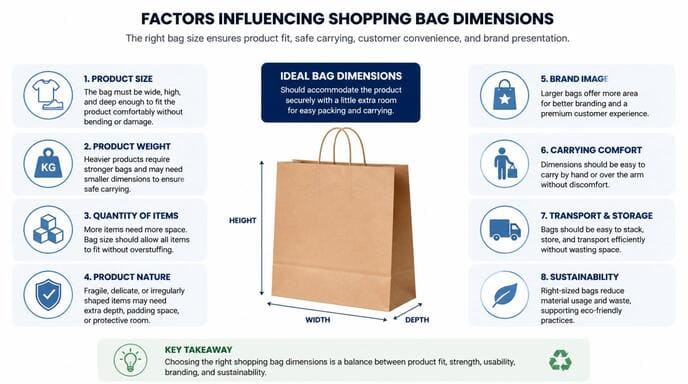
The ideal shopping bag dimensions are determined by your product's exact measurements (length, width, height, thickness), its estimated weight, and the specific application or usage scenario. These factors dictate the necessary capacity, carrying strength, and overall practicality of the bag.
Product Dimensions: The Foundation of Fit
When selecting shopping bag sizes, the most direct influence is the size of the item you'll be placing inside. It's essential to measure your product accurately. You'll need to record its length, width, height, and any significant thickness. A good rule of thumb for the bag's internal dimensions is to add a comfortable buffer to your product's measurements. For most standard retail items, adding 2-5 cm to each dimension is usually sufficient. However, for bulkier items like clothing, especially if multiple pieces are involved, you might need to add 5-10 cm. For delicate gifts that require tissue paper or other fillers, even more space should be allocated to ensure the item is protected and presented beautifully within the bag. I've seen many clients underestimate the space needed for soft goods like t-shirts, leading to bags that are too snug.
Product Weight: Dictating Durability and Design
Beyond just fitting the item, the shopping bag size must also accommodate its weight. A bag that's large enough for a bulky but light item might not have the structural integrity for a smaller, heavier object. While larger bags often imply greater capacity, they don't automatically guarantee increased load-bearing strength. This depends heavily on the material's GSM (Grams per Square Meter), the bag's construction (like reinforced seams or bottom boards), and the handle design. For instance, a bag intended for items weighing between 0.5 to 2 kg might be a small shopping bag, while one designed for 5-10 kg would require a larger, more robust construction, possibly with stronger handles. Overlooking weight can lead to premature bag failure and a poor customer experience. One time, a client ordered bags that looked large but were made with a lightweight material. They failed under the weight of books – a classic case of size not equaling strength.
Application and Usage Scenarios: Tailoring the Size
The context in which the bag will be used significantly impacts its ideal dimensions. A bag designed for a quick trip to the supermarket will differ greatly from one intended for a luxury boutique or a promotional event.
- Supermarket shopping bags need to be spacious enough for groceries, often requiring durable construction.
- Apparel packaging bags for boutiques might prioritize aesthetics and size suitable for a single garment or a few items.
- Gift bags can vary widely, from small, elegant designs for jewelry to larger ones for hampers.
- Promotional bags used at trade shows need to hold brochures, samples, and merchandise, often balancing capacity with portability.
- Takeaway bags for restaurants must accommodate food containers securely.
- Insulated bags have specific size requirements based on the food or items they need to keep temperature-controlled.
Each scenario presents unique demands that shape the optimal shopping bag size.
A Comprehensive Overview of Common Shopping Bag Sizes
While custom sizes offer precision, familiarizing yourself with standard dimensions can be incredibly efficient, especially for common retail and promotional needs. These established sizes provide a great starting point, balancing utility, cost, and aesthetic appeal.
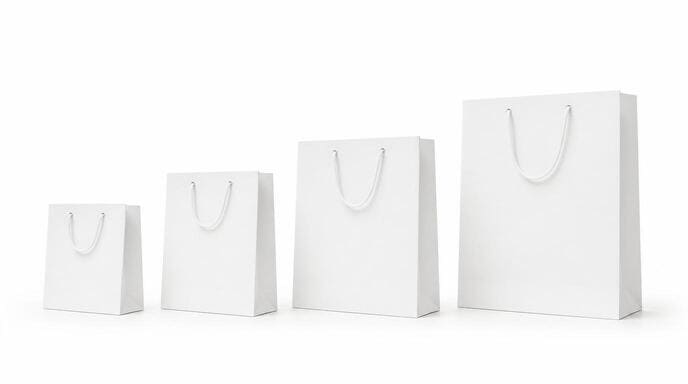
Common shopping bag sizes range from small dimensions (approx. 20x25x10 cm) for delicate items and small gifts, to medium (approx. 30x35x10 cm) for apparel and daily essentials, and large (approx. 40x45x12 cm) for groceries and bulkier items. Extra-large bags (50x60x15 cm+) are suited for bulky goods like bedding or large gift sets.
📌 Quick Overview: Shopping bag sizes generally fall into four categories: small bags for accessories and gifts, medium bags for everyday retail products, large bags for groceries and multiple items, and extra-large bags for bulky products. Selecting the right category helps optimize capacity, customer convenience, and packaging costs.
Small Shopping Bags: Perfect for Precious Items
When dealing with smaller, high-value, or delicate items, a small shopping bag is often the ideal choice. Common dimensions for this category include roughly 20 cm x 25 cm x 10 cm or 25 cm x 30 cm x 8 cm (Length x Height x Gusset). These sizes are perfect for packaging cosmetics, luxury jewelry, small gift items, accessories, or mobile phone accessories. The primary advantages of using small shopping bags are their material efficiency, which helps control costs, and their compact size, which makes them easy for customers to carry. They also lend themselves well to premium branding, making even small items feel special and well-presented.
Medium Shopping Bags: The Versatile Standard
The medium category represents the workhorse of retail packaging. Sizes like 30 cm x 35 cm x 10 cm or 35 cm x 40 cm x 10 cm are extremely popular across various industries. These dimensions are versatile enough to hold a T-shirt, a pair of shoes in a standard box, or other general merchandise. Many boutique clothing stores and gift shops find these sizes hit the sweet spot, offering enough capacity without being overly cumbersome. This is arguably the most common size range found in general retail environments because it caters to a broad spectrum of everyday purchases.
Large Shopping Bags: For Bulkier Purchases
When customers are buying more items, or larger individual products, large shopping bags become essential. Standard dimensions in this class often measure around 40 cm x 45 cm x 12 cm or 45 cm x 50 cm x 15 cm. These bags are well-suited for carrying multiple clothing items, larger product boxes, or substantial grocery hauls. Their increased capacity makes them practical for significant shopping trips. However, it's crucial to note that while the size increases, the carrying capacity is also critically dependent on the material's strength and construction. For large bags, reinforced handles and a strengthened bottom are often necessary to prevent breakage.
Extra-Large Shopping Bags: For Significant Loads
For items that are exceptionally large or numerous, extra-large bags are the solution. Dimensions typically start at 50 cm x 60 cm x 15 cm and can go even larger. These are the go-to options for packaging bedding, large home decor items, significant gift hampers, or for use as substantial promotional bags at events. When opting for extra-large shopping bags, special attention must be paid to the material's thickness (higher GSM), the robustness of the handle attachments, and the overall structural integrity of the bag, particularly the base, to ensure it can handle considerable weight and volume without failure.
Recommended Shopping Bag Sizes by Material Type
The material of your shopping bag plays a significant role in its potential size, durability, and cost. Different materials offer varying strengths and aesthetics, which inform the best dimensions for their intended use.
📌 Quick Overview: Different materials are suitable for different shopping bag sizes and applications. Non-woven bags offer flexible customization, woven PP provides heavy-duty strength, canvas delivers durability and premium appeal, while paper bags are ideal for retail presentation.
Material choice influences viable shopping bag sizes. Non-woven bags (e.g., 30x35x10cm to 45x50x15cm) are versatile; Woven PP bags (e.g., 40x50cm+) offer high strength for heavy loads; Canvas totes (e.g., 35x40cm) are durable for daily use; and Paper bags (e.g., 18x23x8cm to 45x35x15cm) suit boutique and gift packaging.
Non-Woven Bags: Adaptable and Popular
Non-woven polypropylene (PP) bags are incredibly popular for promotional purposes and retail due to their balance of cost, durability, and customizability. For these bags, common shopping bag sizes include:
- 30x35x10cm: Excellent for general promotions and lightweight items.
- 35x40x10cm: A widely used size for supermarket shopping and general retail.
- 40x45x10cm: Suitable for brands that want a slightly larger bag for better product display or for holding more items.
- 45x50x15cm: Ideal for larger shopping loads or as a more substantial reusable grocery bag.
The beauty of non-woven bags is their flexibility; by adjusting the GSM of the material, the width of the bottom gusset, and the length and type of handles (e.g., standard loop handles or die-cut handles), you can significantly alter the bag's carrying capacity and overall strength without drastically changing the fundamental size. Laminate finishes can also enhance durability and print quality.
Woven PP Bags: Strength and Durability
Woven polypropylene (PP) bags are known for their exceptional strength and durability, making them suitable for heavier items and frequent reuse. They are often used for agricultural products, bulk goods, and heavy-duty shopping. Typical dimensions for these robust shopping bags are larger and designed to maximize capacity and strength:
- 40x50cm
- 45x55cm
- 50x60cm
These dimensions often don't include a significant gusset by default but are designed to carry substantial weight. The woven structure provides high tensile strength, resisting tears and punctures better than many other materials. Their suitability for repeated use makes them a sustainable choice for bulk purchasing and heavy-duty applications.
Canvas Tote Bags: Classic Style and Longevity
Canvas tote bags, often made from cotton or a blend, offer a classic, stylish, and durable option for reusable shopping bags and fashion accessories. They are favored by fashion brands and environmentally conscious consumers. Common dimensions are:
- 35x40cm
- 40x45cm
- 45x50cm
These sizes are practical for everyday use, capable of holding books, laptops, groceries, and general personal items. The thickness of the canvas material (measured in ounces per square yard) plays a significant role in their carrying capacity. While generally durable, ensuring reinforced stitching, especially at the handle attachment points, is key for longevity.
Paper Bags: Elegance and Eco-Friendliness
Paper bags, especially those made from recycled materials and with sustainable sourcing, offer an elegant and eco-conscious packaging solution for retail and gifts. Their shopping bag sizes can vary widely, but common examples include:
- Small: 18x23x8cm
- Medium: 32x25x12cm
- Large: 45x35x15cm
Paper bags are excellent for clothing stores, gift shops, and high-end retail where presentation is key. They can be enhanced with various finishes like matte or gloss lamination, spot UV, or embossing to add a premium feel. However, their load-bearing capacity is generally lower than plastic or woven alternatives, and they are less resistant to moisture. The strength of paper bags is significantly influenced by the paper's GSM and the quality of the construction, including reinforced handles and bottoms.
How to Accurately Measure Your Shopping Bag Sizes?
Precision in measurement is key to ensuring your products fit perfectly and your bags function as intended. Understanding the standard way shopping bag dimensions are expressed will help you communicate your needs clearly to manufacturers.
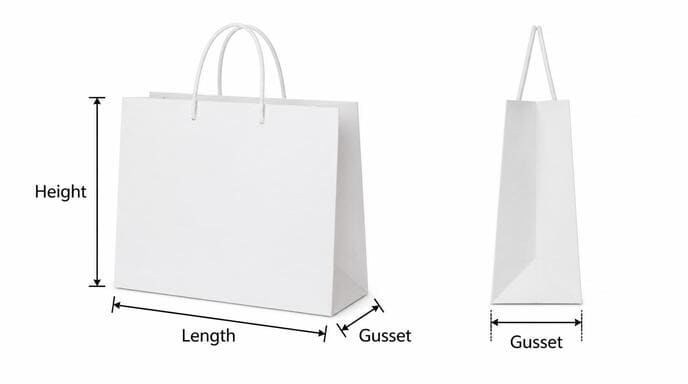
Shopping bag dimensions are typically stated as Length × Height × Gusset (Width/Depth). For example, a 35x40x10cm bag has a 35cm length, 40cm height, and a 10cm side or bottom gusset. Accurate measurement involves determining your product's longest dimension, height, calculating the needed gusset, confirming handle length, and considering how items will be placed inside.
Understanding Standard Bag Dimension Notation
When you see specifications like "35 x 40 x 10 cm," it refers to the bag's external dimensions in a standard format: Length × Height × Gusset.
- Length: This is the measurement across the front of the bag, typically the widest dimension when laid flat and opened.
- Height: This is the measurement from the bottom of the bag up to the top edge where the handles are attached.
- Gusset: This refers to the depth of the bag. It can be a side gusset, a bottom gusset, or both. It determines how much the bag can expand to hold items. A larger gusset means a wider base or sides, allowing for more volume.
Step-by-Step Measurement Process
To ensure you choose the correct shopping bag size, follow these steps:
- Measure Your Product's Longest Dimension: Take your primary item or a combination of items that will typically be carried together. Measure the longest side, the height, and the depth or thickness.
- Measure Product Height: Determine the height of your product.
- Calculate the Required Gusset (Depth): Consider the depth of your product and whether you'll be placing multiple items in the bag. This is where you'll add extra space. For instance, if your product is 5cm thick and you're placing two side-by-side, you'd need at least 10cm of gusset, plus a little extra for ease of insertion and slight movement.
- Confirm Handle Length: The handle length is crucial for comfort. Will the bag be carried by hand, over the shoulder, or both? Ensure the handles are long enough for the intended carrying style and for the bag to sit comfortably when full.
- Consider the Filling Method: Think about how items will be placed into the bag. If items are rigid (like shoe boxes), you need precise dimensions. If they are flexible (like clothing), you have more leeway. Also, consider if the bag will be filled to capacity or just partially.
I always advise clients to mock up their product in the bag with any internal packaging to truly test the fit before committing to a size. Remember, these are often internal dimensions for fit, but manufacturers work with external dimensions and allowances. Providing your product measurements and intended use is often clearer than guessing shopping bag sizes.
📌 Quick Overview: Shopping bag dimensions are usually expressed as Length × Height × Gusset. Accurate measurement should consider product size, thickness, filling method, and handle requirements to ensure the final bag fits properly and performs as expected.
Understanding the Relationship Between Shopping Bag Size and Cost
It's a common assumption that bigger bags always mean higher costs, but the relationship is more nuanced. While size is a significant factor, other elements interact with dimensions to influence the final price of your custom shopping bags.
While larger shopping bag sizes generally increase costs due to more material, increased print area, and higher shipping volume, the relationship isn't linear. Factors like material choice, production efficiency (special sizes can slow down machines), and shipping logistics (dimensional weight) also play critical roles in the overall cost.
Material Costs: More Fabric, More Price
The most direct impact of increasing shopping bag dimensions is the amount of raw material required. Larger bags use more fabric, paper, or film. This also extends to printing: a larger surface area means more ink is used, and potentially more complex or multi-color printing processes are needed, driving up print costs. Furthermore, larger finished bags will require larger cardboard boxes for shipping, increasing packaging material costs for the bags themselves. A bigger bag simply consumes more physical resources.
Shipping and Logistics: The Volume Factor
Beyond the weight of the goods, the physical volume of the bags themselves impacts shipping costs, especially for international sea freight and domestic trucking. Larger shopping bags, even if not completely full, occupy more space. This leads to increased 'dimensional weight' or 'volumetric weight,' which carriers often use to calculate shipping charges. A shipment of larger bags might require more pallets or take up more space in a container, resulting in higher freight bills. Conversely, optimized, smaller bag sizes can lead to more efficient packing and potentially lower shipping expenses.
Production Efficiency: Beyond Simple Scaling
The cost of manufacturing isn't always a linear increase with size. While larger bags use more material, very unusual or non-standard shopping bag sizes can sometimes lead to increased production costs per unit. This is because:
- Layout Changes: Standard bag sizes are optimized for machine settings and material layout. Deviating significantly might require custom adjustments or slower production speeds.
- Machine Adjustments: Converting machines might need parameter changes or even minor tooling adjustments for significantly different dimensions, adding setup time and complexity.
- Material Waste: In some cases, non-standard dimensions might lead to less efficient cutting patterns from larger rolls of material, increasing waste.
While the increase in material is proportional to surface area, production inefficiencies can add an additional layer of cost for highly custom or extreme dimensions.
Selecting the Perfect Shopping Bag Size for Your Brand
Ultimately, the goal is to select shopping bag sizes that enhance your brand image and serve your customers effectively. Different industries and brand archetypes benefit from specific sizing strategies that align with their offerings and target audience.
Choosing the right shopping bag size depends on your brand's sector. Fashion brands might prefer 35x40cm or 40x45cm. Supermarkets need larger, durable bags (40x45cm+ with reinforced features). Promotional events benefit from cost-effective, portable sizes (e.g., 35x40cm), while luxury packaging demands custom, perfectly proportioned dimensions for an exquisite feel.
Retail / Fashion Brands
For apparel, footwear, and accessories, the shopping bag size should complement the product's presentation. Dimensions like 35x40cm or 40x45cm are often ideal. These sizes offer enough room for a shirt, a pair of shoes in a box, or a few small accessories, while maintaining a sophisticated look. The handles should be comfortable for carrying, and the bag's overall aesthetic should align with the brand's style, whether it's minimalist, trendy, or classic. For luxury fashion, custom sizes that perfectly cradle a specific product or gift set can elevate the unboxing experience.
Supermarkets and Grocery Stores
The priority for supermarket shopping bags is capacity and durability. Customers are often buying multiple items, sometimes heavy or bulky ones. Therefore, larger dimensions are crucial, typically starting from 40x45cm and often extending to 45x50cm or larger, with generous gussets (e.g., 10-15cm). Beyond size, reinforcement is key: strong, comfortable handles, robust stitching, and a reinforced bottom structure are essential to prevent breakage. Materials like thick non-woven fabric or woven PP are excellent choices here.
Promotional Events and Trade Shows
For promotional events, the balance is often between cost-effectiveness, portability, and sufficient capacity to hold giveaways, brochures, and small purchased items. A medium size, such as 35x40cm, is frequently recommended. It's large enough to be useful but not so big that it becomes cumbersome for attendees to carry around the venue. Ease of bulk production and a good surface area for clear branding are also significant considerations for these shopping bags.
Luxury Packaging and High-End Gifts
Luxury packaging demands meticulous attention to detail, and shopping bag sizes are no exception. Often, custom dimensions are preferred to achieve a perfect, bespoke fit for high-value items. The goal is to create a sense of exclusivity and premium quality. Considerations include:
- Proportion: The bag's dimensions should feel balanced and elegant, not too tall or too wide.
- Visual Impact: The size should enhance the presentation of the luxury item inside, perhaps with a smaller, more refined bag for jewelry or a perfectly sized carrier for a designer handbag.
- Material & Finish: High-quality materials, sophisticated finishes, and refined handles (like ribbon or rope handles) are paramount.
I recall a project where a bespoke bag size for a high-end perfume bottle created an unparalleled unboxing experience, justifying the custom dimensions. For these applications, a custom-designed bag size is almost always the best approach.
Crucial Size Information for Your Custom Shopping Bag Order?
When ordering custom shopping bags, providing clear and comprehensive details is vital for manufacturers to produce exactly what you envision. Beyond just "a bag," specific dimensions and usage information streamline the process.
To order custom shopping bags, provide: bag type, material, exact dimensions (Length x Height x Gusset), product weight it needs to carry, intended use, handle length and type, desired print area, and preferred packaging method. This detailed information ensures accurate production and a perfect final product.
Essential Details for Custom Orders
When you're ready to place an order for custom shopping bags, clarity is paramount. Here’s a checklist of information that manufacturers like us need to ensure we create the perfect bags for your needs:
- Bag Type: Specify the general style, such as tote bag, grocery bag, gift bag, promotional bag, or insulated bag.
- Material: Indicate your preferred material (e.g., non-woven PP, woven PP, canvas, paper, RPET, etc.) and GSM if known.
- Exact Dimensions (L x H x Gusset): Provide the precise measurements for Length, Height, and Gusset (Width/Depth). It's often helpful to also specify if this is an internal or external measurement and if a specific type of gusset (side, bottom, or both) is required.
- Product Weight Capacity: State the maximum weight the bag needs to carry reliably. This helps manufacturers recommend appropriate materials and construction methods.
- Intended Use/Application: Describe how and where the bags will be used. Is it for supermarket shopping, high-end retail, event giveaways, or food delivery? This context guides design choices.
- Handle Details: Specify the desired handle type (e.g., loop handles, die-cut handles, rope handles), length, and how they should be attached (e.g., sewn, heat-sealed).
- Printing Area and Specifications: Indicate where logos or designs should be placed, the number of colors, and any special printing requirements (e.g., screen printing, heat transfer, full-color CMYK printing).
- Packaging Method: How should the finished bags be packed for shipping? Folded flat, stacked, or in specific quantities per carton?
Providing this comprehensive list ensures that your unique requirements are understood, minimizing misunderstandings and ensuring that the final shopping bag sizes and specifications meet your exact needs for branding, functionality, and cost-effectiveness.
📌 Quick Overview: For custom shopping bag orders, buyers should provide key specifications including bag type, material, dimensions, weight capacity, handle design, printing requirements, and packaging details. Clear specifications help manufacturers deliver accurate and cost-effective solutions.
Frequently Asked Questions
Q1: Is a larger shopping bag size always better for carrying more items?
Not necessarily. While larger shopping bag sizes offer more volume, carrying capacity is primarily determined by the material's strength (GSM), construction quality, and reinforced features like handles and the bottom. An oversized bag made from flimsy material might fail before a smaller, well-constructed bag.
Q2: Why do shopping bags of the same dimensions have different weight capacities?
The weight capacity of shopping bags with identical dimensions varies significantly due to the material used (thickness, tensile strength), the specific manufacturing process (e.g., stitching vs. ultrasonic welding), handle attachment method, and whether the bottom is reinforced. Higher GSM materials and stronger construction methods increase load-bearing potential.
Q3: Can I request custom shopping bag sizes that aren't standard?
Yes, absolutely. Reputable manufacturers, especially those specializing in OEM/ODM services, can produce custom shopping bag sizes tailored precisely to your needs. They can also customize colors, printing, materials, and structural designs to create unique packaging solutions.
Q4: How important is the gusset size in shopping bag dimensions?
The gusset size is crucial as it defines the bag's depth and volume, determining how many items or how bulky an item the bag can comfortably hold. A larger gusset allows for items to sit better and increases the overall capacity of the shopping bag without necessarily changing the length or height.
Conclusion
Choosing the right shopping bag sizes is a strategic decision that impacts everything from product protection and cost control to customer satisfaction and brand perception. By carefully considering product dimensions, weight, application, and material properties, you can select or customize bags that perfectly meet your needs. Don't underestimate the power of accurate sizing; it's a critical element of effective packaging.
Contact us today to get expert recommendations on the ideal shopping bag dimensions for your brand and receive a no-obligation quotation for our custom manufacturing services.