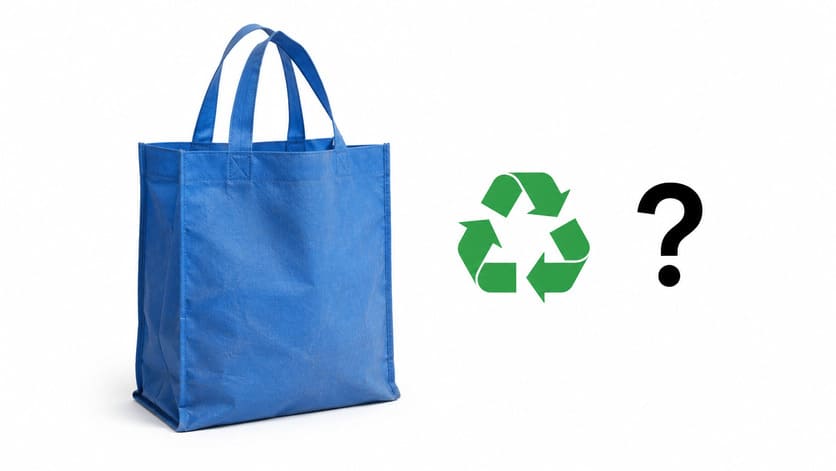
Many People Want Eco-Friendly Bags, But Are They Really Recyclable?
More countries are restricting single-use plastic bags, and more businesses are switching to reusable shopping bags. Among the most popular choices are PP non woven bags, widely used by supermarkets, retailers, exhibitions, and promotional campaigns.
However, one question continues to appear during purchasing decisions:
Can non woven bags be recycled?
The answer is yes—but not always in the same way everywhere. A bag's recyclability depends on its material, construction, and the recycling facilities available locally. Understanding these factors helps businesses make better sourcing decisions and support more sustainable packaging.
Yes. Most non woven shopping bags are made from polypropylene (PP), a #5 plastic that is recyclable in many regions. However, actual recycling depends on local collection systems and processing capabilities. In many cases, reusing a durable PP non woven bag for as long as possible delivers greater environmental benefits than recycling it immediately.
For wholesalers, retailers, and brand owners, sustainability is no longer just about using reusable bags. Material selection, product design, manufacturing quality, and end-of-life disposal all influence a bag's environmental performance. This guide explains everything buyers should know before sourcing PP non woven bags.
Table of Contents
- What Are Non Woven Bags Made Of?
- Can Non Woven Bags Be Recycled?
- Why Are Some Non Woven Bags Easier to Recycle Than Others?
- How Does the Recycling Process Work?
- Reuse vs Recycling: Which Is Better?
- Environmental Benefits and Limitations
- How Businesses Can Improve Recyclability
- Choosing a Reliable Non Woven Bag Manufacturer
- Conclusion
- FAQ
What Are Non Woven Bags Made Of?
Many consumers believe non woven bags are made from fabric because they look and feel similar to cloth. In reality, most reusable non woven bags are manufactured from polypropylene (PP), a lightweight thermoplastic polymer identified as Plastic #5.
Unlike traditional woven textiles, PP fibers are not woven together. Instead, fine polypropylene fibers are bonded using heat and pressure to create a durable sheet that resembles fabric while retaining the characteristics of plastic.
This manufacturing method produces material that is lightweight, strong, printable, and economical, making it one of the most widely used materials for reusable shopping bags worldwide.
PP fibers are bonded together with heat and pressure instead of traditional weaving.
Why Are They Called "Non Woven" Bags?
The name simply refers to the manufacturing process.
Traditional fabrics are created by weaving yarns together. Non woven materials skip this step entirely. Instead, polypropylene fibers are directly bonded into continuous sheets using heat and pressure.
Because no weaving is required, manufacturers can produce large volumes efficiently while maintaining consistent thickness and strength.
Why Polypropylene Is Used
Polypropylene has become the preferred material because it offers an excellent balance of cost, durability, and performance.
Key advantages include:
- Lightweight
- Moisture resistant
- High strength-to-weight ratio
- Easy to print
- Cost-effective
- Recyclable in many recycling systems
These characteristics make PP non woven bags suitable for retail shopping, promotional events, grocery stores, exhibitions, and corporate giveaways.
Is PP Non Woven Fabric Plastic?
Yes.
Although it feels like fabric, PP non woven material is still plastic.
It belongs to Polypropylene (PP), identified as Plastic #5, which is commonly accepted by industrial recycling systems and increasingly accepted by municipal recycling programs in many countries.
PP Non Woven Bag Material Overview
| Property | Description |
|---|---|
| Material | Polypropylene (PP) |
| Manufacturing Process | Heat and pressure bonding |
| Plastic Identification Code | #5 PP |
| Typical Weight | 60–120 GSM |
| Reusable | Yes |
| Recyclable | Depends on local recycling facilities |
Can Non Woven Bags Be Recycled?
The simple answer is yes.
Most reusable non woven bags are manufactured from polypropylene, a recyclable thermoplastic. However, being recyclable does not guarantee that every bag will be recycled, because recycling depends on local infrastructure as much as the material itself.
For businesses purchasing reusable bags, understanding this distinction is essential when making sustainability claims.
Material Recyclability vs Local Recycling Acceptance
Many people confuse recyclable materials with materials that are actually recycled.
These are two different concepts.
- Material recyclability refers to whether polypropylene can technically be recycled.
- Recycling acceptance depends on whether local facilities collect and process PP products.
Polypropylene satisfies the first requirement.
The second varies widely between countries, cities, and recycling providers.
Some municipalities collect PP products through curbside recycling, while others require drop-off centers or commercial recycling programs.
Because recycling systems differ, manufacturers should avoid claiming that every PP non woven bag is "100% recyclable everywhere."
A more accurate statement is:
PP non woven bags are recyclable where suitable recycling facilities are available.
Efficient sorting is essential for successful polypropylene recycling.
Are All Non Woven Bags Equally Easy to Recycle?
Not necessarily.
Although most bags are based on polypropylene, additional materials can make recycling more difficult.
The simplest bags—those made almost entirely from PP—are generally the easiest to process.
Products that combine several different materials often require additional sorting before recycling.
Common features that increase recycling complexity include:
- Cotton handles
- Polyester linings
- PVC pockets
- EVA windows
- Metal rivets
- Zippers
- Thick decorative accessories
This does not automatically mean these bags cannot be recycled, but they may require more advanced recycling equipment.
Do Printing and Lamination Prevent Recycling?
In most cases, no.
Standard printing methods such as screen printing, flexographic printing, gravure printing, and digital printing generally have little effect on recyclability.
Similarly, lamination does not automatically make a bag unrecyclable.
However, laminated products contain additional layers that some recycling facilities may need to separate before processing. Whether they are accepted therefore depends on local recycling technology rather than the lamination itself.
| Feature | Influence on Recycling |
|---|---|
| Standard PP Material | Easy |
| Logo Printing | Minimal |
| Full Surface Printing | Low to Moderate |
| Lamination | Moderate |
| Multiple Materials | High |
Commercial Recycling Is Often More Practical
Large retailers, manufacturers, and distribution centers usually generate clean and consistent polypropylene waste streams.
Compared with household waste, commercial PP materials are easier to collect, sort, and recycle efficiently.
For businesses purchasing customized reusable bags, establishing commercial recycling partnerships may be more practical than relying solely on municipal collection systems.
Why Are Some Non Woven Bags Easier to Recycle Than Others?
Although polypropylene itself is recyclable, product design has a major influence on recycling efficiency.
Small design decisions made during manufacturing can determine whether a bag is simple to process or requires extensive separation.
Mono-Material Designs Simplify Recycling
Whenever possible, recycling facilities prefer products made from a single material.
A shopping bag manufactured almost entirely from polypropylene can usually move through sorting and recycling with minimal additional processing.
By contrast, combining PP with cotton, PVC, metal, foam, or other materials increases labor and processing costs.
For brands pursuing sustainable packaging, mono-material construction is one of the simplest ways to improve recyclability.
Comparison of Different Bag Structures
| Bag Structure | Recycling Difficulty | Comments |
|---|---|---|
| 100% PP Non Woven | ★☆☆☆☆ | Easiest to recycle |
| PP + Laminated Film | ★★☆☆☆ | Depends on local facilities |
| PP + Zipper | ★★★☆☆ | Extra separation required |
| PP + Cotton Handles | ★★★★☆ | Mixed materials increase complexity |
| Multi-material Promotional Bag | ★★★★★ | Most difficult to recycle |
Food Contamination Can Reduce Recycling Quality
Even recyclable polypropylene may be rejected if it is heavily contaminated.
Typical contaminants include:
- Food residue
- Cooking oil
- Grease
- Chemicals
- Paint
- Organic waste
Most recycling facilities clean materials before processing, but excessive contamination increases costs and may make recycling uneconomical.
Cleaning reusable bags before disposal improves the likelihood that they will be successfully recycled.
Local Infrastructure Is Still the Biggest Factor
Even the best-designed PP bag cannot be recycled if suitable facilities are unavailable.
Different regions prioritize different materials. Some recycling programs accept polypropylene products, while others focus mainly on PET bottles, HDPE containers, or paper packaging.
As a result, two identical bags may have completely different recycling outcomes depending on where they are discarded.
Main Factors Affecting Recycling Success
| Factor | Impact |
|---|---|
| Local recycling infrastructure | Very High |
| Material consistency | High |
| Sorting technology | High |
| Contamination level | Medium |
| Lamination | Medium |
| Printing coverage | Low |
For this reason, businesses should view recyclability as a combination of material selection, product design, and local recycling capability, rather than relying on a single environmental claim.
How Does the Non Woven Bag Recycling Process Work?
Understanding how polypropylene is recycled helps explain why material selection and product design matter.
Although recycling technologies differ from country to country, most PP non woven bags follow a similar mechanical recycling process. The cleaner and more consistent the material, the higher the quality of the recycled plastic.
Step 1: Collection
The process begins after the bag reaches a recycling system.
Collection methods typically include:
- Municipal recycling programs
- Commercial recycling services
- Retail take-back programs
- Industrial waste collection
Commercial waste streams usually contain cleaner and more consistent polypropylene, making them easier to recycle than mixed household waste.
Step 2: Sorting
Collected materials are separated according to plastic type.
Both manual workers and automated sorting equipment identify polypropylene and separate it from plastics such as:
- PET (#1)
- HDPE (#2)
- PVC (#3)
- LDPE (#4)
Accurate sorting is essential because mixing different plastics lowers the quality of recycled material.
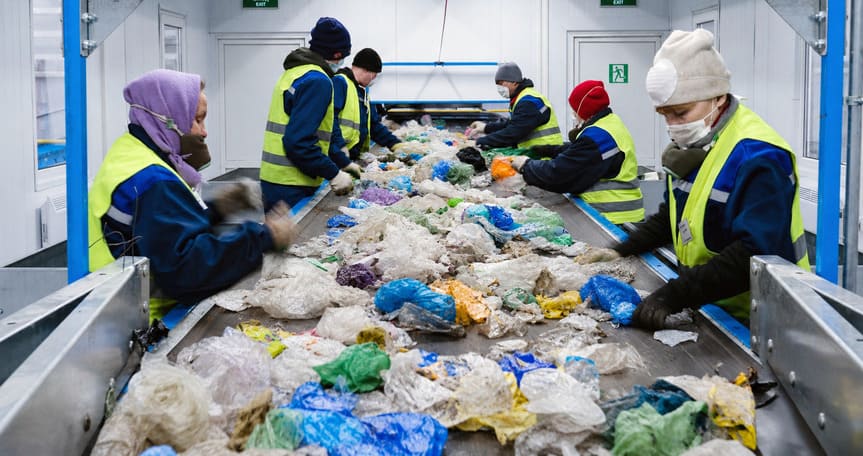
Proper sorting is one of the most important steps in producing high-quality recycled polypropylene.
Step 3: Cleaning
Before processing, recyclable bags are washed to remove contaminants.
Typical contaminants include:
- Dust
- Food residue
- Oil and grease
- Labels
- Adhesive
- Dirt
Cleaner input material produces higher-quality recycled plastic with fewer defects.
Step 4: Shredding
After washing, the bags are cut into small plastic flakes.
Shredding creates a uniform material size, allowing the next stages of recycling to operate more efficiently.
Step 5: Melting
The shredded polypropylene is heated until it becomes molten plastic.
Unlike chemical recycling, mechanical recycling preserves much of the original polymer while allowing it to be reshaped into new products.
Step 6: Pelletizing
The molten plastic is cooled and cut into small recycled PP pellets.
These pellets become raw material for manufacturing a wide range of plastic products.
Step 7: Manufacturing New Products
Recycled polypropylene can be used in many industrial applications.
Common examples include:
- Plastic pallets
- Storage boxes
- Utility containers
- Flower pots
- Outdoor furniture
- Automotive parts
- Industrial packaging
- Selected reusable shopping bags
The percentage of recycled content depends on product requirements and quality standards.
The Recycling Process at a Glance
Collection → Sorting → Cleaning → Shredding → Melting → Pelletizing → New Products
Reuse vs Recycling: Which Is Better?
Many people assume recycling is always the most environmentally friendly option.
In reality, extending a product's lifespan is usually even better.
Most environmental organizations follow the same waste hierarchy:
Reduce → Reuse → Recycle
This order exists because every new product—even one made from recycled plastic—still requires energy, transportation, and manufacturing.
Keeping an existing bag in use for longer usually has a lower environmental impact than replacing it with a newly manufactured one.
Why Reusing a Bag Creates Greater Environmental Value
A durable PP non woven bag can replace dozens or even hundreds of disposable plastic bags during its lifetime.
Each additional use spreads the environmental cost of manufacturing across more shopping trips.
For retailers and brand owners, encouraging customers to reuse bags is often one of the simplest ways to improve sustainability without changing materials.
What Determines the Lifespan of a Non Woven Bag?
Not every reusable bag lasts the same length of time.
Several manufacturing factors directly influence durability.
| Factor | Influence |
|---|---|
| Fabric GSM | Higher GSM generally increases strength |
| Stitching Quality | Reinforced seams reduce failure |
| Handle Construction | Strong handles improve carrying capacity |
| Lamination | Improves wear and moisture resistance |
| Overall Design | Better weight distribution extends service life |
A well-manufactured bag can remain in use for years under normal shopping conditions.
Although thicker bags usually last longer, the ideal GSM should match the intended application rather than simply being as heavy as possible.
Environmental Benefits and Limitations
PP non woven bags have become one of the world's most widely used reusable shopping bags because they combine affordability, durability, and reusability.
Like any packaging material, however, they offer both advantages and limitations.
Understanding both sides helps businesses communicate sustainability claims accurately.
Environmental Benefits
1. Reduce Single-Use Plastic Consumption
The greatest environmental benefit comes from replacing disposable shopping bags.
A reusable bag that is used repeatedly can significantly reduce demand for single-use plastic bags over time.
For retailers, this not only reduces packaging waste but also supports a stronger sustainability image.
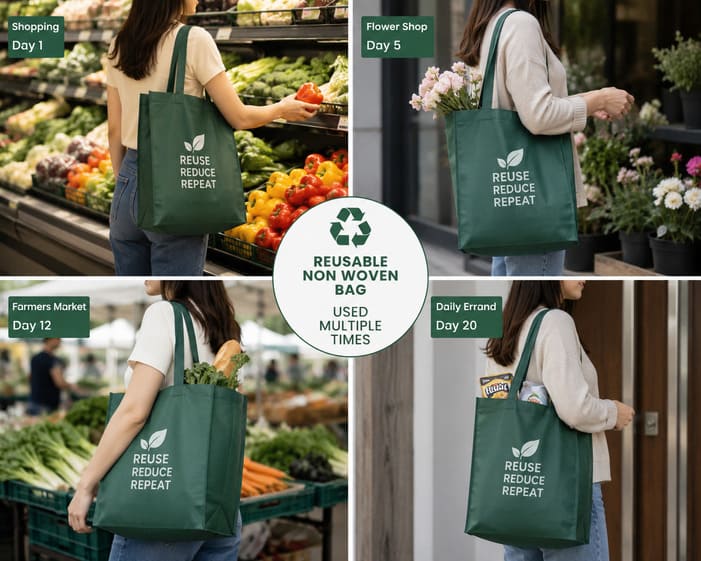
The environmental value of a reusable bag increases with every additional use.
2. Lower Environmental Impact Per Use
Every manufactured product consumes raw materials, energy, transportation, and labor.
The longer a reusable bag remains in service, the lower these impacts become per shopping trip.
The relationship is straightforward.
| Approximate Number of Uses | Environmental Performance |
|---|---|
| 1–5 | Limited improvement |
| 10–20 | Moderate reduction in waste |
| 30–50 | Significant environmental benefit |
| 50+ | Excellent long-term resource efficiency |
This is why many businesses prefer durable reusable bags over very lightweight alternatives designed for only a few uses.
3. Polypropylene Can Be Recycled
After proper collection and sorting, polypropylene can become raw material for many new products, reducing demand for virgin plastic.
As recycling technologies continue to improve, recycled PP is finding applications in an increasing number of industries.
4. Efficient Transportation
Compared with heavier reusable materials, PP non woven fabric offers an attractive balance between strength and weight.
Its lightweight nature reduces transportation costs and can help lower emissions during shipping, particularly for large export orders.
Environmental Limitations
Despite these advantages, PP non woven bags are not a perfect environmental solution.
They Are Not Biodegradable
Polypropylene does not naturally break down within a short period.
If bags are discarded irresponsibly instead of being reused or recycled, they can remain in the environment for many years.
Proper waste management remains essential.
Sustainability Depends on Consumer Behavior
A reusable bag only becomes environmentally beneficial when it is actually reused.
If consumers treat reusable bags as disposable products, much of their environmental advantage disappears.
For promotional campaigns, attractive designs and durable construction can encourage customers to keep using the bag instead of discarding it after one event.
Environmental Advantages vs Limitations
| Advantages | Limitations |
|---|---|
| Reusable dozens of times | Not biodegradable |
| Reduces single-use plastic consumption | Recycling depends on local facilities |
| Lightweight for transportation | Mixed-material designs are harder to recycle |
| Durable for long-term use | Improper disposal still creates waste |
| PP material is recyclable | Benefits rely on repeated reuse |
One important conclusion becomes clear throughout this guide:
A high-quality PP non woven bag that is reused many times generally provides greater environmental value than a poorly made bag that is recycled after only a few uses.
Therefore, sustainability begins with thoughtful product design and manufacturing quality—not only with end-of-life recycling.
How Businesses Can Improve the Recyclability of Non Woven Bags
Sustainability starts long before a reusable bag reaches the consumer.
For manufacturers, wholesalers, retailers, and brand owners, improving recyclability is largely a matter of smart product design. Small design decisions can make bags easier to recycle, extend their service life, and reduce their overall environmental footprint.
Choose Mono-Material Designs
One of the simplest ways to improve recyclability is to minimize the number of materials used.
Whenever possible, use polypropylene for both the bag body and handles instead of combining PP with cotton, PVC, EVA, or metal accessories.
A mono-material structure:
- Simplifies sorting
- Reduces separation costs
- Improves recycling efficiency
- Supports circular packaging initiatives
For many retail shopping bags, this approach provides the best balance between performance and sustainability.
Select the Right GSM Instead of the Highest GSM
Some buyers assume thicker fabric automatically means a greener product.
Not necessarily.
A bag should be strong enough for its intended application, but excessive material use increases raw material consumption, shipping weight, and cost.
Selecting the appropriate GSM helps achieve both durability and resource efficiency.
| Application | Recommended GSM |
|---|---|
| Promotional Bags | 60–80 GSM |
| Grocery Shopping Bags | 80–100 GSM |
| Heavy-Duty Retail Bags | 100–120 GSM |
Choosing the correct GSM often has a greater environmental benefit than simply increasing thickness.
Use Lamination Only When It Adds Value
Lamination improves appearance, print quality, and moisture resistance.
For premium retail packaging, these benefits may justify the additional processing required during recycling.
However, for simple promotional or giveaway bags, lamination may not be necessary.
Selecting lamination based on actual product requirements helps balance aesthetics, durability, cost, and recyclability.
Choose Responsible Printing Methods
Modern printing technologies generally have little impact on recyclability when used appropriately.
Common options include:
- Screen printing
- Flexographic printing
- Gravure printing
- Digital printing
- Water-based inks where suitable
Avoiding unnecessary specialty coatings or decorative finishes can further simplify recycling while maintaining strong brand presentation.
Print Clear Recycling Information
Many consumers are unsure how to dispose of reusable bags correctly.
Simple printed markings can improve recycling awareness.
Examples include:
- PP (#5) identification
- Recycling symbol
- Material information
- Disposal guidance where appropriate
These small additions encourage responsible disposal without increasing manufacturing complexity.

Clear material identification helps consumers recognize recyclable polypropylene products.
Design Bags People Want to Keep
Perhaps the most effective sustainability strategy is simply designing a bag people enjoy using.
Features that encourage repeated use include:
- Comfortable handles
- Reinforced stitching
- Attractive printing
- Practical dimensions
- Easy storage
- Good carrying capacity
Every additional reuse reduces the environmental impact per use, making product longevity one of the most important sustainability factors.
Choosing a Reliable Non Woven Bag Manufacturer
Choosing the right supplier affects far more than product price.
A professional manufacturer contributes to product quality, consistency, durability, customization, and long-term sustainability.
Evaluate Raw Material Quality
Consistent raw materials produce more consistent products.
Ask suppliers about:
- Virgin PP options
- Recycled PP availability
- Fabric consistency
- GSM tolerance
- Color consistency
Stable material quality improves durability and reduces quality variations across production batches.
Assess Manufacturing Capability
An experienced factory should have the equipment and production capacity to support large-scale orders while maintaining consistent quality.
Important indicators include:
- Years of manufacturing experience
- Automated production equipment
- Production capacity
- Skilled technicians
- Export experience
Reliable manufacturing processes also improve delivery consistency and reduce defect rates.
Review Quality Control Systems
Quality inspection should take place throughout production rather than only at the final stage.
Typical inspections include:
| Inspection Stage | Purpose |
|---|---|
| Raw Material Inspection | Verify fabric quality |
| Printing Inspection | Confirm color accuracy |
| Sewing Inspection | Check seam strength |
| Finished Product Inspection | Verify appearance and dimensions |
| Packaging Inspection | Protect products during shipment |
Comprehensive quality control helps ensure every shipment meets customer expectations.
Look for Strong Customization Capabilities
Different businesses require different packaging solutions.
A capable manufacturer should support:
- Custom sizes
- Custom colors
- Logo printing
- Multiple handle styles
- Various GSM options
- Laminated and non-laminated finishes
- OEM and ODM services
Strong customization allows businesses to develop packaging that matches their branding while remaining practical for end users.
View Sustainability as a Long-Term Partnership
A reliable supplier should provide more than manufacturing services.
Experienced manufacturers can recommend practical improvements such as:
- Appropriate material thickness
- Cost-effective bag structures
- Simplified mono-material designs
- Durable construction methods
- Efficient packaging for export
These recommendations often improve both environmental performance and long-term purchasing value.
Conclusion
PP non woven bags have become one of the most widely used reusable shopping bags because they combine affordability, durability, lightweight construction, and long service life.
So, can non woven bags be recycled?
Yes. Most are made from polypropylene (#5 plastic), which is recyclable in many recycling systems. However, whether a bag is actually recycled depends on local collection programs, sorting technology, and the bag's overall design.
For businesses, recyclability should not be viewed as the only measure of sustainability.
Greater environmental benefits often come from:
- Choosing durable materials
- Designing bags for repeated reuse
- Reducing unnecessary mixed materials
- Selecting appropriate manufacturing methods
- Working with experienced suppliers
- Encouraging responsible disposal
Ultimately, the most sustainable reusable bag is not simply the easiest one to recycle—it is the one that remains useful for the longest time before entering an appropriate recycling system.
By combining thoughtful design, quality manufacturing, and responsible use, businesses can reduce packaging waste while providing customers with practical, long-lasting reusable bags.
Frequently Asked Questions (FAQ)
Are non woven bags recyclable?
Yes.
Most reusable non woven bags are made from polypropylene (PP), a #5 plastic that can be recycled in many regions. Actual recycling depends on local collection and processing facilities.
Can non woven bags go into household recycling bins?
It depends on where you live.
Some municipal recycling programs accept PP products through curbside collection, while others require them to be taken to designated recycling centers.
Always check local recycling guidelines.
Are laminated non woven bags recyclable?
Often, yes.
Lamination does not automatically prevent recycling, but it may require additional processing. Acceptance varies depending on the recycling technology available in your area.
Do printed non woven bags affect recycling?
Generally, no.
Standard printing methods such as screen printing, flexographic printing, gravure printing, and digital printing have little impact on recyclability. Mixed materials and heavy specialty coatings usually have a greater influence.
What plastic are non woven bags made from?
Most reusable non woven bags are manufactured from polypropylene (PP), identified as Plastic #5.
PP is widely used because it is lightweight, durable, moisture resistant, and recyclable in many recycling systems.
Are non woven bags biodegradable?
No.
Standard PP non woven bags are not biodegradable.
Their environmental advantages come from repeated reuse and responsible recycling rather than natural decomposition.
How many times can a PP non woven bag be reused?
There is no fixed number.
Its lifespan depends on:
- Fabric GSM
- Stitching quality
- Handle construction
- Carrying weight
- Frequency of use
A well-manufactured bag can typically be reused dozens of times and, in many cases, much longer with proper care.
What can recycled polypropylene be made into?
Recycled PP is used to manufacture many products, including:
- Plastic pallets
- Storage containers
- Flower pots
- Outdoor furniture
- Industrial packaging
- Automotive components
- Utility boxes
Some recycled PP can also be incorporated into new reusable products, depending on quality requirements.
Are reusable non woven bags better than single-use plastic bags?
Generally, yes.
When reused many times, PP non woven bags can replace dozens or even hundreds of disposable plastic bags, reducing overall packaging waste and improving resource efficiency.
How can businesses make non woven bags more sustainable?
Businesses can improve sustainability by:
- Using mono-material PP designs
- Selecting appropriate GSM
- Reducing unnecessary accessories
- Choosing durable construction
- Printing recycling information
- Encouraging repeated reuse
- Working with experienced manufacturers that maintain consistent quality standards
These measures improve product lifespan, simplify recycling, and support more responsible packaging solutions.