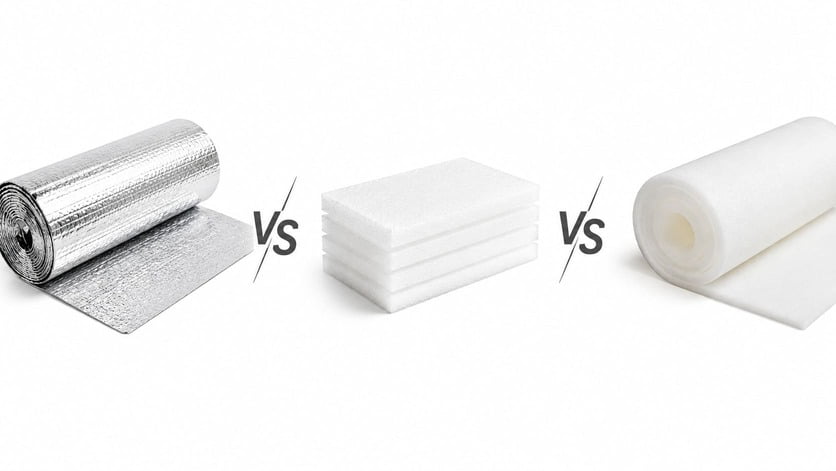
Choosing an insulated bag is confusing. The wrong material means spoiled food or lukewarm drinks. Let's break down the core materials to help you make the right choice.
The best insulated bags combine three key materials: aluminum foil for reflecting heat, EPE foam for blocking heat transfer, and a durable outer fabric. This multi-layer design ensures your food stays hot or cold for longer, balancing performance, durability, and cost.
When we started manufacturing insulated bags over a decade ago, many clients focused only on the outer fabric. But we quickly learned that the true magic of an insulated bag lies hidden inside. The real performance hero isn't what you see, but the combination of materials working together. In this guide, I'll walk you through the three key materials—aluminum foil, EPE foam, and PE foam—and explain how they work together to keep your items at the perfect temperature.
Understanding How Insulated Bags Retain Temperature?
Ever wonder why some bags keep ice frozen for hours? It's not magic. It's science, and not understanding it can lead to poor choices and wasted money.
Insulated bags work by fighting the three types of heat transfer: conduction, convection, and radiation1. Specialized materials like foam and foil are used to block these transfers, trapping the initial temperature of the contents inside and keeping external temperatures out.
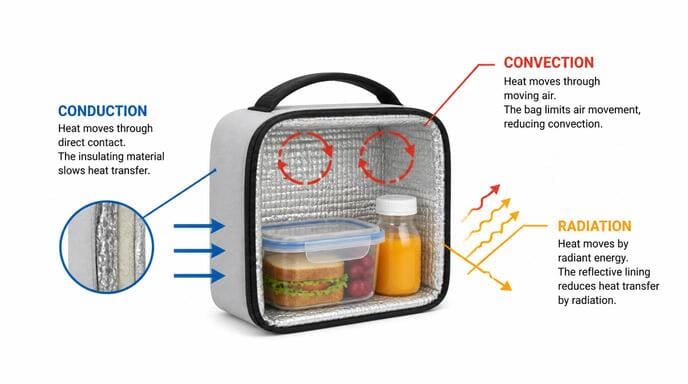
To create a great insulated bag, you must first understand what you're up against: heat transfer. Heat naturally moves from a warmer area to a cooler one2 in three ways. Our job as manufacturers is to stop this movement.
The Three Ways Heat Transfers
- Conduction: This is heat transfer through direct contact. If you touch a hot pan, the heat transfers to your hand via conduction. In a bag, heat can conduct through the bag's solid materials.
- Convection: This is heat transfer through the movement of fluids, like air or water. Warm air rises and cool air sinks, creating currents that transfer heat. Inside a bag, air can circulate and transfer heat to or from your food.
- Radiation: This is heat transfer through electromagnetic waves, like the heat you feel from the sun. Hot items radiate heat outwards, and items can absorb radiant heat from their surroundings.
A bag's insulation materials are specifically chosen to combat all three of these. The foam layer is designed to be a poor conductor and to stop convection3, while the shiny foil lining is there to reflect radiation4.
What Makes Aluminum Foil a Reflective Barrier in Insulated Bags?
You see that shiny lining and assume it's keeping things cold. But how does it actually work? Without this knowledge, you can't judge a bag's true quality.
Aluminum foil works by reflecting thermal radiation. Up to 97% of radiant heat is bounced back5, preventing it from penetrating the bag. This makes it an essential, lightweight, and cost-effective layer, especially when combined with foam insulation for maximum effect.
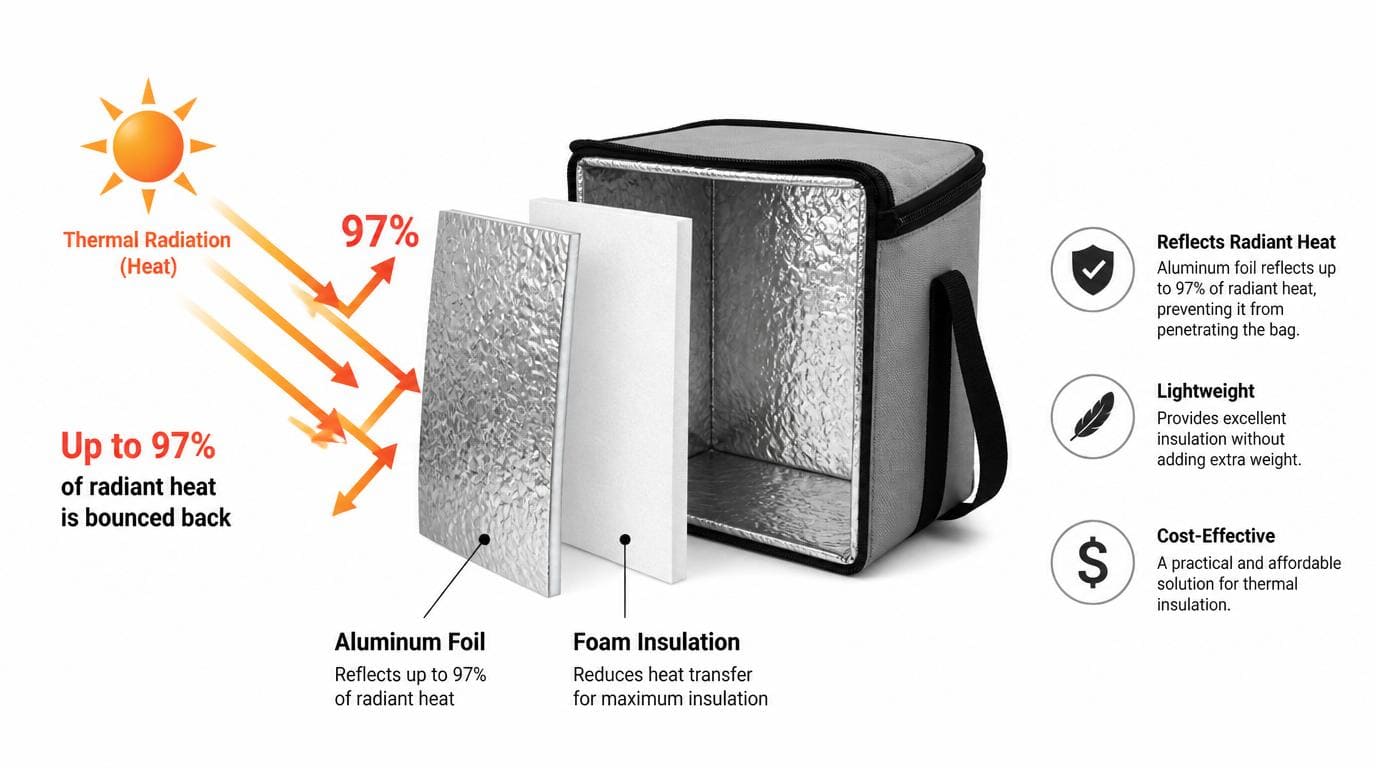
Aluminum foil is one of the most misunderstood components of an insulated bag. On its own, it’s a terrible insulator against conduction6. However, its power lies in its shininess. The primary role of the aluminum foil lining is to act as a radiant barrier. It reflects thermal energy instead of absorbing it. This means it helps keep heat from the sun out of your cooler bag, and it helps keep the heat from your hot takeout food inside the bag.
It's an incredibly efficient material for this job, but it has its limits. It’s thin and can tear or wrinkle, which can reduce its effectiveness. That's why it almost always needs to be paired with a foam layer to provide a complete insulation solution. For many promotional bags, we fuse the foil directly to a non-woven fabric using ultrasonic welding, which is a fast and low-cost method perfect for high-volume orders.
| Advantages | Limitations |
|---|---|
| Lightweight | Poor insulation when used alone |
| Moisture & water proof | Prone to wrinkling and tearing |
| Low cost | Needs a foam layer for structure |
| Easy to clean |
Why Is EPE Foam the Most Popular Thermal Core for Insulated Bags?
Not all foam is created equal. Choosing the wrong type means a bag that fails quickly. Let's look at why EPE foam is the industry's go-to choice.
EPE (Expanded Polyethylene) foam7 is popular due to its excellent thermal insulation, lightweight structure, and cushioning properties. Its closed-cell design traps air effectively8, blocking heat transfer while being durable and cost-effective, making it the ideal core for most high-quality insulated bags.
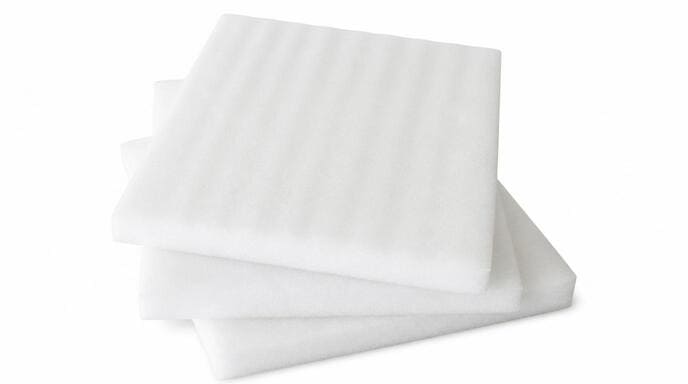
EPE foam, which we often call "pearl cotton," is the workhorse of the insulated bag world. Its structure is made up of millions of tiny, closed air bubbles. Since air is a poor conductor of heat9, trapping it in these small pockets is an incredibly effective way to stop both conduction and convection. This is what gives EPE its superior insulating power.
Beyond insulation, EPE foam provides crucial cushioning to protect contents like glass bottles or delicate food containers. It's also incredibly lightweight and flexible. We stock it in various thicknesses to meet different performance needs. Thicker foam provides better insulation and protection10 but also increases cost and bulk. Bags with thick EPE foam are usually sewn, which is a more labor-intensive process that adds to the overall cost but results in a much more durable and premium product.
| Common Thickness | Best Application |
|---|---|
| 2mm - 3mm | Grocery & Supermarket |
| 3mm - 5mm | Food Delivery |
| 5mm - 8mm | Premium Cold Chain |
Is PE Foam a Good Cost-Effective Alternative for Insulation?
When budget is tight, you might look at cheaper options. But will a bag with PE foam still do the job? Here's what you need to know before you decide.
PE (Polyethylene) foam11 is a cost-effective alternative to EPE foam. While its thermal performance is slightly lower, it remains lightweight and easy to process, making it a suitable choice for budget-friendly insulated bags, single-use cold chain packaging, and promotional giveaways.
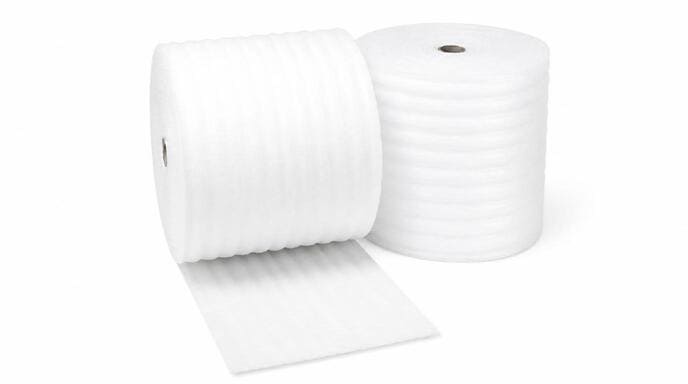
PE foam is a close relative of EPE foam. It's also a closed-cell foam insulation material, but its manufacturing process and cell structure are slightly different. This results in a material that is less expensive to produce but offers slightly lower thermal performance and less cushioning compared to EPE of the same thickness.
So, when does PE foam make sense? It's the perfect choice for applications where cost is the primary driver and high-level thermal performance is a "nice-to-have" rather than a "must-have." We often use PE foam for large-volume promotional bags where the main goal is brand exposure, not long-term food preservation. It's also a common choice for one-time use shipping liners for meal kits or pharmaceuticals, where the packaging will be discarded after a single journey. It provides a basic level of insulation at a very attractive price point, making it a valuable option in our material toolbox.
Why Do High-Performance Insulated Bags Combine Multiple Layers?
You see bags advertised with multiple layers. Is this just marketing hype? Or is there a real performance benefit that you might be missing out on?
High-performance bags use a multi-layer design because no single material can do everything. Typically, an outer fabric provides strength, a middle EPE foam layer blocks heat, and an inner aluminum foil lining reflects radiation, creating a synergistic effect for superior insulation.
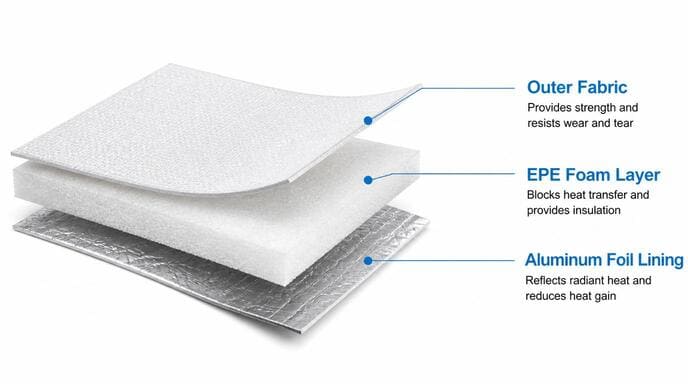
A single material simply cannot provide strength, block conduction, and reflect radiation all at once. That's why the best insulated bags are like a team where each player has a specific job. We've spent years perfecting this combination to create bags that perform exceptionally well.
The Typical High-Performance Construction
- Outer Fabric: This is the bag's first line of defense. Materials like non-woven, polyester, or canvas provide durability, tear resistance, and a printable surface for logos and branding.
- EPE Foam Layer: This is the core insulator. It's the thick, spongy layer that does the heavy lifting of blocking heat transfer through conduction and convection. The thicker the foam, the better the insulation.
- Aluminum Foil Lining: This is the inner layer that faces the contents. Its job is to reflect radiant heat, either keeping heat in or keeping it out. It also provides a waterproof and easy-to-clean surface.
When these three layers work together, the result is far greater than the sum of its parts. The foam stops the conductive heat, and the foil stops the radiant heat. It's this one-two punch that keeps contents at the desired temperature for hours.
How Do You Choose the Right Insulation Material for Your Application?
Now that you know the materials, how do you pick the right bag? Choosing incorrectly can mean overspending or getting a bag that doesn't meet your needs.
Choose your insulation based on need and budget. For promotional bags, a thin foam and foil combo works. For food delivery, use 3–5mm EPE with foil. For premium cold chain, upgrade to 5–8mm EPE with foil for maximum performance.
Selecting the right insulation is a balancing act between performance, durability, and cost. Based on our experience working with global brands, here is a simple guide to help you choose the right combination for your specific needs. There's no single "best" bag, only the best bag for a particular job. The key is to define your primary goal—is it brand visibility, ensuring food safety for delivery, or long-distance cold chain transport? Once you know your goal, matching it with the right material combination becomes straightforward. Here are our most common recommendations.
| Application | Recommended Insulation Combination | Why It Works |
|---|---|---|
| Promotional Cooler Bags | Thin PE Foam + Aluminum Foil | Prioritizes low cost and brand visibility. Provides basic, short-term insulation. |
| Grocery & Supermarket Use | 2–3mm EPE Foam + Aluminum Foil | A perfect balance of cost and performance for keeping groceries cool on the way home. |
| Food Delivery | 3–5mm EPE Foam + Aluminum Foil | Offers excellent thermal performance and durability for repeated professional use. |
| Premium Cold Chain | 5–8mm EPE Foam + Aluminum Foil | Maximum insulation for temperature-sensitive items like medicine or gourmet foods. |
Conclusion
Foil reflects heat, foam blocks it, and EPE offers the best all-around performance. The optimal structure is Fabric + EPE Foam + Foil, but the final choice depends on your insulation needs, durability requirements, and budget.
"[PDF] Conduction, Convection, Radiation • Combined-Mode Heat Transfer", https://www.purdue.edu/freeform/me418/wp-content/uploads/sites/30/2025/09/ME-418-Lec-67-Heat-Transfer.pdf. A heat-transfer textbook or university source defines conduction, convection, and radiation as the principal modes of heat transfer, supporting the article’s framing of insulated-bag performance around these mechanisms. Evidence role: definition; source type: education. Supports: Insulated bags work by reducing conduction, convection, and radiation.. ↩
"[PDF] The movement of heat from a warmer object to a colder one", https://www.bu.edu/gk12/kai/Lesson%205/Heat%20Transfer/HT_PhasesBack.pdf. A thermodynamics or heat-transfer reference explains that heat transfer occurs because of a temperature difference and proceeds from higher to lower temperature, supporting the article’s basic physical premise. Evidence role: mechanism; source type: education. Supports: Heat naturally moves from warmer regions to cooler regions.. Scope note: This supports the general thermodynamic principle, not the measured performance of any specific insulated bag. ↩
"Best Thermal Insulator | Physics Van - University of Illinois", https://van.physics.illinois.edu/ask/listing/1810. Materials and building-science references describe foam insulation as relying on low-conductivity gas trapped in cellular structures, which reduces conductive heat flow and limits convective air movement within the material. Evidence role: mechanism; source type: education. Supports: Foam insulation reduces conduction and internal convection by trapping air or gas in cells.. Scope note: The source would support the general mechanism of foam insulation; actual performance varies by foam type, density, thickness, and bag construction. ↩
"Radiant Barriers - Department of Energy", https://www.energy.gov/energysaver/radiant-barriers. Radiant-barrier references from energy agencies or research institutions describe low-emittance, reflective aluminum surfaces as reducing radiant heat transfer, supporting the role of foil linings as radiation barriers. Evidence role: mechanism; source type: government. Supports: Shiny aluminum foil linings reduce radiant heat transfer by reflecting thermal radiation.. Scope note: Radiant-barrier performance depends on surface condition, orientation, and adjacent air spaces, so the source may not directly quantify performance inside a bag. ↩
"[PDF] Challenges of Cold Conditioning and Static Testing the Ares ...", https://ntrs.nasa.gov/api/citations/20110015519/downloads/20110015519.pdf. A government or university radiant-barrier source reporting that aluminum foil can reflect approximately 95–97% of radiant heat would support the numerical reflectance claim for clean, properly installed foil surfaces. Evidence role: statistic; source type: government. Supports: Aluminum foil can reflect up to about 97% of radiant heat under suitable conditions.. Scope note: The percentage generally applies to clean radiant-barrier surfaces under specified test or installation conditions and may not directly represent wrinkled, laminated, or worn bag linings. ↩
"Thermal Conductivity - HyperPhysics", http://hyperphysics.phy-astr.gsu.edu/hbase/Tables/thrcn.html. A materials-property source listing aluminum’s high thermal conductivity supports the statement that aluminum foil alone is not an effective conductive insulator. Evidence role: mechanism; source type: education. Supports: Aluminum is highly thermally conductive, so aluminum foil alone provides poor resistance to conductive heat transfer.. Scope note: High thermal conductivity explains poor conductive insulation by aluminum itself, but a foil layer can still contribute to thermal performance through low emissivity and radiation reflection. ↩
"Expanded polyethylene - Wikipedia", https://en.wikipedia.org/wiki/Expanded_polyethylene. A materials encyclopedia or technical reference defining expanded polyethylene as a polyethylene foam material supports the article’s identification of EPE as expanded polyethylene foam. Evidence role: definition; source type: encyclopedia. Supports: EPE stands for Expanded Polyethylene and refers to a polyethylene foam material.. Scope note: A definition source may not support the article’s later claims about popularity or application-specific bag performance. ↩
"Case Study 17.1 Foam Insulation - EdTech Books", https://books.byui.edu/plastics_materials_a/case_study_foam_insu. A polymer-foam or insulation reference explaining that closed-cell foams contain discrete gas-filled cells supports the statement that closed-cell EPE traps air within its structure. Evidence role: mechanism; source type: research. Supports: Closed-cell foam structures trap air or gas in individual cells.. Scope note: The source would support the physical structure of closed-cell foam generally; exact cell morphology depends on manufacturing conditions and foam grade. ↩
"Temperature and Heat -- Thermal Conduction", https://www.pa.uky.edu/sciworks/courses/heat/cond4.htm. A heat-transfer or materials-property reference listing air’s low thermal conductivity supports the article’s explanation that trapped air contributes to foam insulation. Evidence role: mechanism; source type: education. Supports: Still air has low thermal conductivity and is therefore a poor conductor of heat.. Scope note: Low thermal conductivity of still air supports the mechanism, but moving air can transfer heat by convection if not confined. ↩
"A simple method for the estimation of thermal insulation thickness ...", https://ui.adsabs.harvard.edu/abs/2010ApEn...87..613B/abstract. Heat-transfer references explain that increasing insulation thickness increases thermal resistance for a given material, supporting the general claim that thicker foam improves insulation. Evidence role: mechanism; source type: education. Supports: For the same insulation material, greater thickness generally increases thermal resistance and improves insulation.. Scope note: This supports the thickness–thermal resistance relationship in principle; bag performance also depends on seams, zippers, surface area, and material quality. ↩
"Expanded polyethylene - Wikipedia", https://en.wikipedia.org/wiki/Expanded_polyethylene. A polymer or materials reference defining polyethylene foam as a cellular foam made from polyethylene supports the article’s identification of PE foam as a foam insulation material. Evidence role: definition; source type: encyclopedia. Supports: PE foam is polyethylene foam, a cellular polymer foam material.. Scope note: A definition source would not by itself establish that PE foam is the most economical choice for any specific bag application. ↩