In the cold-chain packaging and grocery delivery industry, insulated grocery bags have become a standard tool for supermarkets, food delivery services, and wholesale distribution. Most buyers focus on insulation materials such as aluminum foil, EPE foam, or non-woven fabrics. However, in real production and daily communication with clients, one factor often determines whether the bag performs well in practice: the closure system.
From a factory-side perspective, the closure design is not just a detail. It directly affects heat loss, user behavior, production cost, and even transportation efficiency. In many cases, a bag with good materials still underperforms simply because the closure is not suitable for its real usage scenario.
1. What Is an Insulated Grocery Bag?
An insulated grocery bag is a multi-layer packaging structure designed to slow down heat exchange during transportation.
Typical structure:
- Outer layer: Non-woven polypropylene, polyester, or Oxford fabric
- Middle insulation layer: EPE foam, PE foam, or composite aluminum foil
- Inner lining: PEVA or aluminum foil film
Each layer contributes to reducing heat transfer. However, in real logistics conditions, the most critical thermal loss does not come from the walls of the bag—it comes from the opening area.
Key Reality from Production Experience
In daily communication with customers, one common misunderstanding is that thicker materials automatically mean better insulation.
But in real testing:
The bag opening is often the weakest thermal point, not the insulation layer itself.
Even a thick insulated bag will lose performance quickly if air continuously enters and exits through the top.
2. How Heat Loss Happens in Insulated Bags
Understanding heat transfer helps explain why closure systems matter so much.
2.1 Conduction (Material Transfer)
Heat moves through physical contact between layers.
- Controlled by foam thickness
- Stable and predictable
- Not the main failure point in real use
2.2 Radiation (Infrared Heat Transfer)
Heat transfers through infrared energy.
- Reduced by aluminum foil lining
- Works better in static environments
- Limited impact in short delivery cycles
2.3 Convection (Air Movement) — The Most Important Factor
This is where most performance loss happens.
Air exchange occurs when:
- The bag is opened frequently
- The closure is not fully sealed
- The top structure is loose
👉 In real delivery environments, convection is the dominant heat loss source.
3. Insulated Bag Closure Systems Overview
Below is a practical comparison based on real manufacturing and usage scenarios.
| Closure Type | Thermal Performance | Cost Level | Durability | Speed | Typical Usage Scenario |
|---|---|---|---|---|---|
| Zipper | ⭐⭐⭐⭐⭐ | High | High | Medium | Cold-chain delivery, premium packaging |
| Adhesive Seal (Sticker) | ⭐⭐ | Very Low | Low | Very High | Promotional / single-use bags |
| Velcro (Hook & Loop) | ⭐⭐⭐ | Medium | Medium | High | Food delivery, retail use |
| Snap Button | ⭐⭐ | Low–Medium | High | High | Lightweight reusable bags |
| Open Top | ⭐ | Lowest | High | Very High | Ultra-short handling use |
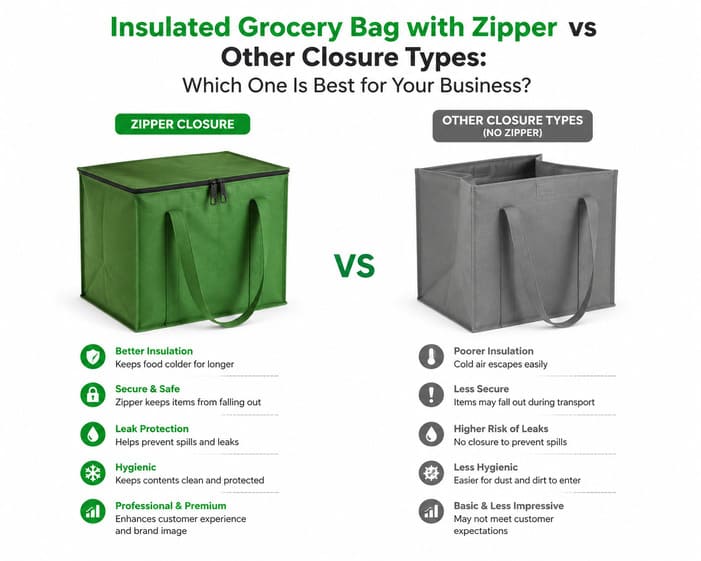
4. Zipper Closure: Best Airtight Performance but Higher Cost
Zipper systems are widely used in higher-end insulated bags, especially when temperature stability is critical.
Advantages:
- Strong sealing performance
- Reduces air leakage significantly
- Stable for repeated use
- Suitable for longer delivery routes
Limitations:
- Higher production cost
- Slower opening and closing
- Adds weight and increases packaging volume
- Requires more sewing or heat-sealing labor
Material Combination Insight
In most real production setups, zipper bags are paired with:
- Aluminum foil + EPE foam + zipper structure
However, it is important to understand:
Aluminum foil is not the main insulation material. It mainly reflects heat, while EPE provides structural thermal resistance.
Real Production Note (from factory communication)
When discussing with clients from supermarket chains, zipper bags are often selected after testing rather than chosen initially. In several cases, clients first requested cheaper closure systems, but later upgraded to zipper after temperature testing showed better consistency in longer delivery cycles.
5. Adhesive Seal Bags (Sticker Closure): Best for Promotional Use
Adhesive sealing is very common in promotional and one-time-use insulated bags.
Typical structure:
- Non-woven fabric
- Aluminum foil lining
- Adhesive sealing strip
Advantages:
- Lowest cost structure
- Very fast production
- Ideal for mass promotional distribution
Limitations:
- Single-use design
- Weak sealing consistency
- Depends heavily on user behavior
Real Usage Scenario
In most supermarket campaigns or seasonal promotions, the bag is only used for a short time (usually 30–60 minutes). In these cases, adhesive sealing performs adequately without unnecessary cost increase.
👉 This is why it remains one of the most widely used solutions for promotional packaging.
6. Velcro Closure: Balanced but Not Fully Airtight
Velcro (hook & loop) is often used in food delivery bags due to its convenience.
Advantages:
- Fast opening and closing
- Adjustable sealing pressure
- Easy to operate during busy handling
Limitations:
- Adhesion weakens over time
- Dust reduces performance
- Not fully airtight
Velcro is often chosen when speed matters more than perfect insulation.
7. Snap Button Closure: Simple Structure with Moderate Performance
Snap buttons are a mechanical closure system commonly used in lightweight reusable bags.
Advantages:
- Low cost
- Durable structure
- Easy to mass produce
Limitations:
- Small gaps between closure points
- Limited insulation performance
- Not suitable for long-duration cold-chain use
8. Open Top Design: Maximum Speed, Minimum Insulation
Open-top insulated bags remove any closure system.
Advantages:
- Fastest loading and unloading
- Lowest cost structure
- High efficiency in busy environments
Limitations:
- Maximum heat loss
- No environmental control
- Only suitable for very short handling time
9. Cost Reality: Closure Systems Affect More Than Just Price
From production experience, closure choice affects more than unit cost.
Zipper increases cost because:
- Additional sewing or heat sealing steps
- Higher material cost
- Larger bag volume increases shipping cost
- Requires larger cartons for packaging
EPE foam bags also increase cost because:
- Manual stitching labor
- Higher material volume
- Increased freight cost due to bulkiness
- Lower carton loading efficiency
👉 In real logistics, cost is not only “product price” but also transportation + packaging efficiency combined.
10. Practical Selection Logic (Based on Real Usage)
In actual client communication, selection is usually based on three questions:
1. How long is the delivery time?
- Under 30–60 minutes → adhesive seal or open top
- 1–3 hours → Velcro or snap button
- 4+ hours → zipper closure recommended
2. Is it disposable or reusable?
- Disposable → adhesive seal is most efficient
- Reusable → zipper is more stable
3. What is the priority: speed or insulation?
- Speed priority → open/Velcro
- Insulation priority → zipper
11. Why Zipper Is Not Always the Best Choice
Although zipper provides the best sealing, it is not always the most practical option.
Key trade-offs:
- Slower operation in high-frequency delivery
- Higher cost for short-term use cases
- Over-engineered for promotional applications
In high-volume delivery environments, speed can matter more than perfect insulation.
12. Material + Closure Interaction
Closure systems do not work alone—they interact with insulation materials.
Aluminum foil + zipper
- Best for reducing heat exchange
- Suitable for longer delivery cycles
Foam + Velcro
- Balanced performance
- Suitable for mid-range applications
EPE foam systems
- Flexible design
- Widely used in customized solutions
13. Common Misunderstandings in Buying Decisions
Mistake 1: “Thicker material means better insulation”
Not always true. Air leakage often matters more.
Mistake 2: “Zipper is always better”
Zipper is better for performance, but not always for cost efficiency.
Mistake 3: “Aluminum foil is the main insulation layer”
Foil mainly reflects heat; it does not provide structural insulation.
14. A Simple Real Example from Factory Communication
A supermarket client once planned to use zipper insulated bags for a seasonal promotion. After testing, we found:
- Average usage time: under 40 minutes
- Most bags were single-use
- Cost impact was too high for large-scale rollout
After switching to:
👉 Non-woven + aluminum foil + adhesive seal
Results:
- Lower cost per unit
- Faster production cycle
- No noticeable performance loss for short-term use
15. Conclusion: The Right Closure Depends on the Use Case
Insulated grocery bags are not defined by a single material or feature. Real performance depends on:
- Usage duration
- Handling speed
- Cost structure
- Transportation conditions
- User behavior
Final Insight:
There is no “best” closure system—only the most suitable one for the actual application scenario.
For short-time delivery, simple sealing is enough. For longer cold-chain transportation, zipper structures become necessary.