
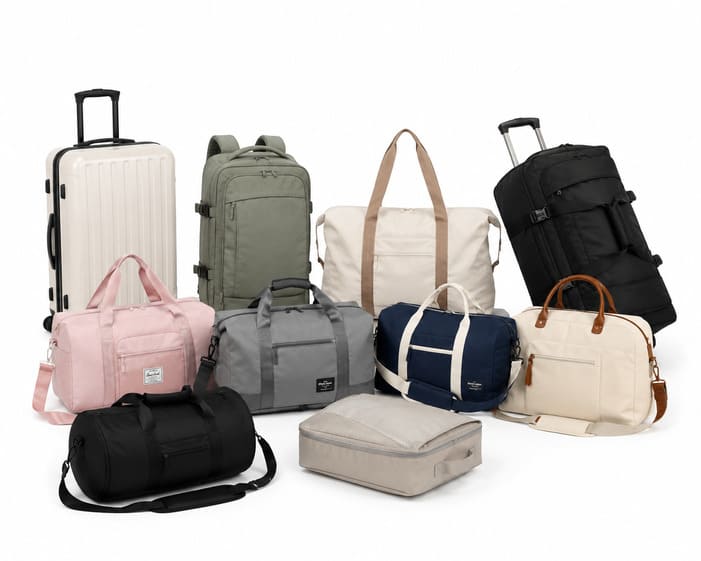
Travel duffle bags (also spelled duffel bags) remain one of the most versatile and widely used luggage products across the travel, sports, fitness, outdoor, corporate gifting, and retail industries.
For importers, travel brands, sporting goods companies, e-commerce sellers, promotional product distributors, and private-label businesses, evaluating a travel duffle bag involves much more than appearance. The real difference between a low-cost bag and a high-quality travel duffle bag lies in material selection, structural engineering, carrying comfort, storage functionality, and long-term durability.
A well-designed duffle bag not only improves the end user's travel experience but also helps brands reduce returns, strengthen customer satisfaction, and enhance product value in competitive markets.
This guide explores the key features that define a premium travel duffle bag from both a manufacturing and commercial perspective.
1. Material Selection: The Foundation of Duffle Bag Quality
Material selection is one of the most important factors affecting a duffle bag's durability, appearance, weight, water resistance, and overall market positioning.
Different materials serve different purposes, and selecting the right fabric depends largely on the target customer, intended use, and price range.
| Material | Key Advantages | Common Applications |
|---|---|---|
| 600D Polyester | Lightweight and economical | Promotional and entry-level travel bags |
| 900D Polyester | Better durability and structure | Sports and travel bags |
| 1680D Polyester | Excellent abrasion resistance | Premium travel products |
| Oxford Fabric | Durable with improved shape retention | Business and travel bags |
| Canvas | Premium appearance and rugged feel | Lifestyle and fashion brands |
| RPET Fabric | Sustainable and eco-friendly | Corporate sustainability programs |
| PU-Coated Fabric | Enhanced water resistance | Outdoor and travel products |
A high-quality travel duffle bag should offer strong tear resistance, abrasion resistance, stable color fastness, and dependable performance under repeated loading. The fabric should also maintain its appearance after extended use while supporting consistent logo printing and branding.
For many travel brands and retailers, investing in better materials often translates into fewer customer complaints, lower return rates, and stronger brand perception.
2. Structural Reinforcement: The Hidden Indicator of Quality
Many travel bags fail at the seams, handles, or shoulder strap attachment points long before the fabric itself wears out.
This is why structural reinforcement is often a more important quality indicator than fabric thickness alone.
A well-engineered travel duffle bag typically includes reinforced stitching at load-bearing points, bar-tack reinforcement around handles and shoulder straps, double-layer bottom panels, reinforced webbing attachment systems, and internal seam binding to reduce fraying.
Manufacturers with strong sewing capabilities understand that stress is not evenly distributed throughout a bag. Strategic reinforcement at critical areas allows the product to carry heavier loads without significantly increasing overall weight.
Poor reinforcement can lead to handle separation, zipper-end failure, strap detachment, and premature wear, all of which negatively affect product reputation and customer satisfaction.
3. Carry System Design: Comfort Reflects Product Quality
Modern travelers often use duffle bags in multiple environments, including airports, hotels, gyms, train stations, and outdoor locations.
As a result, carrying comfort has become an important factor in determining overall product quality.
Most high-quality travel duffle bags feature dual carry handles, adjustable shoulder straps, detachable strap systems, and padded shoulder sections designed to reduce carrying fatigue. Some models also include backpack-style conversion systems or luggage trolley sleeves for improved convenience during travel.
Good carry system design focuses not only on comfort but also on load distribution. A bag that feels balanced when fully packed creates a better user experience and contributes to positive product reviews.
For travel brands and retailers, ergonomic design can become a key selling point that differentiates products in crowded markets.
4. Storage Architecture: Capacity Alone Is Not Enough
A large bag does not automatically provide a better travel experience.
The most successful travel duffle bags combine adequate storage capacity with thoughtful organizational design.
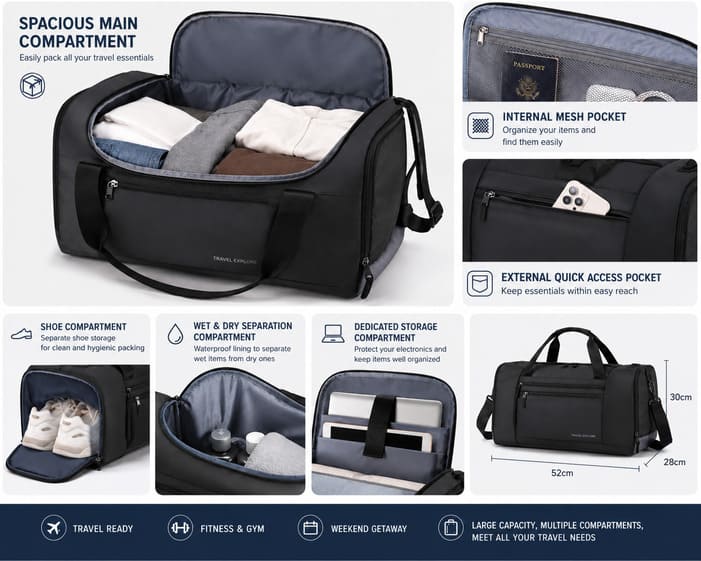
Common features include wide-opening main compartments, internal mesh pockets, exterior quick-access pockets, shoe compartments, wet and dry separation sections, and dedicated storage areas for electronics or personal items.
Different industries often prioritize different storage requirements. Sports-focused products may emphasize shoe storage and moisture separation, while travel-oriented bags may focus on large main compartments and efficient packing layouts.
Well-designed organization helps users locate items more quickly, improves packing efficiency, and enhances the overall functionality of the product.
5. Water Resistance and Surface Protection
Travel bags are regularly exposed to changing weather conditions, airport environments, accidental spills, and humidity during transportation or storage.
For this reason, water resistance has become an expected feature rather than a premium upgrade.
Common protection methods include PU coatings, PVC laminations, TPU films, and water-resistant inner linings. These treatments help prevent moisture penetration while maintaining flexibility and appearance.
A quality travel duffle bag should comfortably withstand light rain, minor liquid spills, and humid environments without compromising the contents inside.
Although most travel duffle bags are not designed for complete waterproof performance, effective water-resistant construction significantly improves practical usability.
6. Lightweight Engineering vs Load Capacity Balance
One of the most important challenges in travel bag manufacturing is balancing lightweight construction with sufficient load-bearing performance.
Many buyers assume heavier bags are automatically stronger. In reality, excessive weight can negatively affect portability, increase shipping costs, and reduce user comfort.
High-quality manufacturers focus on engineering efficiency rather than simply adding more material.
How Premium Duffle Bags Achieve Better Strength-to-Weight Ratios
| Design Objective | Engineering Solution |
|---|---|
| Lower Overall Weight | Optimized fabric selection |
| Improved Durability | Strategic reinforcement placement |
| Better Shape Retention | Structural support panels |
| Enhanced Comfort | Balanced load distribution |
| Reduced Freight Cost | Lightweight construction methods |
Instead of using excessively thick materials throughout the entire bag, experienced manufacturers reinforce only the areas that experience the greatest stress. This approach creates a product that remains durable while staying comfortable for travel.
The best travel duffle bags are not necessarily the heaviest. They are the products that achieve the highest level of performance while maintaining manageable weight.
7. Size Design and Airline Compatibility
Travel duffle bags are available in a wide range of sizes, each designed to support different travel requirements.
Small bags between 20 and 30 liters are commonly used for gym visits, day trips, and overnight travel. Medium-sized bags ranging from 30 to 50 liters are among the most popular options for weekend travel and business trips. Larger models between 50 and 80 liters are often selected for extended vacations, sports equipment transportation, or outdoor activities.
Many travel-focused brands also design products around airline carry-on restrictions. Dimensions, weight distribution, and packing efficiency all play important roles in ensuring compatibility with overhead storage compartments.
A bag that balances storage capacity with airline-friendly dimensions often appeals to a broader customer base.
8. Customization Capability and Brand Adaptability
For travel brands, promotional product suppliers, corporate gifting companies, retailers, and private-label businesses, customization capability is often a critical purchasing consideration.
A manufacturer's ability to adapt a design to specific branding requirements can significantly influence the success of a product program.
Common customization options include logo printing, embroidery, woven labels, rubber patches, custom zipper pullers, Pantone color matching, personalized packaging, hangtags, barcode labeling, and private-label solutions.
Beyond aesthetics, customization allows businesses to strengthen brand identity, create exclusive product lines, and maintain consistent visual standards across multiple product categories.
As competition continues to increase in the travel and promotional product industries, flexible customization capabilities have become an important component of supplier evaluation.
9. Quality Control Standards in Manufacturing
Even the most attractive design can fail if production quality is inconsistent.
Reliable manufacturers typically implement quality control procedures throughout every stage of production.
| Production Stage | Inspection Focus |
|---|---|
| Incoming Materials | Fabric, webbing, zippers, accessories |
| Cutting Process | Dimension accuracy and consistency |
| Sewing Process | Stitch quality and reinforcement |
| Assembly Stage | Structural integrity |
| Performance Testing | Strength and durability |
| Final Inspection | Appearance, packing, and labeling |
Additional testing may include handle strength tests, shoulder strap load testing, zipper cycle testing, water-resistance evaluations, and overall workmanship inspections.
For importers and private-label brands, consistency across multiple production runs is often more important than achieving a perfect sample. Reliable quality control systems help ensure that every shipment meets the same standards and performance expectations.
Conclusion: What Truly Defines a High-Quality Travel Duffle Bag?
A high-quality travel duffle bag is not defined by appearance alone. It is the result of thoughtful decisions across material selection, structural engineering, ergonomic design, storage functionality, water resistance, weight optimization, and manufacturing consistency.
The most successful travel duffle bags combine durable materials, reinforced construction, practical organization, comfortable carrying systems, and reliable quality control processes. They are designed not only to meet user expectations but also to support long-term product performance in competitive travel and retail markets.
As travelers increasingly prioritize versatility, convenience, and durability, manufacturers and brands that focus on these core quality factors will be better positioned to deliver products that stand out and create lasting customer value.
FAQ
What is a duffel bag?
A duffel bag, also commonly spelled duffle bag, is a soft-sided travel bag designed for flexible storage and easy transportation. It is widely used for travel, sports, gym activities, outdoor adventures, and promotional programs because it offers large storage capacity while remaining lightweight and easy to carry.
What is the best material for a travel duffle bag?
The best material depends on the intended application and target market. Polyester remains one of the most popular choices because it balances durability, weight, and affordability. Oxford fabric offers improved abrasion resistance and shape retention, while canvas provides a premium appearance often preferred by lifestyle brands. RPET fabric is increasingly selected by companies that want to support sustainability initiatives and environmentally responsible product development.
How durable should a high-quality travel duffle bag be?
A high-quality travel duffle bag should withstand frequent loading, transportation, and daily handling without experiencing structural failure. Strong stitching, reinforced stress points, durable zippers, and quality webbing systems all contribute to long-term performance. The bag should maintain its functionality and appearance even after repeated travel use.
Are duffle bags better than suitcases?
Neither option is universally better because they serve different travel needs. Duffle bags are generally lighter, more flexible, and easier to store when not in use. Suitcases provide greater structural protection and may be better suited for fragile items. For short trips, gym use, weekend travel, and situations where flexibility is important, many travelers prefer duffle bags.
What size travel duffle bag is best for air travel?
For most travelers, a duffle bag between 30 and 50 liters offers the best balance between storage capacity and airline carry-on compatibility. This size range is commonly used for weekend trips, business travel, and short vacations because it provides sufficient packing space while remaining manageable during transit.
What features should a sports duffle bag include?
A sports duffle bag should offer practical organization for athletic gear and personal items. Features such as shoe compartments, wet and dry separation pockets, reinforced shoulder straps, durable fabrics, and easy-access storage areas help improve convenience and organization for fitness and sports activities.
Can travel duffle bags be customized with logos and branding?
Yes. Most professional manufacturers support a wide range of customization options, including screen printing, heat transfer printing, embroidery, woven labels, rubber patches, custom colors, personalized packaging, and private-label solutions. These options help businesses create products that align with their brand identity and market positioning.
What industries commonly use custom travel duffle bags?
Custom travel duffle bags are widely used by travel brands, sporting goods companies, fitness businesses, promotional merchandise suppliers, corporate gifting programs, outdoor equipment brands, event organizers, retailers, and e-commerce businesses. Their versatility makes them suitable for a broad range of commercial applications.
How are travel duffle bags tested for quality?
Professional manufacturers often conduct strength and durability evaluations throughout production. Common tests include handle pull testing, shoulder strap load testing, zipper cycle testing, water-resistance assessments, stitching inspections, and final appearance checks. These procedures help ensure consistent product performance before shipment.
What should buyers look for when choosing a travel duffle bag manufacturer?
When evaluating a manufacturer, buyers should consider material sourcing capability, customization flexibility, production capacity, quality control procedures, sample development support, export experience, and long-term production consistency. A supplier that can balance quality, customization, and reliable delivery is often better positioned to support sustainable business growth and long-term product development.