What Is GRS Certification? Why It Matters When Buying Reusable Bags
Sustainability has become one of the biggest selling points in the reusable bag industry. Almost every supplier today claims to offer recycled, eco-friendly, or sustainable bags.
For buyers, however, the challenge is no longer finding suppliers that make these claims—it's determining which claims can actually be trusted.
A bag made from recycled material isn't necessarily backed by verified recycled content, responsible manufacturing, or a transparent supply chain. Without independent verification, it's difficult to distinguish genuine sustainability from marketing.
This is exactly where the Global Recycled Standard (GRS) has become valuable.
Rather than accepting environmental claims at face value, GRS provides an internationally recognized system that verifies recycled content, audits manufacturing facilities, and tracks materials throughout the supply chain. For retailers, importers, and brand owners, it offers something increasingly important: confidence backed by evidence, not promises.
Why "Made from Recycled Material" Isn't Enough
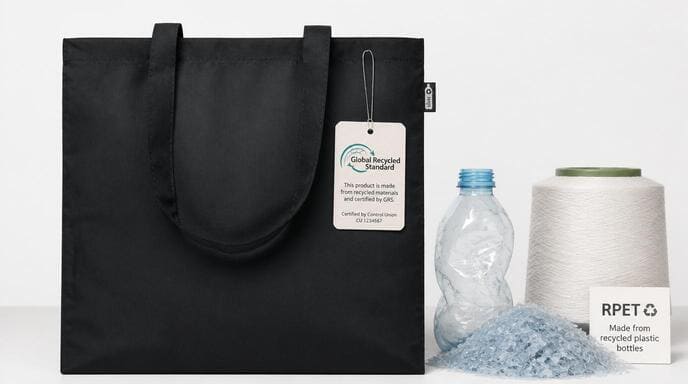
Ten years ago, simply labeling a bag as "made from recycled materials" was often enough.
Today, procurement teams are asking much deeper questions:
- Where did the recycled material come from?
- How much recycled content does the bag actually contain?
- Can the supplier prove it?
- Has an independent organization verified the claim?
These questions have become increasingly important as sustainability moves from a marketing initiative to a sourcing requirement.
Many retailers now require suppliers to provide evidence—not just product descriptions.
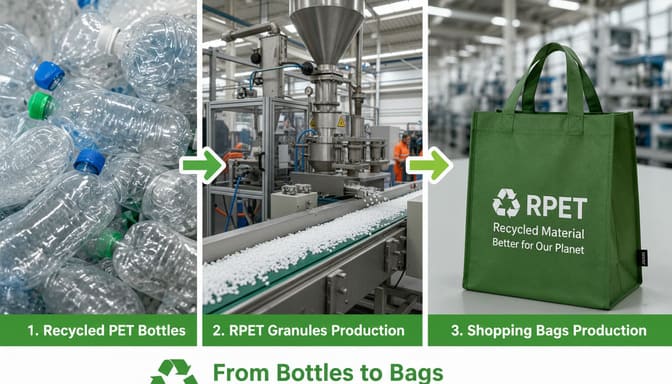
This is where GRS differs from a simple environmental claim.
Instead of relying on supplier declarations, GRS requires documented proof throughout the manufacturing process.
What Does GRS Actually Verify?
One common misconception is that GRS simply confirms a product contains recycled material.
In reality, the standard evaluates much more than the raw material itself.
For buyers, GRS helps answer four critical questions.
| Buyer Concern | What GRS Verifies |
|---|---|
| Is the recycled content genuine? | ✅ Verification of recycled input materials |
| Can materials be traced throughout production? | ✅ Full Chain of Custody documentation |
| Is the factory independently audited? | ✅ Regular third-party certification audits |
| Are environmental and social practices reviewed? | ✅ Compliance with environmental and social criteria |
Rather than focusing on a single product, GRS evaluates the entire production system behind it.
This gives buyers greater confidence that sustainability claims are supported by documented processes rather than marketing language.
Traceability Is What Makes GRS Different
One of the biggest challenges in sustainable sourcing is traceability.
Imagine purchasing 300,000 RPET shopping bags for a nationwide retail promotion.
Without a traceability system, it becomes difficult to verify whether every production batch actually contains the recycled materials specified in the quotation.
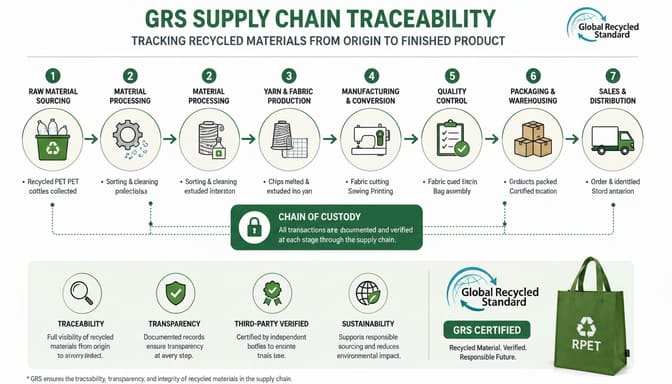
GRS addresses this by requiring a documented Chain of Custody.
Each certified production order must be linked to verified raw material purchases, production records, inventory management, and sales documentation. During audits, certification bodies review these records to confirm that recycled materials have been properly controlled throughout manufacturing.
For buyers, this means the recycled content isn't simply claimed—it can be traced and independently verified.
GRS Doesn't Only Audit Materials
Many buyers assume GRS is purely a recycled-content certification.
In reality, recycled material is only one part of the assessment.
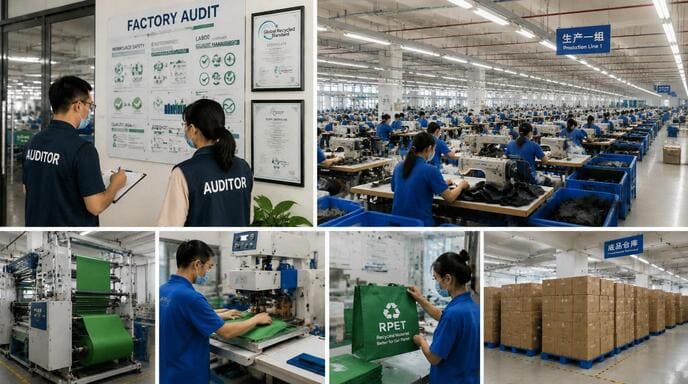
Certified facilities are also evaluated on how products are manufactured.
This includes areas such as:
- Chemical management
- Wastewater treatment
- Environmental management
- Worker health and safety
- Labor practices
- Quality management procedures
In other words, GRS looks beyond what a bag is made from and also considers how it is produced.
For brands working with global retailers, this broader assessment helps reduce supply chain risks while supporting corporate sustainability goals.
What GRS Doesn't Guarantee
Although GRS is an important certification, it's equally important to understand its limitations.
A common misconception is that a GRS-certified bag is automatically a higher-quality product.
This isn't necessarily true.
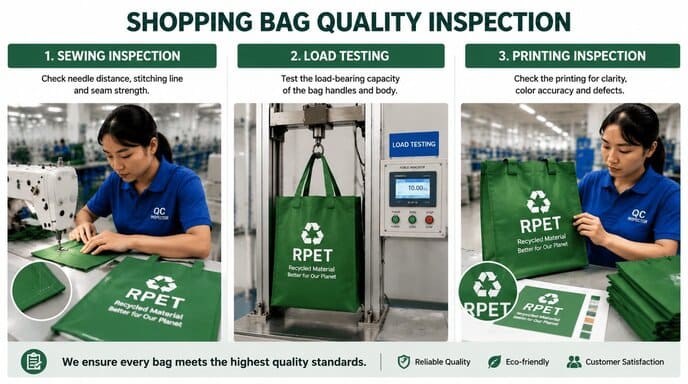
GRS verifies responsible sourcing and manufacturing practices, but it does not evaluate product performance.
For example, GRS does not certify:
- Stitching strength
- Printing quality
- Load capacity
- Thermal insulation performance
- Product lifespan
- Design functionality
Two suppliers may both hold valid GRS certificates, yet their products can differ significantly in durability, workmanship, and consistency.
For procurement teams, GRS should therefore be viewed as one part of supplier evaluation—not the only criterion.
Manufacturing capability, quality control systems, production experience, and technical expertise remain equally important.
Why More Buyers Ask for GRS Before Asking for a Price
Several years ago, buyers often compared suppliers primarily on price.
Today, many sourcing projects begin with compliance requirements.
Before discussing quotations, buyers may request:
- GRS Certificate
- Scope Certificate
- Factory Audit Reports
- Social Compliance Certificates
- Quality Management Certifications
Only suppliers that meet these requirements move to the pricing stage.
This shift reflects a broader change in global procurement.
Sustainability is no longer treated as a marketing advantage—it has become part of supplier qualification.
For brands selling into major retail markets, verified compliance reduces sourcing risk, simplifies customer audits, and strengthens consumer trust.

Choosing a Supplier Beyond the Certificate
A certificate can verify compliance, but it cannot replace manufacturing expertise.
When evaluating a bag supplier, experienced buyers typically consider both compliance and production capability.
Questions worth asking include:
- Is the recycled content independently verified?
- Can the supplier provide transaction certificates when required?
- Does the factory have stable quality control procedures?
- Can production remain consistent across large orders?
- Does the supplier have experience serving international retailers or brand owners?
A reliable long-term partner should be able to demonstrate both verified sustainability and consistent manufacturing performance.
Conclusion
As sustainability expectations continue to grow, environmental claims alone are no longer enough.
Brands increasingly need evidence that recycled materials are genuine, traceable, and responsibly processed throughout the supply chain.
The Global Recycled Standard (GRS) provides that independent verification.
While GRS doesn't measure product quality or guarantee better design, it significantly reduces uncertainty by validating the integrity of recycled materials and manufacturing practices.
For buyers, that's its greatest value.
It's not simply proof that a bag contains recycled materials—it's proof that a supplier's sustainability claims have been independently verified.